
One major lesson learned from the economic meltdown is that far too many people in American business today are morally bankrupt. And it seems the higher up you go in the corporate org chart, the more malfeasance one finds. The post-Enron push made by companies to hire more ethical workers has been shown for the farce it is. We continue to hire and promote foxes for hen-house guard duty.
With allegations of fraud dogging Goldman Sachs, and with further indictments and allegations (thankfully) coming to others behind this debacle, the question is: Are we going to learn anything about the bankruptcy of the American soul from this?
I want to pass along a story on CNN written by Bob Greene. It details a transaction that goes on many thousands of times in this country each day, though this transaction has a slight, but important, twist. Greene tells of his encounter with Mark Dalton, the owner of a mom-and-pop bookstore, after purchasing a used book online:
In 2008, I found a book I was looking for on that Amazon marketplace, and submitted an order. The price was more than reasonable: $6.95 for the used hardcover. Used books are not shipped by Amazon itself, but by the local booksellers.
A week or so after I placed the order, the package arrived, from High View Books in Smithfield, Rhode Island. The book seemed to be in good shape. I was pleased.
But with it was a personal letter to me. It said:
“Thank your for your recent book order. I have enclosed a check to you for $2.95. The reason for this is that this book is only in ‘Very Good’ condition, while I mistakenly described it as being in ‘Near Fine’ condition in my listing. Please accept my apologies for the error. (Also, please note, the soiling that you see on the dust jacket is actually on the Mylar and not the dust jacket itself.)”
[Dalton] wrote that he hoped his apology and the refund were satisfactory. Sure enough, tucked into the book was a check made out to me, for $2.95.
Greene goes on to mention that the condition issue was beyond his ability to discern. Instead, he was surprised that anyone would go to the lengths Dalton did to ensure that the sale was completely up and up, especially for an item with such a small price tag.
As they say, read the whole thing (“A $2.95 Lesson for Wall Street“).
One of these days the business world is going to wake up to the reality of genuine customer service. But beyond that, I hope they finally discover whatever moral compass the owner of High View Books possesses.
The allure of money in our society, that “get rich quick by any means necessary” mentality that permeates our culture, may be only one of our many vices, but it certainly is the root of great evil. 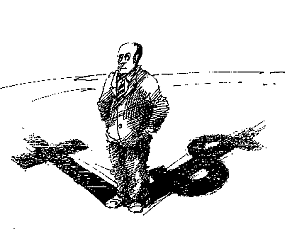 My brother had a CAT scan done recently and got a $4,000 bill for the procedure. That’s insanity for what amounts to a glorified x-ray, but I’m sure it reflects a “gotta get my cut” reality from a dozen different sources who stand to profit from that scan.
I don’t know about you, but I find that kind of pile-on mentality wicked. Yet it’s the norm anymore in America. It’s why an airplane ticket is more fees and taxes than payment for time spent in the plane traveling. It’s why gas prices are so high, why it costs so much to educate our kids in public schools, and why the answer to everything governmental seems to be a tax hike. It’s the Great Gouge. We’ve reached an era when sick people avoid the doctor not because of the fear of a cancer diagnosis but of bankruptcy!
But in a bookstore in Rhode Island, a man realized a $6.95 used book may not have been in the condition he described, so he refunded the purchaser $2.95.
In contrast, on Wall Street we have morally bereft con men who knowingly sold worthless securities because they could get rich, even if their jackpot ruined other people.
I say all this because The Wall Street Journal once featured an article that exposed the religious backgrounds of all the major players in the Enron, WorldCom, and other business scandals of the early 2000s. They found that almost all the people with the dirtiest hands were pillars of their churches.
I don’t know anything about the religious beliefs of the owner of the bookstore in Greene’s story. But I know that he had far more Christian character than church elder Ken Lay of Enron infamy.
The little things matter folks. There’s courage in sending back $2.95. God not only looks at our weights and measures, but He knows what we do in secret.
As Christians, do we conduct our daily business with God in mind? When there’s money to be made, do we join the pile-on, even if it ends up hurting people? Would we have sent back $2.95 because the book we sold was a fraction less perfect than we had described?
Honestly, if America wants to get back to greatness, a good first step would be for American businesses to fire the morally bankrupt (no matter how high up the org chart) and hire godly men and women who realize that the God they serve is always watching.
In ending, I want to help reward the courage to send a $2.95 refund. While I could not find an online link to them directly, I did find contact info and a means to order books directly from High View Books through Biblio. So the next time you want to buy a book, consider supporting High View Books. And let’s send a message that character still counts.