
Let’s Play “Spot the Heretic!”

Standard

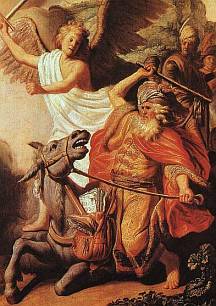
Balaam's Ass by RembrandtThis is the post wherein I make my secret confession before you all.

I've been a Christian for nearly thirty years. I've read a lot of books by a whole host of authors. And despite the fact that I'm fairly intelligent, graduated with high honors from probably the toughest Christian college in the country, and can use seven-syllable words with abandon, I don't read today's Christian writers much anymore.

Now I'm not speaking of Christian novels about young, chaste teachers coming of age on the Kansas prairie of 1880—aren't all Christian novels about that?—I'm talking about the non-fiction works of everyone from N.T. Wright to Brian McLaren.

If I were a proud man, I would attribute this to the lofty theological edifice I have constructed from bare rubble through my hard-won Christian discipleship. But I'm not a proud man; I'm simply a person like you who finds himself progressively confused by what passes for Biblical scholarship and discipleship lately.

Now with the Christian blogosphere filled from one end to the other with wild-eyed apologists, "remnant watchers," bell-ringers, deconstructionists, and self-christened "apostles for a time such as this," I've come to the conclusion that I simply can't parse it all. Yeah, this guy may be right and then he might not. She's got a good point, but arrived at it through a highly tortuous route that deviated through "Suspect City" to get there. And that guy in the corner always cries "Heretic!" over any idea that isn't his.

Sadly, there just isn't enough time in the day, so my only recourse is to ignore the vast majority of it. If it comes down to a case of discernment, perhaps the best discernment that a Christian in the 21st century can achieve is to always assume something's wrong unless it's been tested by time.

So that's my stance.

I used to help manage a Christian bookstore. I was the Bible and book buyer. Once you're in a position like that, you quickly attune your sense of smell to the stench of one lousy book after another grappling for bestseller status. I got adept at finding the stinkers before they found us. I attribute this to the Holy Spirit and to the spirit of our age.

The "spirit of our age" as I use it here is the quality of a book or set of thoughts that smacks of everything that is trending one way or another at this moment in time. Doesn't matter if it's right or wrong; in the end it simply won't last. Twenty years from now, no one will be referencing it for anything. It was dead on arrival, but the readers simply couldn't tell because the hype machine and word of mouth drowned out the naysayers.

Honestly, I think the Lord understands the dilemma of most earnest Christians today as they attempt to trudge through the mountains of half-baked theology and pseudo-spiritual tripe that get served to us on a sizzling hot platter—every single day. I believe that He knows it is far worse than in His own day when He battled the superstitions and mindless obeisance to the prevailing ethic of the land that relentlessly fought for the minds of His own disciples.

What is my out? Well, I'm hopelessly behind the times. I've said here before that most of the authors I read are dead. And that's my out. They're dead, no one is making big bucks off 'em, and yet their words last from one generation to the next. One set of Christians a hundred years ago read this stuff and found it spoke to the soul. And now another set today is reading it still because someone continues to be blessed. It won't crack the top ten on the bestseller list, or even the top ten thousand, but the words on those pages live. They give life and will do so until the day the Lord comes back—if, on that glorious and awful Day, He still manages to find enough people who take those old words to heart.

So I don't keep up with "New Think" for the most part. If I do mention a new book from time to time here, or mention a new blog that seems to have "it," then it's only because every reference in it goes back to someone from fifty years ago who could be trusted. I can tell you right now that Tozer, Ravenhill, Schaeffer, and a few like them can be trusted. Time's imprimatur has shown they can stand up and still speak the truth to a day and age where truth is so easily warped to be untruth that even the best of us can't always spot the mistakes.

I just can't filter it all; too much comes in. And while ninety-nine and forty-four one hundredths pure is good enough for soap, it's not good enough for the Gospel. As for me, I'm simply not smart enough or spiritually adept enough to mercilessly spot the 0.56% impurity that exists in today's writings.

Are you?

{Image: Detail of Rembrandt van Rijn's "Balaam's Ass" (1626)}

Stay-at-Home Dads (or “Guys the Church Would Like to Forget Exist”)

Standard

Just this last week, the following was posted to a few Christian blogs:

Probably if everyone in the United States circa 1960 had known that taking modest steps in the direction of feminism would, in fact, lead during their lifetimes to the legalization of sodomy, to gay men marrying each other, to a small but growing number of fathers staying home to take care of the kids, to legal abortions, etc., etc., etc. the public would have overwhelmingly rejected those early steps. But the poo-pooers won the day, the people did not believe, and now majorities support most of those developments….
—Matt Yglesias—“Slippery Slopes

Sodomy. Homosexual marriage. Legal abortion. Stay-at-home dads.

In the Church in America, it is not hard to see how many—particularly of the Evangelical persuasion— are up in arms about the moral slide of this country. But when I read something like this, it hurts me. A lot. Dad with kidsThat’s because I find myself lumped in with women who murder their unborn children, with men who lust after other men, with people who seek to mock God’s great gift of heterosexual marriage.

You see, I’m a stay-at-home dad.

In the four years that I have been in this role, the one thing I have learned is that Evangelicals find stay-at-home dads to be that chunk of indigestible gristle that wedges in the back of the throat. Now while I don’t need for them to come right out and say this to my face, the position taken by so many Evangelicals is the literal “death by a thousand cuts” when it comes to stay-at-home dads. If every stay-at-home dad would simply vanish overnight, I think most Evangelicals would breathe a huge sigh of relief.

Open up any Christian book that discusses the American family and you see this:

  • Dad works a high-paying job outside the home as the sole breadwinner. He continues this till the day he retires from the firm with the solid-gold pocketwatch.
  • Mom stays at home with the three to four children and homeschools them until the last one gets pushed out of the nest at age eighteen.

These are the two gold standards by which Evangelical families are judged for their conformity to a Scriptural mandate for the home. Any variance from this and the wrath of God is incurred.

I know this is the case because I read. Plus, any casual glance at the bestselling books on How to Have the Perfect Christian Family will tell us that this is the measure by which Christ judges us from His Bema Seat. Never have I seen an Evangelical Christian book or magazine that ascribes to this model even once consider stay-at-home dads except to brand them a breech of the natural order and anathema in the Church. As Mr. Yglesias points out (whether intended or not), a family with a stay-at-home dad can easily be equated to a household with two same-sex parents.

I also know the trouble caused by the existence of stay-at-home dads because I’ve been a Christian for almost thirty years. I’ve seen how families are treated when they don’t perfectly hew to the Evangelical family model. The judgment is passed (“As a family, you get an ‘F'”) and the arms come out to keep your perverted family at a safe distance.

This plays out in many ways. My son cannot come over to another house for playtime if the other child’s at-home parent is a woman. Wouldn’t be seemly for her to be seen with an “unknown man” coming into her home while her husband is away. I can understand that to a point, though it paints the at-home dad as a sex machine that will seduce any female he manages to get alone.

As an at-home dad, I’m not welcome into “parenting group” activities with at-home moms. In one such group that I was investigating, it was made all too clear that by my presence I was ruining the moms’ chance to catch up on daily gossip. How clear? One of the moms came up to me and told me that right to my face. Now she didn’t call it gossip (gossip is a sin, you know), but I’m not stupid. I recognized what I was hearing.

Whenever the Church devises mid-week events for parents, the at-home dad gets a sinking feeling because “parent” is not really the word they intend, unless the sole definition of “parent” is “mother of the children.” Simply showing up for such an event throws the organizers into chaos.

Now you would think that Evangelicals would be overjoyed that a family chooses to have one parent at home raising the children. You would think that they would celebrate the fact that some families have chosen to abandon the dual-income rat race that is afflicting so many families. You would think. But you would be wrong, dead wrong, if you think that the Church would be happy if the parent staying at home happens to have a penis.

One of my favorite foils here at Cerulean Sanctum is Focus on the Family. Seeing that I am a conservative Christian would make you think I hold Focus on the Family in high regard. Yet one of the reasons I find the whole organization to be less than stellar is their unwillingness to admit that the cultural forces that are tearing the family apart are not necessarily the ones they think are causing the problems. FotF’s blindered look at Christianity and culture finds them upholding many of the cultural anomalies that are responsible for the outcomes they decry.

Case in point: feminism is an easy target. A much harder target is the Industrial Revolution. In Stephen Prothero’s American Jesus: How the Son of God Became a National Icon, he discusses how prior to the industrial revolution, almost EVERY dad was a stay-at-home dad. But then so was every mom. In fact, the economy revolved around the home. FotF, on the other hand, seems to lean to dad being locked up in a cubicle all day at Dewey, Cheatham, and Howe. Likewise, almost every book I’ve read about being a perfect Christian dad makes dad out to not only be the captain of his household, but a captain of industry as well—even if this means the family never sees dad because he’s slaving away for fifty hours a week or out being Steve, the Road Warrior. I’ve never heard an Evangelical organization similar to Focus on the Family question whether the work world we have created as a result of the Industrial Revolution is hurting our families.

Many men are stay-at-home dads because of mitigating business factors that Evangelicals refuse to address or address in totally anti-Christian ways. For instance, I was recently given some links to Christian businessmen networks. On one of the online forums I read a message by a Christian business leader talking about how “Christian excellence” requires him to fire all his IT people and move his IT operations offshore. He believed such a move was God’s will. However, nothing seemed to register in him that perhaps a little less profit could be had and that he could keep the employees he already has in an action that is far closer to the heart of the Gospel than what he’s claiming as God’s will. His downsizing move creates a hardship for the fired male employee who must come to grips that his career is drying up and that his family might be more stable if mom became the breadwinner (because she’s less likely to be fired in a downsizing move by her company in her field of college study.) The fallout of this is that the Christian business owner just created the very Evangelical headache—a stay-at-home dad— that every Christian family bestseller on the shelf of the local Christian bookstore insists must not exist lest the sky fall and dogs and cats start living together in violation of the created order.

In other words, if Evangelicals don’t like stay-at-home dads, then just what are they doing to ensure that work world issues are addressed that prevent families from having to consider that option? Truthfully, the answer is that they simply don’t care about preventing the “problem” of stay-at-home dads at all, preferring to attribute their blighted existence to evils of feminism rather than the natural fallout of the Industrial Revolution and the very worst aspects of capitalism gone to greedy selfishness. It is far easier to point a finger toward the at-home dad than to do something about ensuring work for all men who truly want to be the breadwinners in their family (even if that is not necessarily God’s perfect design.) Nor is anything being done to restore the work of fathers and mothers back to the home, just like in the days when this country was founded. As much as parachurch Christian organizations like Focus on the Family idolize America of that day, they make no mad rush to take on that particular aspect of the economy of that day and bring it into today’s homes.

So yes, I am a stay-at-home dad. To all the Christians out there who express concern about the fact that I exist in that role, I say, put your money where your mouth is and stop crucifying me on the cross of your righteous indignation.

Or is that a little too harsh?

The Devil’s Instrument

Standard

I sometimes wonder if too many people out there who call themselves Christians have become little more than bouncers for the Kingdom. By this I mean that they seek to spend all their time outside of the party trying to keep out the “rabble.”

In 1984, I attended InterVarsity’s Urbana conference. My goal was to get on with an evangelistic music group Playing the drumsthat would tour the communist satellite countries like Hungary and Czechoslovakia. What I did not expect was to run into problems with my choice of instrument.

Several music ministries had set up for the conference and I hit each one. On only my second interview with a group, I was asked what instrument I played by a very pleasant late thirty-ish woman with a mushroom cloud of hair that dwarfed her elfin face. I told her, “Drums.”

She swiftly drew back in her chair and put her hand to her mouth as if I had said I was a big fan of Baal. In her best Southern drawl she let me know my deception: “Well, young man, drums are the devil’s instrument—and we’ll have none of that.” She just shook her head full of Basic Youth Conflicts messages as if to say, “Such a nice young man and yet he’s one of the Enemy’s footsoldiers.”

Shock. Complete and total—that’s all I could say about how I felt. No one had ever said such a thing to me before despite my having played for more than a dozen years (at that time.) But then I started to consider the source and just walked away to the next booth.

I was greeted by skeletally thin man with an even thinner tie and the look of a lot of years of tobacco abuse before he saw the light. Told him what I was hoping to do and he, too, asked the vital question, “Waddya play?”

I told him.

This time there was less of a look of horror and more of a “Son, I was a prisoner of that hellish music, too, but now I’ve come clean.” He said, “We’ve got no place for that kind of instrument. We sing for the glory of God.”

So okay. Two out of three and already I’m starting to despair. How much had I paid to come here?

No one was at the next booth—it was singers only anyway.

At the end of the row was a lovely young woman about my age. Conservatively dressed, quite perky, with a fashionable hairstyle, she was the quintessential spokesperson for her traveling musical group. I looked over the material she had. Lots of good-looking young people and a full band—with one glaring exception.

“I see all sorts of instruments in your band, but I don’t see any drums.”

“Oh,” she said, taken aback, “drums are the devil’s instrument.”

I wanted to ask if she was somehow related to the Gothard with the bouffant, but what was the point? In a row of five musical evangelistic groups, three of them had basically told me I was going to hell because of my choice of instrument.

Eric Liddell, the great missionary of China (and martyred in an internment camp), said that the reason he loved to run was that when he ran, he felt God’s pleasure. I feel that same pleasure every time I pick up a pair of drumsticks.

I wonder if we truly know what it is to feel God’s pleasure. Many would contend, and rightly so, that much of Christianity has fallen under the spell of emotionalism. But we cannot merely chuck our emotions out of worship, nor can we assume that God’s pleasure cannot be experienced outside of a church building.

God’s pleasure is felt by the man putting the final touches on a piece of handmade furniture that will grace a home. God’s pleasure is revealed in the accountant who manages to save his company a small fortune by finding inefficiencies in the business process. God’s pleasure is alive in the mother who bakes her children cookies from scratch. God’s pleasure is in an elderly couple savoring the bottle of Cabernet Sauvignon they’ve been saving since their honeymoon in Paris fifty years ago.

Tim Challies has a well-reasoned look at worship that I think all of us should read. However, I think Tim’s reasoning has the tendency to turn worship into a “bloodless” experience. Not all of Christian worship can be reasoned, I think. When Isaiah fell on his face in his vision when King Uzziah died (Isaiah 6), I don’t believe he was filtering any of this through the “Regulatory principle of worship.” Not everything is so easily categorized. I don’t care if the Regulatory principle forbids dancing in worship, Psalm 150 says to go for it:

Praise him with tambourine and dance; praise him with strings and pipe!
—Psalms 150:4 ESV

Honestly, what are we afraid of? Do we fear that God enjoys listening to a full-bodied band of musicians playing for Him? Does the thought that dancing before the Lord might shake the dust off a few people frighten us? “Good grief, Martha, look at that woman over there raising up her hands during worship! Have you ever?”

God is worshiped when we experience His pleasure, when we open ourselves and lay bare our hearts in adoration of Him. When He is pleased, we are pleased. Even as I type, the Lord is preparing the greatest party that will ever be. Why are we so interested in being the bouncers?

So as I step back onto the role of drummer for the worship team at my new church, I just want to tell the boothminders at Urbana all those twenty-one years ago, “This pleases God more than you can know.”

Praise the LORD!
Praise God in his sanctuary; praise him in his mighty heavens!
Praise him for his mighty deeds; praise him according to his excellent greatness!
Praise him with trumpet sound; praise him with lute and harp!
Praise him with tambourine and dance; praise him with strings and pipe!
Praise him with sounding cymbals; praise him with loud clashing cymbals!
Let everything that has breath praise the LORD! Praise the LORD!
(Psalms 150:1-6 ESV)