
Charismatics, Cessationists, Strange Fire, Logic, and Bible Truth

Standard

Now there are varieties of gifts, but the same Spirit; and there are varieties of service, but the same Lord; and there are varieties of activities, but it is the same God who empowers them all in everyone. To each is given the manifestation of the Spirit for the common good. For to one is given through the Spirit the utterance of wisdom, and to another the utterance of knowledge according to the same Spirit, to another faith by the same Spirit, to another gifts of healing by the one Spirit, to another the working of miracles, to another prophecy, to another the ability to distinguish between spirits, to another various kinds of tongues, to another the interpretation of tongues. All these are empowered by one and the same Spirit, who apportions to each one individually as he wills.
—1 Corinthians 12:4-11 ESV

Last week was something of a new low in the “conversation” between those who believe the gifts of the Spirit (charismata) continue today (charismatics or continualists) and those who claim those gifts ceased as of the closing of the apostolic age (cessationists). It’s almost a fact that charismatics don’t start battles with cessationists. If only the opposite were true, especially on the Internet.
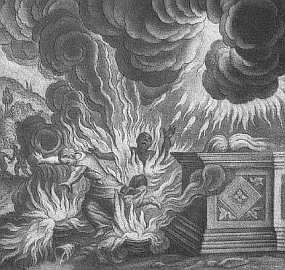
Nadab and Abihu offered "strange fire" to God and were slainThe supposed reason for the Strange Fire Conference of last week was to address and correct “charismania”—out-of-control or flat-out bogus gifts and the people who express them. The authority question arises when the correctors included no charismatics. So much for cleaning one’s own house first or sticking to the log in one’s own eye before finding the speck in your brother’s.

There is no doubt that the charismatic movement is a mess. Most charismatics with orthodox theology will acknowledge this—and there are MANY of us. I know I’m not happy with charismania and have written EXTENSIVELY on it and its practitioners, decrying the nuttiness and flat-out heresy. And MANY of us have loudly proclaimed this.

Which is why it’s frustrating that some folks who reject the charismata waltz into the charismatic house and tangentially proclaim by live streamed conferences that every charismatic is borderline, and if we’re actual born-again Christians, we’re so in spite of our charismatic beliefs. Like I said, a new low. No end exists for the ways in which such reasoning can be reversed and delivered back upon the correctors. But then, most charismatics don’t want this fight and never asked for it.

I was working through a response to a teaching at the Strange Fire conference that was liveblogged by Tim Challies and given by Tim Pennington, “Strange Fire Conference: A Case for Cessationism.” Frankly, I was appalled at the teaching, not only for descending into the very argument types that the group giving the conference would ordinarily savage if they came from others, but also for the teaching’s extensive logical fallacies. In short, the entire teaching has so many obvious problems, it besmirches legitimate Christian scholarship. And I say that with great reluctance and sadness.

I was prepared to blog a response in light of Scripture, history, and logic, but someone else wrote an almost identical rebuttal. I’d say it’s amazing how similar my response would have been, but then that’s how the Holy Spirit works in like-minded charismatics.  😉

Anyway, please do read Andrew Wilson’s “Cessationism and Strange Fire,” as it mirrors my thoughts.


The Church and the “Hot Mess”

Standard

And [Jesus] came to Nazareth, where he had been brought up. And as was his custom, he went to the synagogue on the Sabbath day, and he stood up to read. And the scroll of the prophet Isaiah was given to him. He unrolled the scroll and found the place where it was written, “The Spirit of the Lord is upon me, because he has anointed me to proclaim good news to the poor. He has sent me to proclaim liberty to the captives and recovering of sight to the blind, to set at liberty those who are oppressed, to proclaim the year of the Lord’s favor.” And he rolled up the scroll and gave it back to the attendant and sat down. And the eyes of all in the synagogue were fixed on him. And he began to say to them, “Today this Scripture has been fulfilled in your hearing.”
—Luke 4:16-21 ESV

Michael, a reader, commenting on my post “Lonely Christian Men,” wrote:

“I come to church broken from the week, and who wants to talk with that ‘hot mess’? Who wants to be dragged down by reality, what with the up-tempo music, extra-foamed latté, and positive message? Sunday seems to have become the day to ignore the struggler, unless you want to invite them on the next men’s retreat.”

Sadly, whatever it is that struggler is dealing with, even if he should accept the invitation, his struggle won’t likely be addressed on the men’s retreat.

Here’s how  the online Urban Dictionary defines hot mess:

A person who is a handful; he/she is a piece of work, and/or a colorful character.

Every church has a few folks best described as such. Truthfully, not a one of us escapes that label, for each of us is probably a hot mess at some point or other in life.

I’m sure many of us have had that same experience as Michael, where we feel as if we’re messing up church by our very presence. Our being there on Sunday is a downer for everyone else because we’re the ones chained to a 10-ton weight we can’t escape. And no one else wants to deal with our load. This makes for the worst alienation imaginable. Because if the Church doesn’t care, who will?

Gordian KnotI think we live in an age where people are burned out of dealing with others who face difficult situations. I also think we’re seeing a multiplication of problems. It’s not enough that someone is facing cancer, but the cost of the treatments is also creating a possible home foreclosure AND the patient is caring for decrepit, elderly parents who live with her. Life, once simpler, now resembles the Gordian Knot. And everyone has his or her own Gordian Knot, small or massive, to untie.

Still, the question remains: If the Church doesn’t care, who will?

In the opening Scripture above, Jesus spoke of why He came. That purpose never left Him. Nor has He abandoned it now that He has ascended to glory. The problems He addressed remain, but it is the Church that must now take on Jesus’ task. We proclaim. We heal. We liberate. We are there when no one else is.

I know everyone is busy. Perhaps busyness is the root problem. Nonetheless, we can’t leave the hot mess to stew. If we aren’t doing those liberating works in the lives of broken, hurting people that Jesus addressed in His reading from Isaiah, then we’ve forgotten what it means to be the Church.

We need each other, folks. Now more than ever. None of us escapes being a hot mess at some point in life. None of us wants to be the downer at the party. But this side of heaven, the Church isn’t tasked with being a 24/7/365 party. It’s meant to be a respite, a source of healing, and a place and people that help others encounter God and help get their needs met.

Have we forgotten what we’re about?

View from a Glass House

Standard

So, how about that recent celebrity performance in the news?

Or that latest ghastly thing our government leaders did/said?

Or that unbelievable event that caused that stir among Christians that we’re all up in arms about?

Or that thing that happened there?

You know, that thing.

Notice how generic those questions are? They’re that way because not a day goes by when there isn’t some uproar from Christians about something that happened that made the news and is causing us to shake our heads and lament the age we live in.

While I may lack the ability to breathe the rarefied air at the altitude occupied by pundit Victor Davis Hanson, he nails the intellectual response to that recent celebrity performance in the news in his “An American Satyricon” post at the National Review. As always, please read the whole thing (though I offer no additional commentary on it).

I have only one general statement:

But evil people and impostors will flourish. They will deceive others and will themselves be deceived.
—2 Timothy 3:13 NLT

In other words, no matter what the latest buzz is, ho hum. Just another day in Babylon.

To all the Christians riled by the latest completely expected behavior from lost people, I ask this:

What are you doing concerning your own glass house?

If I have a beef with the contemporary Christian Church in America, it’s that we seem to be startlingly reflective about what other people are doing but almost never so about our own behavior. Broken glass cuts everyoneWe can wonder what kind of lousy father or mother some debauched former teen superstar might have had that led that fading star to commit whatever sins he/she committed, but then we scream at our kids on the way home from church and generally let ourselves off the hook for our own miserable taint.

I wish there were some way to get Christians in America and their self-appointed spiritual leaders to start looking in the mirror and asking what can be done about the person staring back. You know, that person who never goofs, never blows an interpretation of world events, never makes a hypocritical comment, and never does anything that requires amending, fixing, or apologies.

With an indignation right of hell, we do a smash-up job of judging the other guy, and I wish we would stop.

Lost people act like lost people. We should not be surprised.

When we SHOULD be surprised is when saved people act like lost people. And even then, the surprise shouldn’t be that great. All have sinned and fall short of the glory of God.

Our biggest problem is that we don’t respond appropriately to what causes our indignation.

Rather than join the masses by spouting off, do something almost no one ever does: pray instead. Rather than posting on Facebook about what some celebrity, government leader, or 15-minutes-of-fame-grabber did, pray. Pray for that person and for the situation. Pray that the holy and perfect light of Christ would dawn in that broken life and dismal circumstance. Do this every time instead of adding to the shrill discourse. Just pray and move on.

And after we’ve prayed, let us consider our own state as a creature of dust that is here one day and blown away by the breeze the next.

There’s a reason the eldest in the crowd dropped their stones and walked away first when confronted with words from Jesus regarding a terrified, guilty-as-sin adulterer. And yet that reason doesn’t seem to grab us anymore. We all think too highly of ourselves and our accumulated “wisdom.”

I wish there were more personal reflection in the American Church today. I wish we all could acknowledge our own glass house. I wish we all spent more time dealing with our own failings rather than concerning ourselves with another’s. I wish we would stop thinking that people who don’t know Jesus should act as if they do, especially when those who do know Him act as if they don’t.

But then, perhaps I should stop wishing and start praying.