
Donald Miller is known for one thing: writing Blue Like Jazz. That book captured the zeitgeist of many younger believers. Heck, it got a movie treatment. Seriously.
I thought the book was a self-indulgent mess that reeked of everything that’s off-kilter with a younger generation of Christians that isn’t satisfied with eschewing the Evangelical subculture but wants to toy with established doctrine too.
In other words, I’m not an apologist for Donald Miller.
Miller stepped in it this week when he wrote a blog post saying he doesn’t attend church often because he finds he doesn’t connect to God there. You can read that confession: “I Don’t Worship God by Singing. I Connect With Him Elsewhere.”
I think a lot of men were nodding their heads after reading that post. I guess they did it in secret, too, because Miller certainly raised the hackles of a LOT of people. So much so he had to a write a retraction. Or maybe it’s a clarification. Probably the latter: “Why I Don’t Go to Church Very Often, a Follow Up Blog.”
In between, some notable Evangelical voices had to show their superiority to the obviously backslidden Miller by schooling him on how REAL Christians should think and act. Of course, they quoted the go-to passage whenever someone appears not to be “into” church all that much:
And let us consider how to stir up one another to love and good works, not neglecting to meet together, as is the habit of some, but encouraging one another, and all the more as you see the Day drawing near.
—Hebrews 10:24-25 ESV
Denny Burk had one of the most brutal rebuttals: “Donald Miller’s prescription for spiritual suicide.”
Burk writes:
It is very clear that Miller’s view of the church differs markedly from what we find in scripture.
After reading Burk’s rebuttal, it seemed clear to me that Burk’s view of church differs markedly from what we find in Scripture too.
In fact, I’d love to see a modern Evangelical church that even gets close to resembling anything I see in the New Testament.
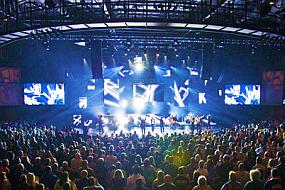 Every Sunday, Americans flock to giant, hangar-like theaters, where rock music with shallow lyrics that most people can’t sing along with well blares out of $200,000 sound systems for a scientifically prescribed number of minutes before some attractive woman gets up and makes an appeal for money. Then a goateed guy in a Hawaiian or bowling shirt talks for a half hour about how we can all enjoy our best life now by doing something that tangentially has to do with the Bible. And maybe Jesus. Maybe. There’s another song, and then everyone goes to IHOP for all-you-can-eat pancakes.
That’s what Church in America has become. That’s what Denny Burk says we must all attend every Sunday lest we commit spiritual suicide.
Excuse me, but it seems to me that attending something like that is the real spiritual suicide. And Evangelicals are committing it weekly.
Donald Miller says he connects better to God when he’s working than when he’s attending something like I just described.
Can anyone blame him?
I suspect there are many Donald Millers out there who went to a pale imitation of New Testament church and didn’t find God there. And when Denny Burk plays apologist for such an Ichabod “church,” how can he be taken seriously?
I’m sure Burk would probably endorse a more serious church, one that wouldn’t be a dog and pony show. But when all is written, is his version any better?
Are the people in Burk’s idea of church selling their possessions and dropping them at the feet of the apostles?
Does his church maintain a common purse so that no one in the church ever suffers need?
Does his church allow a few prophets to speak revelatory words from the Lord through the Holy Spirit and then have other wise people weigh those words?
Does his church encourage tongues and people who can interpret those tongues?
Does his church celebrate communion as a full meal and not just a thimble of grape juice and a stale cracker?
Does his church encourage others to bring their prayer requests and then prays over them all?
Does his church meet together daily in each other’s homes?
Does his church worship in such a way that the meeting place is shaken by God?
Well?
Just what is Burk defending that he chastises Miller for eschewing it? Why aren’t the leaders of those off churches faulted instead for delivering such a wan imitation of a genuine New Testament church that spiritually astute people find a whole bunch of smoke and mirrors and not a whole lot of God?
In the end, Miller may be edging toward a bad position, but in his edging is a stinging indictment. If our churches today are connecting people with cultural entertainment and not with a risen Lord, then what person in his right mind would want that? And what right-minded person would defend it?
Anymore, I don’t encounter much of God in a traditional Evangelical church setting. I have a hard time with the music, and I’m a musician. I wish the words were more meaningful and the tunes more melodic. I wish there were more quiet, contemplative songs. I wish we worshiped God in ways that didn’t always come down to something that emanated from Hillsong or the pen of Chris Tomlin. I keep hoping for a bright, airy space filled with people who minister to each other. I want to see the assembly of the people of God filled with prayers, and not just for a couple minutes. We need to use our individual gifts on a Sunday, and not just stare dully at a stage from whence the show pours forth. We each need to practice our spiritual gifts with each other in the assembly, because that’s what God gave them to us for. We need to eat a real meal together and bear each other’s burdens so that people leave encouraged and strengthened and not burdened by yet one more thing the pastor said they’re doing half-heartedly or altogether wrong. And we need to know that someone at that church has our back if the going gets rough. And we need to know whose back we’ve got when he or she stumbles.
Donald Miller needs that too.
And Denny Burk needs to open the Bible he teaches professionally and get a real vision for what the Church in America must be. He needs his definition of what the Church is altered so that it’s not a building and not an activity done once a week, but a living, vital people filled by the Holy Spirit and sealed for the Kingdom, who are the Church wherever any single Spirit-filled believer goes, regardless of how many go with him or her.
God help us that we have these national voices, who supposedly speak truth about the Christian life, and yet they can’t even get the basics right!
The truly sad part is that the person who asks if we’re doing it right is the one who receives the beat-down. Confess in all honestly that such a church as Miller avoids doesn’t personally provide a solid connection to God and it’s the questioner who is on the receiving end of the resulting indignation. The questioner is wrong. The questioner is spiritually immature or deficient. The questioner is the one committing spiritual suicide.
I have one word: Maranatha!
 The family with the unruly special needs child, the kid that hoots and hollers sometimes during a quiet Sunday meeting. That harried mom and dad who got one too many stares one Sunday and then weren’t there the next to receive more.
 If we are drunk, then we lack the sobriety in the Spirit to know the difference between the good and the best. Have we asked soberly if spending 10-15 times as much time singing on a Sunday turns prayer into an afterthought? Should we then scratch our heads when nothing changes for the better? Should we then blame God for the fruit of our corporate prayerlessness?