
The Intimate, Faraway God

Standard

You had to be living under a rock to miss the brouhaha over Mother Teresa’s confessionary book detailing the profound absence of the presence of God in her life. Not only did the secular media sources jump all over that news, but so did the Godblogosphere.

While I apologize for being late to this news story due to situations here at home, I feel the need to comment nonetheless. Perhaps in the wake of this story’s looming obsolescence (as is common in today’s frenetic media environment) people have had a chance to ponder it a bit more—or forget it completely. No matter the case, I hope to add grist to the mill or refresh your memory.

You can read the original Time article here.

I appreciate Mother Teresa’s work in India to the extent that she cared for the dying. Few of us would be so dedicated in such a hellhole as the one she ministered in. In that regard, she’s a far better person than I am.

On the other hand, no evidence exists that she told dying, hell-bound people how to be born again in Jesus Christ. To have ephemeral earthly comfort without eternal spiritual comfort is no comfort at all.

So in the end, I have strongly mixed feelings about Mother Teresa.

If you cruise the Christian blogosphere, you’ll find all sorts of opinions about the state of her soul. Some would damn all Catholics to hell, saying Teresa’s crisis of faith was due to a complete lack of saving grace; she didn’t feel Christ’s presence because she wasn’t born again. Others sympathetic to the Catholic cause are more lenient, claiming she partook of Christ’s sufferings by enduring an incredibly long, God-ordained “dark night of the soul.”

I’ll let readers decide where they stand on that continuum. Seeing as Teresa ministered in one of the bleakest spots on the planet, the slums of Calcutta, I can see how she might tend toward that dark night. Still, for the purposes of this post, I want to make the issue less about Teresa and more about you and me.

The longer I’m a Christian, the more people I encounter who put on a brave face concerning their own encounters with Christ. If I had to choose a side, I would say that I know far more Christians who would confess in secret that they never experience the feeling of God’s presence in their lives. In that way, they understand what Mother Teresa endured because they feel the same disconnection. That experience nags at them daily.

Can we be honest here? For every one Christian who claims an intimate, uniquely personal encounter with the person of Jesus Christ, I suspect there’s ten who have not.

That’s not a figure we Christians like to trumpet. I think it’s the dirty secret we don’t wish to discuss–ever. Why? Because it calls one’s salvation into question, at least by the standard that some Christians use.

When we talk about having a “personal relationship with Christ,” how many people can claim that this relationship resembles in every way (and better) the kind of relationship one has with a spouse?

To some people, to even ask that question is nuts. “Of course a person doesn’t have a relationship with God, a spiritual being, in the same way as a flesh and blood human being,” some would say. Others would argue, “Anyone who doesn’t have that kind of kind of relationship isn’t really filled with the Spirit and may not be a Christian at all!” Still others would say, “The truth lies somewhere in-between.”

I’ve had some interesting conversations with men of late. More than once I’ve heard them say that God responds to their wives’ prayers in a way that they themselves do not experience. One even went so far as to say that when something he’s been praying for happens in his favor, he has to check to see if his wife was praying the same thing. If she wasn’t, then he can rest knowing that God answered him alone. A dry weary land without waterOtherwise, he fears that his prayers go unheard if they don’t overlap his wife’s. (I may unpack that fear in a later post.)

If I polled men here, I would suspect that some of them are squirming in their seats over hearing this revelation.

Given this, I suspect that a lot of the Godblogosphere’s most vocal proponents of the Gospel harbor a real dryness on the inside for that voice of God they never seem to hear. And given how readily some talk and talk about the little two-sided chats they have with God every day, you won’t hear those dry folks fessing up.

In the case of Mother Teresa (or those of you out there who share her lot), I can say without hesitation that no matter what we might say about her spiritual state, she did one thing right: she pressed on.

One of my favorite passages in Scripture puts it this way:

“Come, let us return to the LORD; for he has torn us, that he may heal us; he has struck us down, and he will bind us up. After two days he will revive us; on the third day he will raise us up, that we may live before him. Let us know; let us press on to know the LORD; his going out is sure as the dawn; he will come to us as the showers, as the spring rains that water the earth.”
—Hosea 6:1-3

Most of us know the last sentence, v. 3. I like the other two as well, for they are Messianic prophecies that also apply to us Christians. Sometimes it takes two days out of three before God revives us. In a life of 80 years, that may be a long time to be dry. But His promise is sure if we press on, isn’t it?

I know plenty of atheists who gloated over Mother Teresa’s dryness. “See, see!” they shouted. “If Mother Teresa can’t touch God, there’s no one’s up there in heaven.”

But the thing about atheists is they know nothing about pressing on. They gave up before the second day, before the rains came.

I know a little about the rains. We’re officially at 19″ of rain for the year in my part of Ohio. The normal? Oh, about 30″. Now combine that with the hottest August on record around here, with five days over 100. Folks, it doesn’t get drier than that. My property looks like a moonscape with all the craters of dead, scorched grass. But as someone who fancies himself a farmer, I don’t give up. Because I know some day the rains will come. Maybe not tomorrow or the day after that, but some day.

So we press on.

As the Scriptures say:

I love those who love me, and those who seek me diligently find me.
—Proverbs 8:17

I believe that. I hope everyone reading this does.

I don’t know about Mother Teresa. I know about me, and I’m not always a fountain of refreshment. Still, the faraway God comes in intimate times and I find Him. Sometimes I find Him when I’m not pressing on. And sometimes I don’t find Him when I am. But He’s still there, and I take comfort in that knowledge.

I pray that you’re finding Him. If you’re not, know that you’re not alone. So don’t be discouraged; press on. If you simply can’t press on by yourself, enlist someone to press on with you. And don’t be surprised if you see in the one who helps you the very person of God.

Be blessed. And bless others.
The Gospel of Manliness

Standard

Our church built a concrete parking area for the bikers.

On hot days, motorcycle kickstands sink into blacktop. Our parking lot is gravel, and when it rains that doesn’t work so well, either. So they chose concrete.

I imagine not too many churches construct a special place for bikers to park their Harleys. My church seems a tad more manly in that regard. Farmers, fishermen, truck drivers, mechanics—salt of the Earth kind of guys fill our pews. Lots of callouses. Talked this morning with a guy who crushed his hand in his tractor’s 3-point hitch.

I’ve got a tractor, too. A big, 35 h.p. Kubota. I pull an eight-foot Land Pride finish mower and a five- foot Bush Hog. Been able to run the service on those myself, so far. But I’m more a gentleman farmer (read: Eddie Albert in Green Acres). I talk about reading Dietrich Bonhoeffer or Stephen Hawking and other farmers’ eyes glaze over. I watch birds in my spare time, too.

See, I’m not very manly.

When I was born, the doctor said to my Mom, “You’ve got a linebacker.” Well, maybe for an NFL team in the 70s. At 6’4″, I’ve got the height, but 215 lbs. goes about 30 too light to play with the big boys nowadays. Half a life ago, I could bench press over 400 lbs and do 160 lb. one-armed bicep curls. Half a life ago.

I never played football in high school. I could’ve been a contender in basketball, but puberty left me with an inability to walk and dribble at the same time, so the NBA never called.

Though the men in my church have a fantasy league for nearly every sport imaginable, I can only name four players on the hometown Reds: Ken Griffey, Jr., Adam Dunn, Bronson Pinchot Arroyo, and the the Great White Hope, Homer Bailey. Standings? I have no idea. I can’t even keep up with sports team names and locations. Just the other day, I learned that the NBA Charlotte Hornets aren’t in Charlotte anymore—and I think that change came five years ago. I had no idea Charlotte had an NHL team, either. And though I enjoy watching hockey games (love the international rules Olympic hockey especially), I’m the oddball in the stands yelling, “Just play the darned game!” whenever a fight breaks out. And I do say darned and not something else.

Me, I was always a cyclist. But if I asked any of the guys at church about the Tour de France, I’d probably be stoned. “France? France??? Heck, the Ohio State football team could probably invade France and kill every last one of them Brie-eaters with their bare hands. Go Buckeyes!

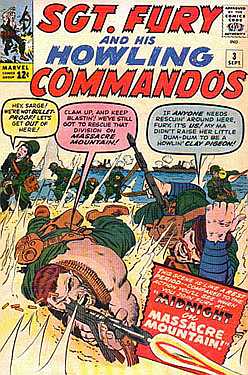
Previously, as a member of a well-off Presbyterian Church, I’d hang with the men and they’d sit around talking investing. Or real estate. Or cars. Or electronics. Marvel Comic's 'Sgt. Fury & His Howling Commandos #3'The latter I knew something about, but the rest flew over my head. And in those rare moments when the subject did stoop to sports, no one wanted to talk about Olympic volleyball, one of the precious few sports I’ll make time to watch.

My Dad’s dad was the pinnacle of manhood—a Marine drill sergeant. But somehow, my Dad inherited little of that manliness. My Dad couldn’t rebuild a carburetor to save his life, relied on his sons to operate the stereo system, and usually injured himself on anything tool-related. He knew everything to know about the Civil War, but, sadly, that never clicked with his sons.

Dad had a job that he loved, though it took him away from home for weeks at a time. Eventually, he rose to the top of his company and was considered the savior of headquarter’s sales division, but a back injury forced him out of that job and into one he hated. I watched that office-bound job suck the life out of him, and when they forcibly retired him six months before he was due his full pension (receiving a third of what he would have received), I witnessed what happens to a man crushed in the cogs of big business. He walked away from the Church and died in 2000 at 66, a shattered man.

I wish my Dad had left me with more than he did. I’m making it up as I go along, so I’ll never be a pinnacle of what most people consider manhood.

After watching my own career go awry at the worst possible time, I decided I had to be my own boss rather than suffer the capricious whims of Jack Welch disciples whose go-to response to a bad quarter meant downsizing. So I started my own business. That meant my wife would have to be the primary breadwinner while I stayed home with our son, homeschooled (I have the education degree), managed the farm, and tried to get my business going. Most freelance writers like me take more than five years to see even the slightest bit of money, so I’ve done better than most. Still, my wife’s the one doing the heavy lifting for now.

Plenty of people don’t consider me very manly for being a stay-at-home dad who’s not the primary breadwinner. Church people like that not one iota. I know, I’ve been on the receiving end of the catcalls. A few holier-than-thous have questioned my worthiness as a husband, income—I guess—their sole characteristic of godliness. I’ve had well-meaning Christians ask me when I was going to get a real job, as if my writing business doesn’t count. When I ask them what writing projects they might refer my way so I can continue to build my business and return to being the primary breadwinner, they go scurrying. It’s easier for them to tell me that I’m not very manly than to actually help me be the man they think I should be.

You get left out of the rest of the world when you’re a stay-at-home dad. To the at-home moms, you run the risk of being considered the slob making your wife work OR some kind of sexual predator stalking the mom who’s a bit too lonely. Men don’t know what to think of you, either. You’re either the smartest guy in the world or the biggest loser.

Men don’t fall into the role of at-home dad very well. We took woodshop and not home ec. For this reason, our house is never as clean as it should be. I may do better than my wife in the culinary skills, but I’m not as naturally nurturing. Your best friend smacked you in the head with a golf ball? Well, son, that’s life. Shake it off. Meanwhile, I’m laughing because I can see the ball’s dimples in the rising bruise. Mom would slather him with attention and ice compresses.

Though I’m plenty creative, I confess I run out of ways to amuse our son. As a result, he spends more time on the computer than I would like. Friends of ours wondered how I could possibly tend our farm, start a writing business, homeschool, and handle what is traditionally the female role, while still doing all the manly things, too. The answer to that? Not as well as I would’ve hoped. So we’re making some changes. We’re putting our son in public school (in part) so I can get out and round up more clients. Of course, to some Christians, I might as well sacrifice my son on an altar to Molech as put him in public school. (I’ve heard that Lowe’s sells Molech Altar Kits for the do-it-yourselfer. Or was that Home Depot? Remember, I’m not very manly, so I get them mixed up.)

John Eldredge’s Wild at Heart took men in the American Church by storm. Today, finding one’s inner bowhunter or professional wrestler appears de rigeur. We’ve been told the Church is feminine, that men are bored with Church, and that singing how lovely Christ is comes off, uh…kind of gay. The antidote, the manliness pundits say, is to hunt bear with a pointy stick.

Manly? Somehow, I don’t think so.

The Dangerous Book for Boys occupies the top rung of nonfiction bestsellers, as sensitive ’80s guys attempt to raise their sons differently. In my neck of the woods, Boy Scouting fit that bill for decades, but the Boy Scouts aren’t trendy, they face countless frivolous ACLU lawsuits, and Dan Beard hasn’t had a bestseller in years. Being dead kind of throws a wrench into cruising the talk show circuit.

Jim Elliot died in an Ecuadoran jungle back in the 1950s. He’d gone to those jungles to reach the lost tribes who’d never encountered Jesus Christ. Elliot and the four other male missionaries that died beside him carried guns that could’ve easily dispatched their attackers, but they took the spears of their killers rather than send unsaved men to an eternal hell.

They deleted that scene in Braveheart…or so I’m told. I haven’t seen that movie, either.

True manliness isn’t found in beating a drum head (Hah! I actually do that one!) or bashing the heads of one’s enemies. God’s man isn’t the sports junkie who can recite all the stats of the greatest baseball team to ever grace a diamond, the ’76 Big Red Machine. He’s not the one who listens to Ted Nugent and hunts Kodiaks with a crossbow. He’s not even the soldier who gave his life in battle believing in a higher truth worth dying for.

No, the greatest mark of a Christian man is that other men desire to emulate him because they see Christ in all His glory living in him. The true manly man serves as a hallmark, a lighthouse, and road sign on the path to heaven. He’s not afraid to cook a meal for the poor. He visits the sick. He looks out for lost little children. A bent reed he does not break. A smoldering wick he does not quench.

Chances are he won’t know who’s on top in the AFC North, can’t regale you with the specs of the hottest electronic gadget, and won’t be out training for a triathlon. God’s man kneels in his prayer closet, where no one sees, and tears down strongholds that would make William Wallace wet himself. That kind of man makes tough choices that take him in a direction the rest of the world can’t understand, even the rest of modern Christian men. He may not be considered the prime example of manhood in his day, but he’ll leave a legacy that shines like a beacon for generations to come.

I’m writing this on Father’s Day. Yesterday, my son and I built a hand drum. We had a good time. A friend gave me The Dangerous Book for Boys (thanks, Eric!) this past Friday, and my son and I will probably do a lot of good projects out of that book this summer. But none of that makes me an acceptable dad. The only thing that makes a man a man is to model Christ for his generation and the next, even if that model doesn’t look anything like the models we typically hold out for manliness. It may mean we holster our gun and take the spear. We may have to forgo the bear-hunting trip to run errands for the elderly lady next door. That won’t make us popular, or even understood.

But it does make us men.

When the Truth Strikes Out

Standard

Once again, they’re doubling the size of the local daycare facility. They doubled it just a couple years ago. In a town of about 3,000.

The latest statistics show that the average American is rapidly approaching working a ten hour work day. Couple this with a daily commute of close to an hour, and you have a country in which people just aren’t home.

Five years ago, the majority of families we knew were single-wage-earner households. Now, almost none are.

Into these statistics wade several parachurch organizations that tell us exactly how Christian families should look:

  1. The father works outside the home.
  2. The father is the spiritual leader of the family.
  3. The mother stays home with the children and, preferably, does not work.
  4. If she must work, she works from home.
  5. The father must always be the primary breadwinner.
  6. Unless parents wish to abandon their children to the spirit of the age, they best homeschool.

Hmm.

On the surface, those are all nice ideas. The problem comes when the parachurch organization uses them to gauge the spiritual health of a family, or to tell certain families they aren’t cutting it. They’ll use Bible verses in their accusations, often in a haphazard manner, to prop up their assessments.

I’m troubled by the “you’re in, you’re out” nature of some of these diktats. When I examine these standards, I have to ask how they reflect most people’s realities. If they don’t, then I would hope that, like a good change-agent, the parachurch organization would address the problems and seek solutions.

I would hope.

Let’s look at one issue above and see how it works in the real world.

I’m all for paternal leadership in the home. I think that’s as God intends, but with an understanding that a godly wife can often hear the Lord as well or better than her husband from time to time. (I’m sort of a wishy-washy complementarian with a few select egalitarian leanings. )

But I simply must ask this: what kind of leadership can we expect of any man if he’s out of the home most of the waking day? Where's Dad?With the growing amount of time spent at work and in the car during the commute, should we be surprised that a father’s authority at home gets taxed by the very lack of his presence most of the day?

Now, you would think that an organization whose whole reason for existing is to uphold paternal leadership at home would be doing something–anything–to combat this trend that takes men out of the home all day. You would think.

But then you’d be wrong.

Last year, I wrote several e-mails to a well-known parachurch organization about this very issue. I asked them what practical means they were taking to help families keep their men at home. They wrote a reply reiterating their standard, but ignored my question concerning their plan to help Christian men meet that standard. When I followed-up with an e-mail asking if the organization was meeting with corporate leaders across the nation in order to advocate for shorter work weeks so that employees could spend more time at home helping their families, I got a rather terse response saying they weren’t doing anything like that.

In the end, they still had a standard, but no way to make it practical in the lives of men struggling against the business world’s expectation of increasing hours (and with no increasing pay to compensate, either).

I asked that same organization about the tendency for businesses today to hire women over men because they can pay women less (and because government quotas with money behind them abet this plan, especially when it concerns minority women). This puts men out of work, and subsequently, many men find themselves having to take jobs that pay less than their wives. The second fallout of this is now both spouses have to work in order to make what the man made before he got RIF’ed. What was the organization’s solution? Silence. The practical steps they were taking to combat this? Nothing.

After a while, one can go through every single standard an organization like that upholds and find that, while they love upholding it, they possess no means to help anyone else meet that standard. How tragic!

Imagine that NASA discovers a planet just beyond Pluto whose surface contains an unusual liquid that bubbles up from within that planet’s core. NASA scientists have almost conclusive proof that a few drops of this liquid, if harnessed, would forever power every energy-using device on Earth. Then NASA issues a press-release stating it has no intentions of sending any craft to that planet to retrieve this precious liquid. They’ve already told their scientists not to pursue further spectral analysis. Nor will they let any other scientists examine the data on the liquid so that it might be synthesized on Earth.

Do you think folks would be furious?

Where’s the fury then when Christian organizations demand a certain way of living, yet offer no means or help to make that living possible?

Truth is never meant to be used as a cudgel, but as a means to help others live life more abundantly. If the guardians and wielders of truth only use truth to shame others and make them live in a perpetual state of guilt with no possible escape, hasn’t the truth struck out?

Christians MUST offer truth to the world. But to do so in such a way that it becomes another set of shackles isn’t New Testament Christianity.

I believe that one of the reasons people today don’t consider Christianity a viable truth comes from our perpetual offering of that truth with no practical expression. For you or me to understand truth, it must intersect our lives. It can only transform us when it indwells us. And to indwell us, it must have a way for us to live it.

I keep wondering who the Christian leader will be who holds out a standard and then helps everyone meet it. I hope that Christian leaders interested in godly families will speak out against the economic forces threatening to destroy us.

And so I keep wondering and hoping…