
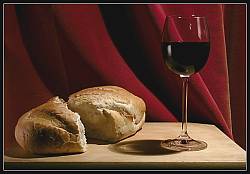
When I was growing up in the Lutheran Church, the Jesus People revolution was beginning to permeate a few more open-minded traditional churches. In my youth group we sang songs by Ray Repp, Larry Norman, Honeytree, and Don Francisco. Everyone sported longer hair and Jesus was “what was happening.” 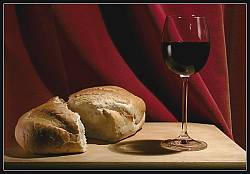 People talked about community, and partaking of the bread and wine went from being just “communion” to “The Love Feast.”
Fast forward more years than I care to admit and while some of that 70s hippie Christian mentality has worn off, the idea of communion being “The Love Feast” has never left me. The Book of Hebrews talks about heavenly things having earthly counterparts, and I see the Marriage Supper of the Lamb as being represented here by our time of communion.
Why then is communion within our churches today such an amazingly lackluster event? Why do so many of us eat “bread” that consists of quarter-sized, airy wafers or little wheat tic-tacs? And where did the wine go? Some feast, huh?
No, I’m not trying to be sacrilegious. This is one of my top five pet peeves with the way we practice the Faith. It baffles me that for those who believe that communion is held strictly as a remembrance it’s done in such a forgettable way. As for the more mystical who believe that something special happens when we partake of communion, are we expected to believe that a thimble of Welch’s and a molar-cracking divot of hardtack are components of a transcendent experience? Evangelicals come off the worst here. The farther away you get from the Lutherans and Old Line Presbyterians, the closer you are to grape Kool Aid in a plastic shotglass and stale, crumbled saltines.
I’ll be honest here: I believe we are dishonoring the Lord by not going all out with communion. Frankly, I’d love to see churches completely bag the juice and crackers routine, hold a special communion service at least once a month, and serve a real meal during which the church fellowships and communion is handed out—and with a genuine varietal wine (Cabernet for those used to wine and Beaujolais for those being weaned off Welch’s) in a real glass and a basketful or two of fresh-out-of-the-oven homemade loaves of bread with some genuine heft to them. (Or, if you want do do it eaxctly right, consider making up some unleavened bread. Either way, get one of the best bakers in your church to make it.) Encourage people to rip off more than a dime-sized piece, too. Hold it in the sanctuary if you have no other space. (And if no one in your church can cook, rent out the local Italian restaurant and use church money to pay for everyone’s meal.) Spend several hours praying for each person who needs prayer. Confess your sins to each other. Dance a group dance if need be. But by all means, be a living church of living people and not a dry desert hostel filled with stoics. Go home refreshed for the joy and exuberance of it all.
And you—yes, you in the house church—stop laughing.

 One of the phenomena I’ve encountered in the portion of the blogosphere I regularly visit is an absolute mania for all things John MacArthur. In my post about Jack Hayford, I noticed that I, too, uttered the name that crops up everywhere I turn.
 Here are