A Hodgepodge of Thoughts on This July Fourth

Standard

Some things rolling around in my head:

Now that the business series is over, I’ll be the first to admit that a few things got left out. I should’ve talked more about the loss of rites of passage within the Church after the economy shifted from agricultural to industrial. I also did not go into detail about how individual Christians can further their careers by playing the business world’s game while not being destroyed by it. I’ll admit that as the series went on, my conclusions there became more grave and I felt I needed to back off, so this omission on that one issue was intentional. There are several Christian Web sites out there with those talking points, but honestly, they seem to me to be mouthing the same old same old that has not made one dent in a real Christian presence at the heart of business. Like I said in the series: you can gold plate a 1975 AMC Pacer and it’s still a lousy car.

I think our answers must be more radical. Even now I’m reading a book called Better Off: Flipping the Switch on Technology, and while the author is clueless as to the religious reasons that people abandon the hectic post-industrial lifestyle we have created for ourselves, his book does show the pervasiveness of healthy community found in those groups that have dropped out of the 21st century rat race. 'Miami' by Alex MacLeanI’m not entirely through the book, but I’ve already got a knot in my chest because he’s talking about the same deep need that I am for real community.

We invited some of our neighbors over a couple weekends ago for an impromptu hanging out in our backyard. No real plan. We supplied all the food and we just chatted as the sun went down. I hope that we can develop truly deep friendships with our neighbors, but I am unsure if it will ever live up to what I imagine it can be.

People are too isolated into little islands. If we can’t rely on the communities we form around us, then we are lost as a civilization. And I’m not just talking about a nod here and a wave there; we need to shoulder each other’s burdens in a way that we are simply not doing. The result over our isolation is overburdened lives completely stretched and stressed to the max. God did not make us to live that way. Should we wonder why so many people founder in it?

Maybe we’ve done it all wrong. The amount of money I pay in insurance alone is criminal, but I’m probably underinsured compared with most people. I spend money to make sure nothing happens to my stuff, to my wife, to my child, or to me. Almost every insurance man I know is a backbone in his church. We talk about wise stewardship of the things God has given us, for sure, but what if our insurance was meant to come from the community of Christ instead? Should my house burned down, what if it was that community—a community that lived directly around me comprised of the saints of God—that shouldered that burden with me. And what if I shouldered theirs? Doesn’t that make so much more sense than what we have now?

We reach out through copper wire and satellite feeds and spill our thoughts into the ether about this and that, but is that community? In my soul, it just doesn’t feel like the same kind of thing I get when my neighbor walks over with a newspaper clipping about a used book sale she thought would appeal to me. If I need a wrench, do I buy it from the Internet, or do I walk over to my neighbor’s and borrow one?

We almost never ask if there is more truth in one over the other. Our perpetual blindness to the way that systems erupt and take hold of us without our thinking bothers me, and I feel as if too many of us have stopped asking the hard questions. Every day lately I wonder if we are not trying to solve the core problems of what it means to live out a real Christian presence as a vital community of faith because we gave up trying to do so. Those problems are intractable, right? Better that the wave just carry us along than we question it.

I wonder if we are far more impoverished in the depths of our being than we understand. Perhaps the injuries we’ve suffered by uprooting the very good for what we initially perceived to be “the even better” has not turned around and bitten us—and we have yet to realize we are bleeding.

For the first time ever this year, I’ve had to reject medical treatments for my family because they were too costly, despite the fact that we have insurance. Did God offer a different kind of medicine, but we scorned it in favor of what grew to be the monolithic healthcare system we have now? At what part of the process did we fumble the ball?

Sales of iPods continue unabated and people risk being oddballs if they don’t have one. But what if we stopped working so hard to buy the massive overload of gadgetry we are told we must have in order to define ourselves or to keep us from being seen as out-of-step? Is out-of-step the worst label we could bear? Could we recover some portion of a life without these things, a life that has more of God in it and less Nokia or Sony or Dell? I’m still astounded at the fact that everyone seems to have a cellphone now when just seven years ago I had no friends who owned one. What did we do before frying our brains with unproven technology became de rigueur? Are our lives better for it? Does the cellphone on our ear replace something that God put in place but we in our desire for rocket packs elected to abandon?

The Church never seemed to question the Industrial Revolution and I can’t see how they could not. And yet we today with the benefit of seeing through the lens of history have the same tunnel vision. The recent post on psychology opened up huge wounds in a lot of readers and the comments on that post are the harshest this blog has ever seen. But are we better people because of psychology? Was the whole world nuts in 1835 compared to today? I’m not sure I see the absolute benefit, but I certainly see the harm psychology has caused the Church. Doesn’t it seem like we gained a handful of toothpicks and lost the entire forest? Isn’t that true of far too many things today?

Perhaps my great-great-grandfather was a better man than I am. Maybe for lack of all the gadgets and gizmoes, for want of THE LATEST KNOWLEDGE™, he was a more satisfied man, too. Could it be the community he lived in knew more about what it took to be a real neighbor?

I think the Church in America has to decide at some point when it will get off the treadmill. I think for our own souls’ sake, we have to. When that will be, I don’t know. I know that ultimately satisfaction is found only after we die, but I sure would like to see a lot more of heaven this side of it. Isn’t that why the Church exists?

Been rambling too long. Just looking out at the fireflies dancing just beyond my reach and wondering….

{Image: “Miami” by Alex MacLean}

The Myth of “Pantribulationism”

Standard

'The Four Horsemen of the Apocalypse' by Albrecht DurerMatt Self of The Gad(d)about has stepped into the Blogosphere with both feet and made a mighty big impression. I think only the (now) ubiquitous Phil Johnson has entered more blogrolls more swiftly than Matt. I read The Gad(d)about every day via Bloglines, and not only do I like Matt’s take on a lot of issues (real level-headed charismatic ones, too!), but he’s probably the only Christian blogger I know that the two of us could get into the merits of Evans hydraulic heads while the rest of the world thought we were talking about cars.

Now he wants to talk about the antichrist and eschatology. (Ooh, scary!)

{Word to Matt: You have to have been blogging for at least two years before you can post opinions on eschatology. It’s the Christian equivalent of the restriction on rabbinical students teaching The Song of Solomon.} 😉

Now I’m all for a good thrashing of Hal Lindsey or that Van Impish guy or whoever he is. And I like the fact that Matt nails the truth down that the spirit of antichrist in people who hate God is as much or more important than actually identifying he/she/it. But your eschatology really doesn’t matter all that much as long as you’re an ardent Christian? Hmm….

I used to think that one’s eschatological leanings made little difference, but after almost thirty years observing the Church, I don’t believe I could’ve been more mistaken. In actuality, people’s eschatology influences almost every single aspect of their lives, especially the way they walk out their interpretation of the Christian faith.

Dispensationalists, for instance, are always thinking about Israel in the light of eschatology. The rise of dispensationalism in the 20th century is one of the reasons that Israel exists as a state today. U.S. foreign policy revolves around dispensational eschatology in many regards. This is no small thing. Dispies have probably donated more money to Jewish causes looking to rebuild the Temple than anyone. And somewhere in Israel, right now as I type, some Lindsey-ite rancher is trying to genetically engineer a red heifer perfectly acceptable to the Lord.

The hardcore pre-tribbers of the Left Behind variety have their own issues. Much of their Christian praxis takes on a disposable mentality because “it’s all gonna burn.” They’re the ones who roll their eyes when some “eco-whackjob” starts talking about wise use of natural resources or preserving the Ivory-billed Woodpecker. If they could find a way to BBQ every known species of woodpecker over the world’s total supplies of coal and oil, they’d do it. At least to this writer, there’s a healthy model of living for today and there’s being psychotic about the whole thing.

Preterists are the stoners of the eschatological wars in that their view is, “Hey man, like it all happened in 70 AD, so we’re like free.” They live by one rule: “Whatever!” To get a preterist to get serious about building a Church that can withstand some persecution is like trying to get Woody Harrelson to stop toking and start planning for the day his movie career dries up. (Oops, too late!) All I can say is, “Wise virgins, foolish virgins.”

Now I just got done talking about postmillennialists and their “Onward, Christian Soldiers!” battle cry in my series on the business world. The “every day, in every way, we’re getting better and better” routine means you might as well flush your head down the john because there’s no way you’re going to get a postmill-er to acknowledge any kind of societal collapse theories. In some ways, the Latter Day Rain aficionados are in that same boat, thinking that worldwide revival is coming…coming…coming despite that fact that the entire West has pretty much traded in their Jesus card for the one that reads “Apostasy.” I don’t know about you, but I think the thinking behind “Jesus, now that you’ve returned, here’s the perfected Christian world we created for you!” takes a WEE bit of tweaking in light of Luke 18:8. (I’ll let you look that one up.)

As for the amillennialists, well, since they take everything figuratively, they just don’t believe anything, now do they?

My whole point here is not to make fun of the different eschatologies, but to point out that what you believe about Christ’s return, the end of the world, and the New Heaven and New Earth does make a difference in how you live out your faith.

I was twenty-six-years old when the infamous book 88 Reasons the Rapture Will Occur in ’88 was #1 with a bullet in Christian bookstores, so I actually remember the fallout from it fairly well. People who believed that numerological piece of detritus did all sorts of wacky things. Most of the senior class of Cedarville Bible College not far from me went out and got married rather than die virgins. People by the score around the country euthanized their pets rather than see Fluffy fall into the hands of the animal-sacrificing Satan-worshipers that would run rampant across the country once all the Christians had been raptured. I was working full-time at a Christian camp and that book was all the young summer staff people could talk about. And they changed their behavior—for good or ill—simply because of that book. I was in the midst of a serious relationship at the time and despite the fact that I thought the whole book was utter ungodly hogwash it still crossed my virginal mind once or twice that perhaps I’d never get to…well, you know. Group-think has power, let me tell you.

In the end, no one is a “pantribulationist.” (Note: it’s an old Mike Warnke joke—”I’m a ‘pantribulationist’ because it’s all going to ‘pan’ out in the end.”) Everything you and I believe about the End daily influences how we live (or don’t live) for the Lord and His Kingdom. Our views on evangelism and discipleship, our thoughts on preparing the Church for tribulation, the manner in which we raise our children, and our general view on daily living—all are influenced by our eschatology. If we “sensible people” were all truly pantribulationists then the Christian bookstores wouldn’t have any eschatological books in the Top 20 every time a world crisis erupts. But you and I know that’s not how it is in reality.

People’s eschatology governs their lives far more than we realize. The old aphorism is that there are no atheists in foxholes. Well, there’s no pantribulationists, either.

{Image: Woodcut, The Four Horsemen of the Apocalypse by Albrecht Dürer, 1498}

Psychology a Pseudo-Science?

Standard

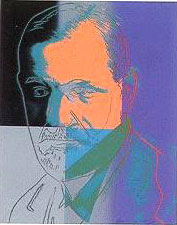
'Sigmund Freud' by Andy WarholDavid Wayne over at Jollyblogger takes Tom Cruise to task for trashing Matt Lauer in a discussion on the merits of psychology as a real science. Scientologist Cruise—he of the belief that evil space aliens control our minds—labeled psychology a “pseudo-science” and there was much rending of clothes and gnashing of teeth as a result.

I’m no apologist for Scientology or for Tom Cruise, but he’s right in one thing: psychology IS a pseudo-science. And Christians have swallowed and subsumed that pseudo-science to the point that it is wrecking the North American Church from the inside out.

Psychology and psychiatry are rooted in the exaltation of the Self. This is clearly at odds with the Gospel. Psychology and psychiatry possess a worldview of their own that conflicts with the truth claims of Scripture time and again.

If ever there was correct labeling of anything as a “pseudo-science,” psychology merits that label.