
Why So Little Evidence of Miraculous Power in the Western Church?

Standard

I’d like to continue the theme on charismata by offering wisdom from A.W. Tozer, the “patron saint” of Cerulean Sanctum. When Tozer preaches, I can’t help but be moved, nodding my head to every word. He understood the Lord in a way few of us do today, and his prophetic voice still rings loudly in the ears of modern Christians.

Are we listening?

Here is Tozer from his book Paths to Power: Living in the Spirit’s Fullness :

***

Break up your fallow ground, for it is time to seek the Lord, till he come and rain righteousness upon you.
—Hosea 10:12

HERE ARE TWO KINDS OF GROUND: fallow ground, and ground that has been broken up by the plow.

The fallow field is smug, contented, protected from the shock of the plow and the agitation of the harrow. Such a field, as it lies year after year, becomes a familiar landmark to the crow and the blue jay. Had it intelligence, it might take a lot of satisfaction in its reputation; it has stability; nature has adopted it; it can be counted upon to remain always the same while the fields around it change from brown to green and back to brown again. Safe and undisturbed, it sprawls lazily in the sunshine, the picture of sleepy contentment.

But it is paying a terrible price for its tranquility: Never does it see the miracle of growth; never does it feel the motions of mounting life nor see the wonders of bursting seed nor the beauty of ripening grain. Fruit it can never know because it is afraid of the plow and the harrow.

In direct opposite to this, the cultivated field has yielded itself to the adventure of living. The protecting fence has opened to admit the plow, and the plow has come as plows always come, practical, cruel, business-like and in a hurry. Peace has been shattered by the shouting farmer and the rattle of machinery. The field has felt the travail of change; it has been upset, turned over, bruised and broken, but its rewards come hard upon its labors.

The seed shoots up into the daylight its miracle of life, curious, exploring the new world above it. All over the field the hand of God is at work in the age-old and ever renewed service of creation. New things are born, to grow, mature, and consummate the grand prophecy latent in the seed when it entered the ground. Nature’s wonders follow the plow.

There are two kinds of lives also: the fallow and the plowed. For examples of the fallow life we need not go far. They are all too plentiful among us.

The man of fallow life is contented with himself and the fruit he once bore. He does not want to be disturbed. He smiles in tolerant superiority at revivals, fastings, self-searchings, and all the travail of fruit bearing and the anguish of advance. The spirit of adventure is dead within him.
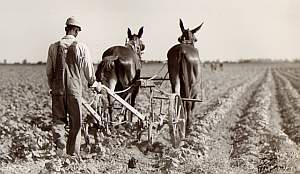
Breaking up the fallow groundHe is steady, “faithful,” always in his accustomed place (like the old field), conservative, and something of a landmark in the little church. But he is fruitless. The curse of such a life is that it is fixed, both in size and in content. To be has taken the place of to become. The worst that can be said of such a man is that he is what he will be. He has fenced himself in, and by the same act he has fenced out God and the miracle.

The plowed life is the life that has, in the act of repentance, thrown down the protecting fences and sent the plow of confession into the soul. The urge of the Spirit, the pressure of circumstances and the distress of fruitless living have combined thoroughly to humble the heart.

Such a life has put away defense, and has forsaken the safety of death for the peril of life. Discontent, yearning, contrition, courageous obedience to the will of God: these have bruised and broken the soil till it is ready again for the seed. And as always fruit follows the plow. Life and growth begin as God “rains down righteousness.” Such a one can testify, “And the hand of the Lord was upon me there.”

Corresponding to these two kinds of life, religious history shows two phases, the dynamic and the static.

The dynamic periods were those heroic times when God’s people stirred themselves to do the Lord’s bidding and went out fearlessly to carry His witness to the world. They exchanged the safety of inaction for the hazards of God-inspired progress. Invariably the power of God followed such action. The miracle of God went when and where His people went; it stayed when His people stopped.

The static periods were those times when the people of God tired of the struggle and sought a life of peace and security. Then they busied themselves trying to conserve the gains made in those more daring times when the power of God moved among them.

Bible history is replete with examples. Abraham “went out” on his great adventure of faith, and God went with him. Revelations, theophanies, the gift of Palestine, covenants and promises of rich blessings to come were the result. Then Israel went down into Egypt, and the wonders ceased for four hundred years. At the end of that time Moses heard the call of God and stepped forth to challenge the oppressor. A whirlwind of power accompanied that challenge, and Israel soon began to march. As long as she dared to march God sent out His miracles to clear the way for her. Whenever she lay down like a fellow field He turned off His blessing and waited for her to rise again and command His power.

This is a brief but fair outline of the history of Israel and of the Church as well. As long as they “went forth and preached everywhere,” the Lord worked “with them,…confirming the word with signs following.” But when they retreated to monasteries or played at building pretty cathedrals, the help of God was withdrawn till a Luther or a Wesley arose to challenge hell again. Then invariably God poured out His power as before.

In every denomination, missionary society, local church or individual Christian this law operates. God works as long as His people live daringly; He ceases when they no longer need His aid. As soon as we seek protection out of God, we find it to our own undoing. Let us build a safety-wall of endowments, by-laws, prestige, multiplied agencies for the delegation of our duties, and creeping paralysis sets in at once, a paralysis which can only end in death.

The power of God comes only where it is called out by the plow. It is released into the Church only when she is doing something that demands it. By the word “doing” I do not mean mere activity. The Church has plenty of “hustle” as it is, but in all her activities she is very careful to leave her fallow ground mostly untouched. She is careful to confine her hustling within the fear-marked boundaries of complete safety. That is why she is fruitless; she is safe, but fallow.

Look around today and see where the miracles of power are taking place. Never in the Seminary where each thought is prepared for the student, to be received painlessly and at second hand; never in the religious institution where tradition and habit have long ago made faith unnecessary; never in the old church where memorial tablets plastered over the furniture bear silent testimony to a glory that once was. Invariably where daring faith is struggling to advance against hopeless odds, there is God sending “help from the sanctuary.”

In the missionary society with which I have been associated for many years. I have noticed that the power of God has always hovered over our frontiers. Miracles have accompanied our advances and have ceased when and where we allowed ourselves to become satisfied and ceased to advance. The creed of power cannot save a movement from barrenness. There must be also the work of power.

But I am more concerned with the effect of this truth upon the local church and the individual. Look at that church where plentiful fruit was once the regular and expected thing, but now there is little or no fruit, and the power of God seems to be in abeyance. What is the trouble? God has not changed, nor has His purpose for that church changed in the slightest measure. No, the church itself has changed.

A little self-examination will reveal that it and its members have become fallow. It has lived through its early travails and has now come to accept an easier way of life. It is content to carry on its painless program with enough money to pay its bills and a membership large enough to assure its future. Its members now look to it for security rather than for guidance in the battle between good and evil. It has become a school instead of a barracks. Its members are students, not soldiers. They study the experiences of others instead of seeking new experiences of their own.

The only way to power for such a church is to come out of hiding and once more take the danger-encircled path of obedience. Its security is its deadliest foe. The church that fears the plow writes its own epitaph; the church that uses the plow walks in the way of revival.

***

Amen, Dr. Tozer, amen.
One Simple Word

Standard

When I consider how things started going awry in the American Church, time and again it comes back to one simple word.

Like too many negative perspectives on life, that word is more commonly defined by what it is not instead of what it is. You see this negating effect when people try to analyze Philippians 4:8:

Finally, brothers, whatever is true, whatever is honorable, whatever is just, whatever is pure, whatever is lovely, whatever is commendable, if there is any excellence, if there is anything worthy of praise, think about these things.

When when we break down that passage, we tend to read it like this:

Finally, brothers, whatever is not false, whatever is not despicable, whatever is not unjust, whatever is not corrupted, whatever is not ugly, whatever is not contemptible, if there is no hint of mediocrity, if there is anything impervious to critique, think about these things.

We end up defining the good as “not bad,” therefore losing all the concepts that attach themselves to the positive idea of what is good.

And so it is with this one simple word.

We find the negation of that word in a marital affair. We uncover its opposite in higher criticism of the Bible. We hear its voice in the followers of Korah. We see its absence in Ananias and Sapphira. And we discover its lack in this lesser known parable:

“What do you think? A man had two sons. And he went to the first and said, ‘Son, go and work in the vineyard today.’ And he answered, ‘I will not,’ but afterward he changed his mind and went. And he went to the other son and said the same. And he answered, ‘I go, sir,’ but did not go. Which of the two did the will of his father?” They said, “The first.” Jesus said to them, “Truly, I say to you, the tax collectors and the prostitutes go into the kingdom of God before you.”
—Matthew 21:28-31

The simple word?

Commitment.

It saddens me that we tend to understand commitment by its absence rather than its presence. Lack of commitment gets more press than commitment, even in our churches.

About the only place you hear of commitment in its positive sense is in the military. No matter what you might think of war—any war—those who come back home in flag-draped coffins modeled commitment all the way to death. Their commitment can never be disputed.

It’s telling that those who complain the most about our soldiers are the ones who least understand commitment. But ask a soldier; they’ll always relate the same positive traits that undergird their understanding of commitment:

  • Belief in a higher truth worth dying for
  • Submission to authority
  • Love of others above love of self

Do we know any other group of folks that should be modeling those traits?

From having been a church watcher now for many years, I believe whatever sense of commitment we once had in the American version of the Body of Christ has largely evaporated. It gives me no peace to say that. Commitment means the death of selfOur lack of commitment may be the sole reason for our ineffectiveness in light of the world’s onslaught.

Do we believe that the higher truth of the Gospel is worth dying for? Who speaks with that kind of passion anymore? John Knox once prayed, “Give me Scotland or I die!” Is that the kind of prayer you hear uttered in your church on Sunday?

Why not?

What else can the following verse possibly mean?

And they have conquered him by the blood of the Lamb and by the word of their testimony, for they loved not their lives even unto death.
—Revelation 12:11

Or this one?

As it is written, “For your sake we are being killed all the day long; we are regarded as sheep to be slaughtered.”
—Romans 8:36

It extends to a proper respect for authority, too. While nearly every Christian bristles at the mere subject of authority and submission, it’s not the griping about the authority of church leaders and submission to them that troubles me as much as the truth that we can’t seem to grasp the authority of Christ and submission to Him.

We would do well to remember the verse that comes before the Great Commission:

And Jesus came and said to them, “All authority in heaven and on earth has been given to me. Go therefore and make disciples of all nations, baptizing them in the name of the Father and of the Son and of the Holy Spirit, teaching them to observe all that I have commanded you. And behold, I am with you always, to the end of the age.”
—Matthew 28:18-20

We go for no other reason than Christ has all authority in heaven and on earth. He says, we go. How many soldiers died on the battlefield knowing their commander ordered them to be cannon fodder? Plenty. But they went anyway. It may even mean our Commander asks us to die as cannon fodder so that the lost of the world may come to saving knowledge of Jesus Christ.

When the Centurion approached Jesus to ask that the Lord heal his slave, he said this:

“Lord, I am not worthy to have you come under my roof, but only say the word, and my servant will be healed. For I too am a man under authority, with soldiers under me. And I say to one, ‘Go,’ and he goes, and to another, ‘Come,’ and he comes, and to my servant, ‘Do this,’ and he does it.”
—Matthew 8:8b-9

That centurion not only recognized the position of authority, but he correctly states that submission to authority allows the authority to have his way—to the betterment of all.

Is our submission to Christ’s authority allowing or preventing Him from having His way? We should not be so arrogant to think that the Lord would not remove us from the battlefield should we continue to defy His commands. Consider King Saul, for instance. And remember, Christ’s court-martial lasts for an immensely long time.

All this disregard for authority occurs because we love ourselves more than the authority or the higher truth the authority represents. Sadly, as the centurion notes, that self-love may damn everyone. Going AWOL at the worst possible moment may mean others suffer needlessly, the entire platoon wiped out because their cover gunner sneaked away.

Look at our society. Have we Christians gone AWOL? I posted a few days ago about people who took out sub-prime loans who now face the loss of their homes as the sub-prime mortgage sector collapses. I was astonished how many commenters immediately jumped on those folks, claiming they got what they deserved.

IF we believe the Gospel, and IF we submit to the authority of Christ, IT MATTERS LITTLE what the circumstances are. Love of our pronouncements of superiority DOES NOT trump Christ and His Gospel.

Which of us has done it all right? None. Are we not all fools for Christ? Shouldn’t our practice make the world sit up and wonder at our folly? Or is our rightness more important than love?

A hard word doesn’t even need to have all the words in place to be hard. Consider this:

We American Christians talk about __________ , but we show little commitment to making it happen.

What can go in that blank?

  • Godly community?
  • Evangelism?
  • Simple living?
  • Justice?

How many words and phrases can fit into our commitment blank?

Earlier, I noted that we tend to think of positive concepts in terms of what they are not, rather than what they are. Perhaps I’ve spent too much of this post falling prey to that same error.

So in the end, I’ll turn it around.

What does real commitment look like in the Body of Christ? When you hear the word commitment, what do you see in the Gospel that reflects positive commitment? How do we achieve that commitment in a positive way so we no longer talk about it, but live it?

And finally, what ungodly systems must we be willing to face in order to make that commitment to Christ and His Body bear fruit?

Something to think about this weekend.

The Half-Born

Standard

Been thinking. Thinking long and hard about life. Some accuse me of thinking too much and they’re probably right.

Been struggling. Struggling long and hard within life. Like most people, I don’t like struggling. I don’t like asking hard questions of myself. Don’t like staring into the sky and wondering why.

Why.

At some point in your life, you’ll sit down, look around, and ask, “Is this it?” Most of us will ask that question from the comfort of a nice home surrounding by nice things, the kind of things that the majority of the world could never afford.

At some point in your life, you’ll sit in church, look around and ask, “Is this it? Does this sum up the abundant life?” You’ll talk to a few folks on the way out of your nice church, load your nice kids into your nice car, and drive home with your nice spouse to your nice house. And it will all be so very nice. The kind of nice you’ve heard from your earliest days. A “gold watch and a handshake” kind of nice when you retire from the company. A nice retirement, a nice set of grandkids, and finally, a nice corpse.

The words of a song came back to me:

Sprawling on the fringes of the city
In geometric order
An insulated border
In between the bright lights
And the far unlit unknown

Growing up it all seems so one-sided
Opinions all provided
The future pre-decided
Detached and subdivided
In the mass production zone

Nowhere is the dreamer
Or the misfit so alone

Subdivisions —
In the high school halls
In the shopping malls
Conform or be cast out
Subdivisions —
In the basement bars
In the backs of cars
Be cool or be cast out
Any escape might help to smooth
The unattractive truth
But the suburbs have no charms to soothe
The restless dreams of youth

Drawn like moths we drift into the city
The timeless old attraction
Cruising for the action
Lit up like a firefly
Just to feel the living night

Some will sell their dreams for small desires
Or lose the race to rats
Get caught in ticking traps
And start to dream of somewhere
To relax their restless flight

Somewhere out of a memory
Of lighted streets on quiet nights… † 

The Bible put it this way:

As they were going along the road, someone said to him, “I will follow you wherever you go.” And Jesus said to him, “Foxes have holes, and birds of the air have nests, but the Son of Man has nowhere to lay his head.” To another he said, “Follow me.” But he said, “Lord, let me first go and bury my father.” And Jesus said to him, “Leave the dead to bury their own dead. But as for you, go and proclaim the kingdom of God.” Yet another said, “I will follow you, Lord, but let me first say farewell to those at my home.” Jesus said to him, “No one who puts his hand to the plow and looks back is fit for the kingdom of God.”
—Luke 9:57-62

You get handed a dream on a silver platter: this is what life is. It looks a lot like the American Dream. At first, you accept it, but then Christ comes along and something happens to you. Suddenly, the cover over the universe rips away and you can see endless possibilities. The opinions you trusted now pale. Perhaps the future isn’t pre-decided.

So you throw yourself into a different work—for a while.

But you want love, and with love comes responsibility. You get married. For a while, the new dream lingers. Miami, ©Alex MacLeanYet time brings changes, a nest, children. You sign for the mortgage, then the nice house, followed by the nice furniture. You buy the life insurance policies—just in case. You buy the health insurance. You work, and work, and work to keep it all from turning to dust.

Then, just as suddenly, the veil falls over the universe and what once burned brightly flames out.

And you don’t know how it happened.

Other seeds fell among thorns, and the thorns grew up and choked them.
—Matthew 13:7

A field of thorns desires nothing more than conformity to thorniness. All it understands is thorns. Anything not thorns must be consumed by them. The imperative is thorns.

So you wake up one day and realize your entire life looks like thorns. Your neighbor’s life does, too. So do the lives of most people in your church. It’s all thorns for as far as the eye can see. Nothing but weeds that will someday be thrown into the fire and burned.

It is said that some serious-minded people approached Charles Finney with a concern. Not enough of his converts went to the mission field, and the serious-minded people wanted to know why. Finney explained that many of these converts went back to their towns to be godly parents, godly mayors, godly bricklayers, and all manner of godly people living out a godly life in some now-godly town in America.

I suspect that this answer mollifies even Finney’s sharpest critics today. Most of those critics may despise Finney otherwise, but from what I see around me, they sure seem to aspire to be godly, serious-minded people in whatever town they went back to, be it big or small.

Finney’s answer seems good to most of us. Isn’t that the exact American Dream life we’ve carved out for ourselves? Opinions all provided. The future pre-decided. We’ll just be Christians wherever we are, and if that means being a suburban Christian in a nice quarter million dollar home we’ll be paying for the rest of our lives, who’s to say that’s wrong?

I never heard anyone say it was wrong. I never heard anyone questioning it at all. And that’s the problem.

I never wanted to put my hand to the plow and look back. But I did. I suspect most of us did.

What role models did we have? Sure, we knew young singles and marrieds who counted the cost. We may have even been those people at some point. But somewhere along the path we made a choice. And that choice was to go the way everyone else does. The wide way.

Who can blame us though? Where were our examples of going the narrow way? Doesn’t everyone conform? And so what if some people sit gauzily musing on their front porches about what might have been?

Do any of us escape this? Or is this the lot of every last one of us?

We wonder why the Church in this country is so ineffective in the face of the world’s onslaught, but which of us has actually counted the cost? In some ways, we’re like half-born people. We started out on the journey, but on seeing what it was going to cost us found ourselves hung up between worlds, neither here nor there.

So we live with the agony of being stuck half-born.

I sit here typing on my computer with more stuff than my ancestors two hundred years ago could possibly imagine, but I wonder if I sold my soul to get here. It bothers me, too, that I knew better, yet I could not escape the black hole’s gravitational pull. Worse, most people around me, especially the Christians, live as if no black hole exists. I don’t know which state is worse, knowing or not.

I don’t want to be half-born, but honestly, I have no way of knowing how to finish the process. Neither do most others.

I look for guides, but so few exist. In too many cases, even those leaders succumb. I find many of them to be young, doing the kinds of things I did when I was that radical young prophet/servant. And like me, they’ll probably fall into the same trap when the kids show up. That may sound jaded, but I can’t escape the inevitability of it; I’ve seen it happen more times than I wish to count.

So what does it mean to live a life in America 2007 that never looks back once the hands fall upon the plow? What does a life free of thorns look like? What does it mean to be fully born?

I thought I knew, but then again, so does everyone else.

†  Subdivisions” by Rush. Lyrics by Neil Peart.

{Image: “Miami” – © Alex MacLean }