
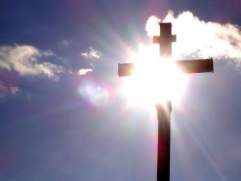
 If you were to ask me what day in the Christian calendar grabs my attention the most, I would have to say Good Friday. Something about that day lays hold of my heart and gets me thinking about the things of Christ, even more so than Easter. (I suspect that is largely due to my upbringing.)
When I enter the online Christian world, one reality hits me time and again: The top Christian blogs present solid cross-centered theology. In an age of Your Local Nondenominational Community Megachurch and its emphasis on showmanship and “what’s in it for me?” churchianity, that’s a good thing.
Yet at the risk of sounding heretical, I wonder if there’s a shortsighted lack associated with a focus on the cross alone.
Over at The Sola Panel, Gordon Cheng titles a post “Too Much Cross of Christ?” and calls on John Stott to help him with his answer, which is no. (HT: Challies)
That answer to the post title troubles me because it follows from a different question than the one Cheng actually addresses in his blog post, especially when he answers in light of a teaching and preaching emphasis. The question he is really asking is “Can the cross be too essential to the core of Christian theology?” That’s a solid no; obviously, much of our theology stems from an understanding of sin and the cross. The problem is that it is not the same question as Cheng asks in his blog post title.
We live in an age soft on sin. Despite this, many parts of the Church today are stuck on sin. Believers are constantly reminded that they are sinners in need of salvation. Reminding people of the necessity of the cross is a fine message, but is it the only one?
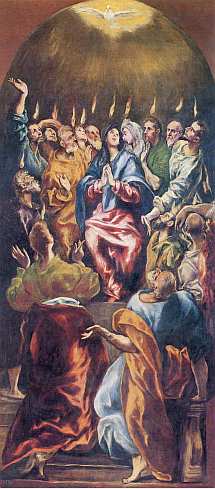
To me, some churches live as if it were always Good Friday and never Easter and Pentecost. As lamented by the inhabitants of Narnia, winter seems to have a perpetual grip on the land, unthawed by springtime and rebirth. Some preachers and teachers capably get people to the cross, but they can’t seem to get them to the empty tomb and to the assembling place where Holy Fire fell from heaven. In that light, the answer to whether we can have too much cross of Christ may very well be yes.
Without the resurrection, Paul writes that our faith is in vain and we are men most pitied (1 Cor. 15:1-22).
Without Pentecost, there is no Church and no empowering of the saints for service (see the entire book of Acts).
So it seems to me that while the Christian faith begins at Good Friday, it continues on and on in Pentecost.
Why then do our churches often fail so badly to venture beyond the cross? Why are so many of us still rooted in our identities as sinners and not in the new birth identity of saint?
Consider this passage:
Now if the ministry of death, carved in letters on stone, came with such glory that the Israelites could not gaze at Moses’ face because of its glory, which was being brought to an end, will not the ministry of the Spirit have even more glory? For if there was glory in the ministry of condemnation, the ministry of righteousness must far exceed it in glory. Indeed, in this case, what once had glory has come to have no glory at all, because of the glory that surpasses it. For if what was being brought to an end came with glory, much more will what is permanent have glory. Since we have such a hope, we are very bold, not like Moses, who would put a veil over his face so that the Israelites might not gaze at the outcome of what was being brought to an end. But their minds were hardened. For to this day, when they read the old covenant, that same veil remains unlifted, because only through Christ is it taken away. Yes, to this day whenever Moses is read a veil lies over their hearts. But when one turns to the Lord, the veil is removed. Now the Lord is the Spirit, and where the Spirit of the Lord is, there is freedom. And we all, with unveiled face, beholding the glory of the Lord, are being transformed into the same image from one degree of glory to another. For this comes from the Lord who is the Spirit.
—2 Corinthians 3:7-18
I am troubled by some denominations and Christian thought-groups that fail to teach believers that they are daily transitioning from sinners into saints. Such pew-dwellers repeatedly hear how they are mired in sin, but they never hear that as the redeemed they are being transformed from one degree of glory into another. In fact, in churches that never seem to venture beyond the cross, one must ask if they are even a New Testament church at all.
In some circles where the sinner mentality reigns, their pneumatology appears rooted more in the Old Testament than New. The radical reality of the New Testament is that the Holy Spirit of God comes to dwell inside the redeemed believer. Such was not the case with the Old Testament heroes of the faith. The Holy Spirit would fall on them for a time, but the permanent dwelling inside was reserved for the New Testament saint.
Some Christians have this tendency to continue to place God solely outside the believer. This is an Old Testament kind of thinking, though. It gives the individual believer no authority. All things supernatural that happen do so despite the believer, not because of the believer. It creates a worldview where the Church does not matter because God can do it all Himself.
There is no doubt that God can do it all Himself. The reality is that He chooses NOT to do it that way. Instead, He invest authority in believers by virtue of His own Spirit dwelling inside them. This is the exciting—and essential—truth of what it means to be in Christ!
The ramifications of this are astonishing: The lowliest New Testament saint is greater than the greatest Old Testament prophet (see Luke 7:27-28 and throughout the NT for corroboration).
When was the last time you got that sermon in church? How many Christian blogs discuss this reality at length?
If the answers to those questions trouble you, they should. This lack is largely due to the fact that we have an underdeveloped understanding of what it means to be Spirit-filled believers. And we have that lack because we are not preaching and teaching what exists beyond the cross: the resurrection, Pentecost, the transition of the sinner into sainthood, and the authority of the redeemed believer in Christ. Instead, we continue to push a theology that keeps the believer a meaningless, individual sinner and not a saint.
Consider this passage:
And God was doing extraordinary miracles by the hands of Paul, so that even handkerchiefs or aprons that had touched his skin were carried away to the sick, and their diseases left them and the evil spirits came out of them. Then some of the itinerant Jewish exorcists undertook to invoke the name of the Lord Jesus over those who had evil spirits, saying, “I adjure you by the Jesus whom Paul proclaims.” Seven sons of a Jewish high priest named Sceva were doing this. But the evil spirit answered them, “Jesus I know, and Paul I recognize, but who are you?”
—Acts 19:11-15
How is it that the demon recognized Paul? Because Paul had authority as a saint in the Kingdom of God. Consider the depth of what that means!
When that same Paul wrote to the young churches, he greeted them as fellow saints, not as fellow sinners. He talked about how they had all once been slaves to sin but were now translated into the Kingdom of God where they were now saints entrusted with the Spirit of God.
For the Church to truly rise to the calling of Christ, we need not only the cross but the resurrection and Pentecost. We need our preachers and teachers to tell the people in the seats that “sinner” is not their final identification. We need to learn what it means to have authority in Christ because He makes His home inside us. We need to know the full breadth of our birthright because of what the cross won for us, not just for the sin Christ took away from us.
We can have no pure Christian theology without the essential of the cross! But the cross is not the sole essential. Resurrection and empowerment by the Holy Spirit spring from the cross. And if we fail to teach and live what comes beyond the cross, we will fail to be the Church of Jesus Christ.
 You have on one side the intellectuals with their systematic theologies who could mount an apologetic that rolls like thunder but are tone deaf when it comes to listening to instructions from the Holy Spirit. On the other side are the charismatics who are always talking about the revelation they’re receiving by the Holy Spirit but who will search for hours if you ask them to locate the Book of Hezekiah in their Bibles.