We all know this passage from the OT:
It is the LORD who goes before you. He will be with you; he will not leave you or forsake you. Do not fear or be dismayed.
—Deuteronomy 31:8
The NT frames it this way:
And behold, I am with you always, to the end of the age.
—Matthew 28:20b
But not as many people know this passage, one that makes for a series of puzzling questions:
And Hezekiah himself stopped the upper water courses of Gihon, and brought it straight down to the west side of the city of David. And Hezekiah was blessed in all his works. But, in regard to the ambassadors of the rulers of Babylon who sent to him to ask about the wonder that was done in the land, God left him in order to try him, to know all that was in his heart. And the rest of the acts of Hezekiah, and his goodness, behold, they are written in the vision of Isaiah the prophet, the son of Amoz, and in the Book of the Kings of Judah and Israel.
—2 Chronicles 32:30-32
So, when this righteous king, one of the few bright lights to sit upon the throne, 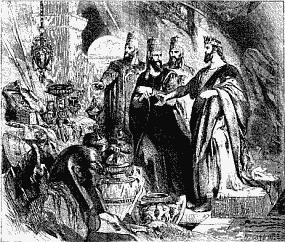 needed God’s wisdom to know how to deal with Babylonian envoys, God leaves Hezekiah in order to test him?
The Hebrew word for left is pretty strong: ‘ âzab. One of its connotations is to forsake.
Hezekiah was a pillar of virtue. Sin was not the reason God left him at that point.
The passage said that God did this to see what was in Hezekiah’s heart. Didn’t He already know?
If Hezekiah had responded in some odd way, would this have surprised God?
Why test a king who had consistently proven himself good?
This is Babylon Hezekiah’s dealing with, not some podunk nation. Wouldn’t God’s presence and help be essential?
If nothing good can come out of a man apart from God, what’s going on here?
And sure, the Holy Spirit always indwells believers, but did God do this personal test with one of His own just this one time in 2 Chronicles? Or does He do something akin to this “leave in order to test” with believers today?
Nearly all the commentaries I have note that 2 Kings 20:13-21 expands what happens, as Hezekiah shows the envoys everything in his kingdom. Some commentators say that this proves that Hezekiah loved earthly riches and did not value God as much as he should. Or that he did not point the envoys to God by explaining the miraculous retrogression of the sun (Isaiah 38:4-8) or his own deathbed recovery (earlier in Isaiah 38). Yet this is what the Bible says elsewhere about Hezekiah:
In the third year of Hoshea son of Elah, king of Israel, Hezekiah the son of Ahaz, king of Judah, began to reign. He was twenty-five years old when he began to reign, and he reigned twenty-nine years in Jerusalem. His mother’s name was Abi the daughter of Zechariah. And he did what was right in the eyes of the LORD, according to all that David his father had done. He removed the high places and broke the pillars and cut down the Asherah. And he broke in pieces the bronze serpent that Moses had made, for until those days the people of Israel had made offerings to it (it was called Nehushtan). He trusted in the LORD, the God of Israel, so that there was none like him among all the kings of Judah after him, nor among those who were before him. For he held fast to the LORD. He did not depart from following him, but kept the commandments that the LORD commanded Moses. And the LORD was with him; wherever he went out, he prospered. He rebelled against the king of Assyria and would not serve him. He struck down the Philistines as far as Gaza and its territory, from watchtower to fortified city.
—2 Kings 18:1-8
So this is a man who doesn’t really love God as he ought? And God left him?
For me, 2 Chronicles 32:31 is one of the oddest verses in the entire Bible. I just can’t make any sense of it. If you can, please clue me in!