
Q1: What is the chief end of man?
A1: Man’s chief end is to glorify God, and to enjoy Him for ever.
— Westminster Shorter Catechism (1674)
My small group met this last Friday and the theme that came out in prayer requests and other revelations was simple: folks are struggling under a load of things to do.  People are going to bed at 4 AM and getting up at 7 AM. Homeschoolers are scheduled to the max trying to pack requirements in every day. Life has become a clumsy dance of “do this, then do that” and our days have come to resemble little more than a succession of nags.
One mom wondered what would happen when her lone hour a day to herself went away come August. Too many of us know exactly how she feels.
In the last few weeks, I spent
- Eight hours on the phone trying to schedule a plane flight for three people
- Three hours trying to get information on my phone service (and still no response)
- Several hours trying to enroll my son in a state-approved homeschooling program (and I’m still not done)
- Cramming six errands spread across the city into two-and-a-half hours
- Mowing the grass to the tune of nine hours
- Switching my entire Web presence to a new host, new domains, and new software—untold hours
- Switching from Eudora (after twenty years of use!) to Thunderbird, and laboring through all the bureaucratic importation nonsense that went with that switch
- Attending six worship band practices
- Dealing with car maintenance issues
- Spending a couple hours wrangling on the phone with a service company that didn’t perform the service I asked of them
- And, sadly, finding very little time to glorify God and enjoy Him forever.
There are countless unmentioned experiences in that list, but suffice it to say, my candle’s had more than two wicks burning at the same time. While this may sound like whining, I suspect it’s a whine all too common in most people’s lives. The pace of life continues to speed up.
One commenter to Part 1 said the answer was in moving to the country. Well, I already did that and only found a new set of problems. The issue is not so much where we live, but how we live.
When I look at what consumed most of my time the last few weeks, much of it had to do with the following:
- Bureaucracy, usually made concrete by the endless filling-out of forms or jumping through hoops
- Technology, our new master
- Maintaining possessions, the things we own that ultimately control us
- Lack of personal community, wherein we must individually do what the community used to do for us collectively
Those four issues form a quadrilateral in no way like Wesley’s, yet they’re just as spiritually significant. Not only that, but they feed off each other. We have bureaucracy because we no longer live in communities of trust. Our lack of community leads us to self-sufficiency, the stepfather of technology. Our bureaucracy safeguards our possessions, of which an increasing number are technological. We ultimately replace people with items and then call our lives good.
Modern Man’s dilemma is not so much that we cannot make time for ourselves, but that the things we’ve created to make time for ourselves ultimately consume all our time and destroy relationships. Not only relationships with flesh-and-blood human beings, but with God Himself.
It’s difficult to imagine not having a car in the United States, but how hard do we have to work to buy and maintain that car? In my own case, it seems not a month goes by that I don’t have something to do related to vehicles: oil changes, tire rotations or replacements, licensing, insurance, various bits of maintenance, and working hard enough to afford the cost of $3 gas alone. With gas that high, every trip becomes a logistical nightmare. How many errands can I run in one sprint into the city? When? How? And what if something comes up that upsets that delicate balance? The dentist wants to reschedule? Ugh.
Cars are a simple one to question. There’s the bureaucracy of simply owning one, with all the titles, government regulations, and yearly paperwork. It’s technology, and it’s gotten so technological that no one can service his own anymore. I can’t get my 13-year old truck an oil change at many oil change centers because they don’t have the right wrench to remove the specific kind of plug that’s on my oil pan. Multiply that by several million cars and you’ve got a tech nightmare. And you thought computer operating system differences were a hassle!
Cars also mean insurance, because in our litigious society no insurance means no legal way to drive in most states. That’s an added—costly—hassle. And as I mentioned earlier, there’s expensive maintenance. And community? Well, there’s not much personal community in a car. Most of us don’t carpool, and it seems odd to even have a neighbor or friend in our cars. Our cars are meant to hold our nuclear families and that’s usually about it.
But unlike Europe, which developed in self-sufficient burghs, America is a vast, spread-out place that astonishes non-Americans. Almost every Japanese I’ve met in America is swift to comment on our interstates and the amount of time we spend on them. And we have to spend a lot of time on them because everything sprawls in this country. A few weeks ago I asked how many of you lived within fifty miles of extended family and I would say that 90% of you did not. So we depend on cars to get us there—if we want to see extended family, that is.
Multiply cars, phones, jets, computers, insurance policies, and the like. My eight hours on the phone trying to schedule a flight is the length of the flight there and back. Hmm. What gained then? And for a family reunion, too. Isn’t family supposed to be nearby? If 90% of us have none within fifty miles, then I guess not.
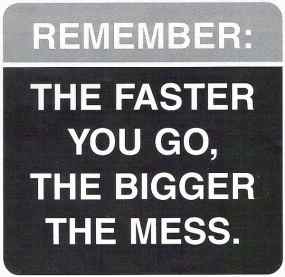
I’m getting snarky here and I apologize. Already this post has failed my usual test for quality. But still I must ask, What has all this bought us except hectic lives that go full throttle 24/7/365?
And what about God? Do we even have time for Him, much less to truly enjoy Him?
It bothers me that it’s the hardcore green liberals that are asking the question that Christians should be asking but aren’t: Is our daily existence dictated by evil, rather than by good? In our case, we understand that God is the good here, but the problem does not go away by defining good.
On this issue, I took Al Mohler to task over his non-answer when he usually has one. Perhaps that was unfair. To Mohler’s credit, he does quote Francis Schaeffer’s book title. Schaeffer asked, “How then shall we live?” in that eponymous book, and it’s a valid question.
I believe we are living in an evil construct. There is no good to be found in much of our activity. In past posts I’ve wondered aloud where the Christians are who are envisioning communities that eschew pharisaic bureaucracy, man-handling technology, devotion to things, and a lack of devotion to people. A few are cropping up, but not nearly enough to make a dent in the dialog in our churches. Mostly, those folks are seen as cranks or environmentalists or some other irritant not worth engaging. That’s too bad.
Not only are our lives being stolen by bureaucracy, technology, possession maintenance, and lack of community, but I genuinely believe that there are demonic components behind those four issues. We dismiss too easily and laugh at the notion, but could there not be a better way, a way that more fully expresses the life of God in the individual rather than the individual at the mercy of his surroundings? I believe that reality exists and is possible, but only if better people than me start working toward it.
In Song of Solomon, it says:
Catch the foxes for us, the little foxes that spoil the vineyards, for our vineyards are in blossom.
—Song of Solomon 2:15 ESV
Our vineyards today are overrun with little foxes, but we are not catching them. In fact, we take them for granted, have made our peace with them, and then no longer wonder why we aren’t fruitful. We take barrenness as the natural state of living.
If we desire to glorify God and enjoy Him forever, something has to give.
 Stations have ratcheted up the speed to fit leisurely classical music pieces into hectic schedules. Next thing you know, they’ll be time compressing the “Moonlight Sonata.” You can read his post
  This weekend proved to me again that we must scrutinize our walk with Christ.