In the past few days it appears the Spirit has wanted me to blog about the supernatural. I wrote about demons on Saturday, Pentecost and the Holy Spirit on Sunday, and on Monday the tendency of some Christians to believe that God no longer speaks to individuals.
 Monday’s post felt incomplete, so I feel compelled to expand it to discuss the fascination some Christians have with deflating everything supernatural, be it inside the Church or outside. And even though there are some naysayers who want to cast doubt on the very miracles that Jesus performed, I would offer that even for Christians who believe in the innerrancy of Scripture, especially those in the rarified air of nationally-known preachers and teachers, this is the least-believed verse in the Bible:
Truly, I say to you, whoever says to this mountain, ‘Be taken up and thrown into the sea,’ and does not doubt in his heart, but believes that what he says will come to pass, it will be done for him.
—Mark 11:23 ESV
From the lips of Jesus Himself and yet so many of us rush right over that verse and automatically filter it through our newfangled Western Scientific Rationalism Sunglasses, so we see it, but we don’t believe it. “Mountains cast into the sea just by believing? I know that’s what it says, but—”
Talk about big “buts!” I think for most of us who have been around for a while, Mark 11:23 merits a logical explanation that goes something like this: “You know, the Bible does contain hyperboles. Jesus was just being hyperbolic. He’s such a card! You ever see a flying mountain? C’mon!”
Now I’ll be accused of faulty exegesis by most of the people who read this blog, but I’m going for it anyway because I don’t believe the following verse has merely the traditional exegesis so often given it. I think Paul is saying something even more startling:
But understand this, that in the last days there will come times of difficulty. For people will be…lovers of pleasure rather than lovers of God, having the appearance of godliness, but denying its power. Avoid such people.
—2 Timothy 3:1-2a,5 ESV
Traditionally, the meaning of “denying its power” has solely been attributed to justification and sanctification, God’s powerful transformation of children of damnation into Children of God. I will not even begin to question that interpretation. However, I also believe that this passage is a cautionary bit of advice to Timothy by Paul concerning those people who would handcuff God’s supernatural power operating in the lives of believers. And those supernatural powers extend to raising the dead, speaking in tongues, healing, and all those other numinous manifestations of God’s power working through the lives of believers, and which operate within God’s justification and sanctification of those same believers.
I find it odd that many who would lessen God’s ability to do such things today love to equate preaching the Word with prophesying. And while I am perfectly comfortable with them believing that, I am mystified as to when preaching passed away when those other gifts supposedly ceased. Preaching/prophesying is listed as one of those supernatural gifts of the Spirit we find in 1 Corinthians 12, though I didn’t know that it or its well-loved compadre faith bit the dust with John’s last breath, yet some would have me believe that.
Although I suspect those same folks would argue they fully believe the least-believed verse in the Bible, they have a funny way of showing it by their tendency to use tangled arugments to mock anyone who might still believe that the Lord can raise the dead today just as He raised Lazarus. And while many are willing to suspend disbelief when it comes to the Earth being created in only six days, somehow a modern day Lazarus-like resurrection just ain’t possible.
I’m really getting fed up with anti-supernaturalists who want to have compartmentalized “miracles” on their own terms and not God’s. If God wants to blow through Bob Jones University and blast everyone there with the gift of tongues, well, stranger things have happened—and God was in control of those stranger things, too.
J.B. Phillips wrote a book with one of the greatest titles ever: Your God Is Too Small. I can’t help but believe that a deity who no longer speaks to people in his own voice, who can do no more miracles, who was once mighty but is now routinely outdone by Satan’s counterfeit parlor tricks is just that small. And perhaps our problem is that we so easily put qualifiers on a verse like Mark 11:23 that we’ve created for ourselves a convenient god that is pleasurable in his smallness, convenient enough so that he does not ruffle our little kingdoms more than he ought, and while a tad bit idolatrous, looks enough like the big “G” God of the Bible that few people will notice his impotence.
That is not the God of Abraham, Isaac, and Jacob. If we really wanted to know why the Church has become a joke to most people I think its largely because too many self-professed Christians believe in a handcuffed God who closely resembles the god of Deism, a god who stepped back and never again brought his superatural touch to mere mortals. This is a god easily encapsulated and who bears a too comfortable resemblance to you and to me. Who wants a god that pathetic?
I don’t know about you, but I want a big “G” in my God.

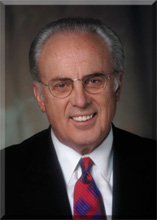
 One of the phenomena I’ve encountered in the portion of the blogosphere I regularly visit is an absolute mania for all things John MacArthur. In my post about Jack Hayford, I noticed that I, too, uttered the name that crops up everywhere I turn.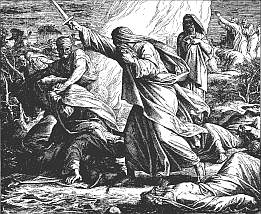
 Here are