
What Past?

Standard

I play drums on the worship team at my church. It's no stretch to say that you'd be hard pressed to find drums in a church sanctuary before 1970, but that's a whole 'nother post.

Having been involved in church music for years, I know a bit about the mindset of worship musicians. Universally, these folks honestly love using their musical talents for the Lord and for the edification of others. And while you do encounter a few moody introverts, my experience is that folks on worship teams are some of the most honest and open people you'll find in a church.

So it's always been odd for me to hear their reactions when I bring up the issue of playing some old hymns now and then and not the same praise and worship-style music we're trapped in. The response 99% of the time: "Yeah, wouldn't that be great? I sure miss singing those old hymns."

And yet we never get around to playing them. It's like those hymns are from a distant past so dusty that to even trot one out would cloud the gleaming modern edifice we call "The 21st Century Church."

Now some of you are saying that this is not your church. Yours sings those hymns with gusto. Fine. But somewhere in your church a paradigm shift occurred that relegated anything from the Christianity that existed before 1860 to the dark recesses of history, regardless of whether you know who Isaac Watts is or not.No Augustines I've yet to encounter an Evangelical church that doesn't seem to live solely in the moment.
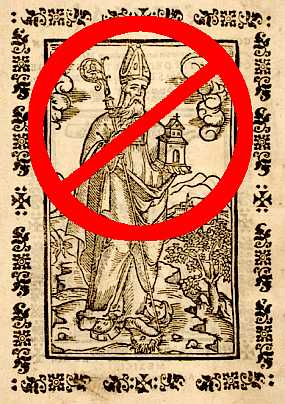
Too many churches today act as if the Church sprang into existence after the Civil War. Eighteen and a half centuries flew by and with the exception of a couple of crusty old Europeans with names like Luther, Calvin, and Knox, Christianity didn't actually exist. Heck, history didn't actually exist, right?

One of the most tortured experiences I ever had in a Third Wave church was when the pastor of the one I was attending was given a portion of the text of Isaiah that was unearthed in the Middle East. It was more than a thousand years old. The group presenting it was tickled pink about their gift, but despite the fact that nearly three thousand people sat packed in the church, I would suggest that maybe ten folks in the seats weren't intellectually yawning. "So what?" would be the collective mantra.

I'd like to know when the American Church put a gun to the head of the Ancient Church and pulled the trigger. What happened that we got so arrogant and self-centered that we looked back on all those Christians who came before us, folks who often went to the flames for their faith, and said, "I'll take a pass, thank you," without considering the ramifications of that stance?

The simple truth about every pitched doctrinal battle now erupting in numerous denominations of Evangelical and Mainline Christianity is that the furor would cease to even be a whimper if we gave credence to what Christians a thousand years ago were saying. The Emerging Church, Open Theism, you name it, someone dealt with it a long, long time ago. But post-Enlightenment, it seems that our minds are stuck on our perceived superiority to what those Dark Ages savages thought.

I'd like to make an exceedingly controversial statement. It's not proffered in most genteel circles because some people would consider it borderline racist or sexist. At the risk of losing readers, I'm going to say it anyway. Just hear me out and think past the rhetoric.

I believe that one of the reasons that many American Christians today have rejected pre-Civil War Christianity as having anything useful to say to us today is because of slavery. The belief here is that if we got the slavery issue wrong back in those days, what else did we get wrong? If there were Christians in those days that thought it was okay to own slaves, then obviously folks back then weren't as smart as we are.

The same goes for how some might perceive women as being treated before that war. Afterwards, we got women's suffrage, their leadership in the temperance movements, and women moving into the workplace. But before that there was only ignorance.

Those two issues (and some others, like the Crusades), I believe led today's Christians down a dark path of swearing fealty to anti-traditionalism. Trying to rationalize older Christian positions on topics that make us queasy have led us to abandon en masse any previous age that did look like our more "enlightened" one.

No one is advocating a return of slavery! But our collective guilt about those less enlightened days must not force us to abandon everything associated with them, particularly the solid theology espoused by spirit-filled men and women of God who lived prior to women's suffrage and the Emancipation Proclamation. Many of those older theologians advocated for greater roles for women in society and the church or were staunchly anti-slavery—but we're just not willing to read them, so they cease to exist.

We cannot live believing that we who comprise the Church in America are the pinnacle of Christian thought. Millions have gone before us blessed of God and we are fools to think that we have nothing to learn from them. Their faith then means something for our faith today. It should come as no shock then that the fact we are adrift in so many parts of of the American Church is that we've grown to despise the very history that has made us who we are.

{Image: Woodcut of Augustine of Hippo, artist unknown}
The Myths of Homeschooling #4 (Conclusion)

Standard

In concluding this series (which previously was found in three parts: 1, 2, and 3), I’d like to reference a reply I made in the comments section of my last post to explain my rationale for taking on these myths:

[H]omeschool is used like a set of brass knuckles to the jaws of some parents. They are being crushed by guilt for not homeschooling or are likened to sinners or profligate parents for not homeschooling. Those accusers and accused know who they are, and I hope they’re reading this and seeing that homeschool is not the be all and end all of life. I also want those parents who homeschool their kids to know how to work the land or to raise animals that they are not freaks for doing so.

I meet victims of homeschoolers’ ire and they are indeed hurting. Many are Christians and yet their own churches label them negatively because they don’t homeschool or they think some things are more important than understanding Plato’s dancing shadows.

I see the moms with seven kids who are homeschooling them all. They get all the accolades. Good for them. But what about the mom who can’t homeschool because her ailing parents consume her time? To have people berate her for that disgusts me! And I’ve seen that happen.

Homeschooling is used increasingly as a ruler to measure people and judge their fitness as parents. If you don’t see that, then count yourself lucky that you live in a place where people don’t do that. I don’t live in that place. Despite living all over the Midwest and California, I’ve never lived in a place where homeschooling wasn’t used to judge people.

All I want is to tone down the rhetoric; it’s hurting people. It’s also forcing people into homeschooling who are not equipped or are overburdened already. If keeping up with the homeschooling Joneses is what it is coming down to, then we need to offer people more grace to pursue other options without feeling like the spawn of hell.

That’s all that this series is about. I hope the people who need to hear this are getting the message.

I’ve had a lot of arguments tossed at me during this series. Several comments, weblinks, and e-mails have said that what I’ve witnessed in my 18 years of watching the homeschooling movement simply isn’t true. At homeschoolOthers have said that they’ve never seen some of the behaviors I’ve talked about.

My challenge to those folks is to look around, step out of the hype for a few seconds, and examine the messages and behaviors espoused in the homeschooling movement. Some scary thoughts and practices exist in homeschooling circles, and we choose to ignore them at our own peril—and to the peril of the accused I referenced in my quoted comment above.

Consider that some women no longer introduce themselves as “a mom of four kids” but as “a homeschooling mom of four kids,” as if the homeschooling tag must be added to ratchet up the standard of successful parenthood one more notch. That’s nothing but competitive pride. Notice, too, what happens when a group of homeschooling parents encounters parents who do not homeschool. Watch the social dynamic. Look at people’s faces. Watch the reactions when the topic of homeschooling arises. The societal pressure is obvious, especially in Christians.

The myths I’ve featured in this series are used to beat down people in a new kind of social class ranking. That stratification extends even to homeschoolers, as various teaching methodologies gain or lose traction. With the rise of classical education within homeschooling ranks, other methods have been relegated to lower positions as if there’s a right and wrong way to present knowledge.

Some of this is a reaction against educational methodologies originally made popular in the public schools. With all things related to public school under massive scrutiny by homeschooling advocates, anything that smacks of public school is subject to scorn. John Holt’s educational ideas that form the backbone of the “unschooling” movement were highly popular in public schools in the late ’60s and early ’70s, and some homeschooling parents consider them suspect. Other homeschooling parents who were not exposed to Holt as practiced in public school are more willing to use his ideas. This, of course, will bring conflict to a massing of homeschooling groups where one methodology is preferred to another. Stick classicists with unschoolers and let them have at it—the results are sadly amusing.

In conclusion, a few points.

Homeschooling is not for everyone. We need to be more accepting of families that choose not to homeschool. In almost all cases, they are not helmed by bad parents. In fact, those parents may be doing their children a favor by acknowledging their own weaknesses in teaching. One of the backbone beliefs of the homeschooling movement is that parents know their own kids best. Why then do some homeschool advocates lambaste parents who believe their children would thrive in a non-homeschooled environment? I have great respect for parents who acknowledge their own insufficiencies to meet their child’s educational needs. Most parents WILL struggle with teaching once a child gets beyond a seventh grade education. We resist thinking the world has changed, but a vast sea of knowledge has been added or has trickled down to lower grade levels since we were in school. Do we persist in homeschooling beyond a certain level for the right reasons? Or do we capitulate to peer pressure and pride?

No one educational method reigns. Frankly, I believe that parents homeschooling to a lone methodology (e.g., classical, unschooling, behavioral, etc.) rob their kids of a broad-based education. That goes for private and public schools, too. There is no magic bullet. Teaching kids to think for themselves is fine, but that’s not what the corporate world wants, quite honestly. Which world do we teach to then? How we accommodate what is valued in our society today matters. Creating a superkid who can’t make his learning conform to societal demands is asking for another Todd Marinovich-type burnout. Tunnel vision is dangerous, and too many homeschoolers have so focused their teaching that I wonder how their kids will cope when their entire education proves to be the square peg in society’s round hole.

Don’t despise the basics. In our rush to turn our kids into quantum physicists who will unite both the particle and wave models of the universe, we may well be creating children who can’t feed themselves. With globalization opening up American workers to foreign competition, our children will not be able to compete on an equal playing field if money is the bottom line. It would be wise of us to acknowledge this truth and prepare our children for a markedly different work future than the one we faced at the same age. Engineers in the U.S. are finding that they can’t convince their kids to go into engineering, and this is a shock to them; perhaps the kids are smarter than they are given credit, considering that many of them would rather work for less pay than face the perpetual layoff cycle they saw their parents endure. In light of this, I firmly believe that instructing our children in a locally-needed trade may be the best work prep we can offer them. If we subsequently add  an understanding of the land, animal husbandry, and small farm techniques, we can ensure them a better future than the one already upon us. Remember, THAT was a biblical education in the days of Jesus. While it is true that we need the educational superstars to continue to build the next-generation medical devices and such, increasingly those superstars are not going to be Americans. Honestly, skyrocketing tuition costs may put college out of reach of the middle class, so other job and education options must be explored. We need to prepare our kids differently for a different future.

God is a God of grace. If we firmly believe He is in control, then we will entrust the care of the children He’s given us—children that are not ours but His—to Him and Him alone. How that plays out in your children’s educations is something God alone can deliver. And that may NOT include homeschooling. We should not limit God on how He can work in our children’s educations. Nor should we enforce our will on other parents. God deals with all of us in different ways. We should not judge people by their schooling choices, especially if we are not vehicles of grace to accept their decision or help them move into a homeschooling model if the toughness of living is making it hard for them to do so. We’ve made homeschooling a millstone around the necks of parents and children alike, and the Lord is not in the millstone necklace business.

Education is not the path to salvation. Ironically, it is the very secular humanists that Christians vigorously oppose who truly believe that premise. However, as much as Christians say that is not them, George Barna recently showed otherwise. In one of  Barna’s published surveys showed Evangelical parents were more concerned that their kids got into an elite college than that their kids followed Christ. That’s a devilishly misplaced priority! Homeschooling, like anything else, can become an idol. God would much prefer a non-scholar with a heart that burns for Him than a Nobel-winning scientist who claims He does not exist. That’s where our focus should be, raising kids for Christ, no matter where they go to school.

Thanks for reading through this series. I hope the gang now preparing the tar and feathers will graciously reconsider.

***

This four-part series:

The Myths of Homeschooling #1

The Myths of Homeschooling #2

The Myths of Homeschooling #3

The Myths of Homeschooling #4

The Myths of Homeschooling #3

Standard

At homeschoolIf you haven’t caught the first two parts of this series (1 and 2), please read them first or you will have missed the rationale for the series and previous myths.

Myth #6: It is “more Christian” to homeschool

Christianity as a cultural norm has taken a few steps backward in this country in the last 30 years, so it’s probably not true that ANYTHING is “more Christian” today than yesterday. I was born in the early ’60s and have never met a peer who was homeschooled, so this forces the question: Were there no Christian parents before homeschooling took off in the late 1980s?

Many homeschooling pundits today claim you can’t be a good Christian and not homeschool your children. What a huge slap in the face to their parents! With almost no adults over 40 today taught through homeschooling, most American parents of my own parents’ generation were profligate in their children’s educations—if you believe the pundits. If we are starting to define a Christian home by homeschooling, then our parents were sinned by allowing us to go to public school. And then there’s the Protestant parents who sent their kids to private Catholic schools…

How foolish a myth, yet how often we hear it tossed out like a live grenade by well-meaning ministries that never think through their propaganda!

Schooling options exist beyond homeschooling and none of them violate the essence of our faith. Too many people forget that Christians started the public school system, and those pioneers had no problem violating the supposed sanctity of school at home. Nor were those schools simply for the unbelievers or for slack parents. Good Christian parents sent their kids to public school.

I understand that today’s public schools are a mess thanks to entrenched teachers unions and liberals who think along the lines of humanists like John Dewey. Still, many options for schooling exist: charter schools, private schools, parochial schools and more. Homeschooling is a choice, not a mandate.

God has not placed His sole imprimatur on homeschooling. In fact, I say with no hesitation that God is less concerned with schooling methodologies and school types han He is that our kids serve Him and love Him with all their hearts, souls, and minds.

Myth #7: Homeschooling protects our children

Our children are not ours; they are God’s. When we become Christians, we forfeit our rights to everything we own. We do not even own ourselves; therefore, we cannot “own” our children.

Would God have us build bunkers? Or is our light intended to shine in the midst of darkness? How long can we shelter our children before they must go out into a dark world and live as salt and light?

We miss chances to strengthen our children to stand up in the midst of a fallen world if we perpetually shelter them from the reality of wickedness this side of heaven. Better for us to teach them in the middle of the fray than to send them out untested with the hope that we covered every chink in their armor.

I’m not convinced a bunker mentality works. That line of thinking is based in fear and not love, in worry and not faith. Good parents will work with their kids to combat bad messages. If we want to train our children to think, what better way than to have them experience lies firsthand? My son and I sometimes turn on TV to watch the commercials so I can work with him to unpack the real messages in the ads. He can now tell me what is being sold, why, and how it is being packaged. If we had no TV in the house, would he be that wise? Hardly. But by exposing him to the world in supervised amounts, I know that he is using knowledge and God’s truth to make wise decisions.

My own personal experience is that the truly sheltered, once out from underneath mom and dad’s shadow, typically throw off the shackles. When I was at Wheaton College, I could tell you which kids were under their parents’ constant scrutiny. Once the all-seeing eyes were gone, the result became painfully clear, or to quote the rock band Kiss, “Junior’s gone wild.”

Myth #8: Homeschooled children are smarter than their peers

I searched forever online but could not find  the Ohio Department of Education survey that showed homeschooled kids scored equal to or lower than their public and private schooled peers in the state’s mandatory educational tests. Still, I remember reading that report and the statistics that backed up the conclusions and was startled—I expected the homeschoolers to be on par or higher, not on par and lower. With as many kids being homeschooled today—and the constant hype from homeschooling organizations—you’d think that test scores would be rising astronomically, but they truly aren’t.

Yes, the National Spelling Bee champion and the National Geographic geography savant are likely to be homeschoolers, but we seldom hear about the many homeschooled kids who are barely above Jell-O in intelligence. I meet kids like that, so they do exist. As much as homeschool proponents love to shine the spotlight on the 16-year-old med student who was homeschooled, they’re tightlipped on the ones who never make it to college or who tanked the SAT or ACT.

I searched online for any Nobel Prize-winning scientists who were homeschooled and couldn’t find a one. And though I did find one page that had interviews with Nobel winners who claimed to hate school, they obviously derived enough out of it to eventually win that coveted prize!

Those are the myths for today. There will be one last concluding post in this look at homeschooling, so stayed tuned.

Until then, I’m breaking into my own series since there have been many questions asked and various comments made about my ability to discuss the topic of homeschooling at all. That was to be expected since any deconstruction of homeschooling is bound to rile at least a few people.

I mentioned some of my qualification in the first post, but I’ll go over this in more detail here:

  • I graduated summa cum laude from Wheaton College in 1992 with a degree in Christian Education. That degree’s requirements included significant analysis of curricula of all kinds. Much of the curricula I examined was homeschool-related. In addition, I studied all the educational theorists and teaching styles, so I’m well versed in both current and historic educational methods.
  • I’ve written countless curricula myself in a variety of Christian and secular environments. I have more than a thousand hours of personal teaching experience.
  • Before Wheaton, I taught outdoor education at several Christian camps in Ohio and Wisconsin, encountering numerous homeschoolers. This was my first exposure to homeschoolers and my fascination with the burgeoning movement led to further personal study of trends within it.
  • I’ve continued to follow all aspects of homeschooling, talked with hundreds of homeschooling parents from all over the teaching methodology spectrum, tracked the most important Internet sites related to homeschooling, read the hottest books in homeschooling circles, and generally have known what’s what in homeschooling since 1987.

In short, I’m well qualified to discuss the topic. I’ve no problem if anyone wants to disagree with my conclusions, but impugning my experience isn’t worthwhile.

Someone said that I was fronting for Wendell Berry by advocating “The New Agrianism.” Well, I might very well be advocating agrarianism! Honestly, how well educated is a person who cannot feed herself or build himself a house? That used to be basic knowledge, but we’ve eschewed knowing how to cover the basics of food, clothing, or shelter for such relatively unusable pursuits as calculus, Latin, or Asian history. I’d just like to know why.

I also want to comment on an interesting outcome of this series. I’ve had both male and female commenters and it’s intriguing to me that men seem to agree with my analysis of the current state of homeschooling more than the women do. Can’t say exactly why that is, but I find it curious.

The conclusion follows: The Myths of Homeschooling #4.

***

This four-part series:

The Myths of Homeschooling #1

The Myths of Homeschooling #2

The Myths of Homeschooling #3

The Myths of Homeschooling #4