

Creation in the Heart of the Christian

Standard

View from Mt. Lassen, Callifornia

When I was a child, my favorite hymn was, by far, “This Is My Father’s World.” There was something inherently organic, yet otherworldly, in the simple words that begin this hymn:

This is my Father’s world,
and to my listening ears
all nature sings, and round me rings
the music of the spheres.
This is my Father’s world:
I rest me in the thought
of rocks and trees, of skies and seas;
His hand the wonders wrought.

This is my Father’s world,
the birds their carols raise,
the morning light, the lily white,
declare their maker’s praise.
This is my Father’s world:
He shines in all that’s fair;
in the rustling grass I hear Him pass;
He speaks to me everywhere.

The planets (the “spheres” as so elegantly put in the hymn) sing the praises of God. Contrary to the small-minded who believe God stopped speaking the second the canon of Scripture was closed, God continues to speak to us through His creation. The beauty of an unfolding lily attests to the artistry of God and His profound love for us that we may delight in what He delights in.

I know that God takes pleasure in what His words have wrought. I also know that I take pleasure in those things. So far this April it has averaged about 70 degrees and sunny here in SW Ohio. I cannot remember an April so auspicious in its loveliness. This kind of weather lifts everyone’s spirit.

Yesterday was the first cutting of the grass. Our property is a bit over thirteen acres, with much of it grass at this point. But as I sit up on my tractor and mow, I cannot help but feel something warm within me. The senses God gave me collect a host of data that all point to one thing: God can speak to us through the land.

I’ve blogged on this before, but I want to reiterate the thought. I believe that one of the reasons that many Christians feel impoverished in their souls is because they lack any connection to the land. Too many of us get all our food from the grocery store and never eat what we could grow ourselves if we had a tie to the land. This divorces us from God’s creation, a state I believe He never intended us to dwell in. Being able to till the soil and grow our own food puts more of our reliance back on the Creator and less on nameless and faceless multinational food production companies.

I believe God is calling Christians to get back to the land, to be better stewards of God’s world than we have been, and to outdo the pantheistic leftists (who seem to inhabit all the environmental groups out there) in our ability to care for Creation. We need to be less reliant on food distribution systems and more reliant on the Lord. I believe that Christians who are considering purchasing a new home buy one with a smaller house, but more property on which to grow food.

This year we are putting in a permaculture fruit orchard with apples, cherries, and Asian pears, plus all the supporting flora (to cut down on our use of harsh chemicals.) We want to be as organic as possible. Since my wife and I both enjoy a nice glass of wine with meals from time to time, we plan on putting in a vineyard after that—we have great soil for it. We live in the viticultural area that in the 1800s was the equivalent to what Napa is today, so we know it can be done.

And there is a blessing that comes from this that I think too many of us are missing. When we become detached from the land, we lose our ability to appreciate the bounty of God’s provision, taking for granted everything we consume. And while the Fall made growing our own food more difficult, the original call of God to be fruitful and to subdue the land has not been rescinded.

Every time I stroll through this property, I thank the Lord. I watched red-bellied woodpeckers cavort on a dying tree yesterday. The meadowlarks stroll in packs through the grass, disturbing the bugs they eat. Bats tear through the sky in random patterns, flying over the blooming pear trees, and the roses with their fresh green leaves. Warblers begin their re-acclimation to southern Ohio, their babbling songs ringing through the budding walnut, sycamore, and locust. Tadpoles swim the creek, while adult frogs croak their mating calls from the pond.

It all speaks to the majesty of God and too many people are missing it, casually ignoring Creation as they fly from one activity to another, dead to the voice of God speaking in the mulberry trees, the bluebirds, or the cirrus clouds wafting by overhead.

This year, rediscover the voice of God in Creation. Find a way to grow your food. Seek out the quiet places in the woods where God can charm you with His verdant lullabies.

In the words of another hymn:

For the beauty of the earth,
For the glory of the skies;
For the love which from our birth,
Over and around us lies;
Lord of all, to Thee we raise
This, our hymn of grateful praise.
Commune-ity Values (or Redefining “Church” Yet Again….)

Standard

Oy vey!

That’s all I can say after reading The House Church Blog’s post on what the Bible really says about house churches.

As someone who has even considered whether a house church was the “church of last resort” for a couple of square pegs like my wife and I, this semi-new definition of what constitutes a house church should have even Robert Fitts throwing a few of his namesake (minus a “t”—of course.)

A distressing—for all those house church proponents, at least—excerpt:

The implications of Gehring’s insights about the importance of oikos [Greek for “household”—Ed.] are huge! For one thing, it means that moving church from a special church building into a home does not go nearly far enough. The churches established by Jesus and his disciples were not mere weekly meetings. They were literally households—ongoing, 24/7, family-like communities.

Consider 1Cor. 16:19 – “Aquila and Prisca greet you heartily in the Lord, with the church that is in their house (oikos)”. If we read this from our 21st Century Western context, we would (unconsciously?) conclude that once a week a group of Christians met in this couple’s home for church. However, if we read this verse from the 1st Century context, we would conclude something quite different.

To say that we have a “house church” because we meet in someone’s home at 7 pm on Tuesday nights, falls significantly short of the New Testament concept of “house church”.

Yikes! Are we back to the redeemed hippie communes of the 1970’s Jesus People era? Well, from this assessment, it seems we are.

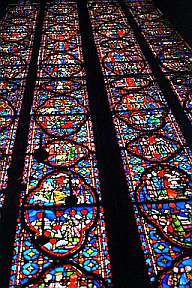
St. Chapelle Stained Glass by Dan EdelenThe perpetually moving target that is the method of some to capture the exact mode of meeting of the first century Church is bothersome. Methodology is great and I applaud those who are going for as pure a methodology as can be understood, but at some point we just need to get on with doing what the Lord commanded: making disciples. If every couple years we rip down the idea of what constitutes a “true” church meeting, then we are only forcing our churches through ever-finer strainers. Who or what comes out of that in one piece is debatable.

Perhaps we are asking too much of people. In the midst of a resurgence in house churches, this is an acid test that few can withstand, I suspect. “Now we have to live in the same house with these people!” is asking too much too early on in this nascent movement.

My wife and I have wondered if the best model is to get a group of six or seven committed Christian families to purchase about fifty acres of land near a smaller town and build a home for each family on that land, along with a larger building that can provide a centralized meeting place. One or two of the families can work the remaining land as a source of food and revenue for the community, not to mention a source for feeding the poor. A portion of the income of each family would be pooled and used to support the community, especially during times of duress (such as medical expenses or job losses), and for basic outreach benevolences. Childcare and homeschooling would also be provided in this model, with every family chipping in. Group meals could also be planned, as well as allowances made for private dinners devoted to the needs of each individual family. The items that many families duplicate (yard care, basic tools, even vehicles) could be pooled in order to save money, while time can be saved not having to work and shop for duplicated items, freeing folks up to spend more time in devotion to the Lord.

Despite this idea of ours, I’m not completely ready to give up on the current model we have used for so long. It may not be perfect, but that imperfection may lie more in our inability to stay true to the Gospel message than in our lack of replicating the Book of Acts’ style of church meeting to a “T.” There is much to be said for the synergy a church of two hundred or more can bring to a locality when all two hundred souls are on the same page spiritually, right with God and with each other. You just can’t get that with any other style of church meeting.

That’s what I am hoping for now in the church we just joined, at least. Should we grow that into something more “organic,” then great. But for now, I’m not going to get flustered by yet another (somewhat) new direction in ecclesiology. You shouldn’t, either.

“Judgmental Christians” and The Way of Christ for 2005

Standard

I have been thinking quite a bit the last week about why we Christians are being progressively labeled “judgmental.” It is a word that seems to erupt out of the very fabric of society, smothering the voice of Christians in the public square, and offering a sanctuary for those who openly oppose, do not understand, or simply do not care to comprehend Christianity.

This is not a political blog, nor do I like mixing politics and the Christian faith. Too many Christian blogs and Web sites inextricably link the two and I wish to avoid that. Still, since politics is so critical a means of expression for many of those who do not side with Christian thought, it is a necessity to speak about this issue with some level of politics involved.

We live in an age when people are defined by what they are for or against. Nihilistic postmodernism has created an odd human, though, who seems to be more “against” than “for.” This last year drove that point home. Many politically-charged people argued vehemently against some person or issue, but when pressed were unable to articulate what they were actually for, or how to make the reverse of the thing they were against a reality. When the political season had run its course, we saw in those same people a new psychosis labeled “Post-election Stress & Trauma Syndrome” or (amusingly—no matter which side you are on) “PESTS.” This syndrome manifested in those who were largely against many things, but once they had wound up on the losing side of politics were unable to cope with the fact that their “against-ness,” once broken, left them nothing to be for. Their subsequent bout with PESTS being the natural outcome of having no positive ideas apart from their negative ones, they lived solely out of their anger toward what they are against.

When Christians spoke into the public square this year, the “judgmental” label was tossed around with abandon. I cannot ever remember hearing the word “judgmental” attached to Christians more than I did this year. Being a presidential election year surely made some of that true, but I think another force is at work here. It is the force of postmodern nihilism, the very heart of PESTS, and the core of what is left in people who dwell solely on the negative.

2004 will be remembered as the year in which postmodernism reached full flower. With its blooming comes a time when what we are for and against can no longer be assigned values (at least in the minds of proponents of postmodernism.) Relativism, so inherent in postmodern thought, has resulted in this resurgence of nihilism. That bleak outlook on life informed much of the discussion in politics this year. What the new Nietzsches accomplished in 2004’s discourse was to successfully stigmatize anyone who was actually for something, rather than being merely against something.

As a people who are defined by what (and who, especially) we are for, Christians drew the most attacks. Unable to understand that a worldview exists that does not merely state what it is against, postmodern voices in the public square operating solely out of a negative worldview successfully used the “judgmental” tag to label all opponents to their cause, opponents who actually stood for an issue. Nine times out of ten the ones labeled were Christians.

We should recognize this twisting. It is the same force that brands love “hate” and calls truth a “lie.” While this affords us Christians the proof we need that the world is hellbent on our destruction, we should not wear this with pride, but humility. We should not counter this opposition with noses in the air, but should instead become more humble in our recognition that the light of Christ only shows the darkness to be what it is. And we know how Mankind loves darkness.

In 2005 I believe we will see this labeling by those on the other side of Christ intensify. While we recognize the spiritual battle, our response should always be one of Christ the Servant. Our enemies are conquered by the burning coals they heap on themselves when we serve them out of true love. Our reminder for this year is to seek first the way of love while holding true to what is good, noble, and pure. No concession is needed to be what Christ has called us to be, but neither should we forget that the servant heart is what overcomes the world. For this coming year let us remember to always seek the way of servant love so that our enemies have nothing they can hold against us. We may never depart the judgmental label, but our enemies will look all the more foolish for using it.

Blessings for 2005.