
The Plagiarism Trap

Standard

One day, as Jesus was teaching the people in the temple and preaching the gospel, the chief priests and the scribes with the elders came up and said to him, “Tell us by what authority you do these things, or who it is that gave you this authority.” He answered them, “I also will ask you a question. Now tell me, Was the baptism of John from heaven or from man?” And they discussed it with one another, saying, “If we say, ‘From heaven,’ he will say, ‘Why did you not believe him?’ But if we say, ‘From man,’ all the people will stone us to death, for they are convinced that John was a prophet.” So they answered that they did not know where it came from. And Jesus said to them, “Neither will I tell you by what authority I do these things.”
—Luke 20:1-8 ESV

Last week, The Wall Street Journal—my personal newspaper of record—ran a front page article discussing the issue of plagiarizing sermons (“That Sermon You Heard on Sunday May Be From the Web“). Some churches and pastors think nothing of using a message already delivered, while others grow livid at the very idea. I’ve followed the issue across several blogs (Challies.com had the most extensive discussion), but it appears to me, now that the dust has settled, that the discussion danced around core issues no one confronted.

Ultimately, the issue of plagiarizing sermons sets multiple traps.

Consider the Luke passage above. Jesus sets up a fork for the Jewish leaders, forcing them down two roads, neither of which they wish to commit to.

To discuss plagiarizing sermons, we must begin with the ultimate source of a sermon message: Does our preaching ultimately have its source in men or in God? 

The Bible makes it crystal clear that our preaching comes from God:

And I, when I came to you, brothers, did not come proclaiming to you the testimony of God with lofty speech or wisdom. For I decided to know nothing among you except Jesus Christ and him crucified. And I was with you in weakness and in fear and much trembling, and my speech and my message were not in plausible words of wisdom, but in demonstration of the Spirit and of power, that your faith might not rest in the wisdom of men but in the power of God.

Now we have received not the spirit of the world, but the Spirit who is from God, that we might understand the things freely given us by God. And we impart this in words not taught by human wisdom but taught by the Spirit, interpreting spiritual truths to those who are spiritual. The natural person does not accept the things of the Spirit of God, for they are folly to him, and he is not able to understand them because they are spiritually discerned. The spiritual person judges all things, but is himself to be judged by no one. “For who has understood the mind of the Lord so as to instruct him?” But we have the mind of Christ.
—1 Corinthians 2:1-5, 12-16 ESV

Plagiarism argues the source of the words is wronged by their taking and should seek redress. It also states the plagiarizer deceitfully passes off the words he speaks as his own.

But if anyone reading now can make a case that anything you or I own has its final source not in God, but humankind, I’d love to hear that argument!

This brings us to the other fork. If we don’t fully believe that God is the one who owns the words that come out of a preacher’s mouth, then those words are merely words of clever men. If that’s the case, then God have mercy on us because we’ve removed Christ from our preaching. Evangelist Billy SundayThe Jewish leaders fell into this problem with the source of John’s baptism, and we merely repeat it.

The converse of this is that an avowed atheist could stand up in a church pulpit and read from the Bible with an actor’s passion, yet would anyone define that as pastoral preaching of the word, especially by the standard some insisting upon in their attacks on sermon plagiarism?

When we discuss this issue, this is the major dilemma we face. We can get all riled up about preaching the word, but then we shoot ourselves by insisting that somehow we’re the true source of that word.

But we aren’t.

Here’s what truly makes me shake my head: The people arguing most fiercely for punishing plagiarism are the same folks who uphold a high view of preaching. Yet by their very arguments, if they make a claim on a message, they strip out God and ascribe it to men. If they insist they’re not doing that, then they agree that God is still speaking.

God is still speaking? Wow, that sounds a lot like what those nutty charismatics believe! Yet you’d be hardpressed to get many of the folks who would argue that sermons aren’t messages that originate solely with men to buy that logical outcome.

If the primary issue here comes down to whether or not the Gospel is preached, does it matter if the person delivering the message was the first person to deliver it? If we humans can’t improve on the Scriptures already delivered to us, then what is being added to an exposition of those Scriptures that makes it rooted to one church on one Sunday, delivered by one human being?

Many argue against re-using a message, but that’s illogical if the message is inspired by God. Did the sermon get preached once and then no longer apply anywhere? Does God’s message return void after it’s been spoken once? It seems the same people who are arguing for stringing up plagiarizers hold a pretty low view of the Gospel, if they believe it only has a specific rendering to one set of people at one time and one place.

What’s worse is the logic that traps them—again. If the message were that specific to only one group of people, then it takes on a prophetic utterance that calls the closed canon of Scripture into question. (At least by their own arguments against an open canon, it would.)

One of the arguments against one person using a sermon delivered by another plays up the pastoral component. Aren’t we paying our pastors to preach the word?

The trap here wonders at what point a sermon no longer becomes relevant because someone else preached it previously. Isn’t a sermon someone else preached still the the word if God is behind it?

What about giving credit to the originator of the message? Well, isn’t the originator God? If you take a look at the sermons delivered in Acts, they bear an uncanny resemblance to each other, laying out God’s redemptive plan in a similar way, yet no one ascribed any authorship to anyone else.

Traps, traps, traps no matter where one turns if one pursues the plagiarism punishment angle.

Perhaps the better case is to forget making the use of someone else’s sermon a crime in the Church, ascribed or not.

What if we did? What if all we’ve done by stigmatizing the corporate use of preaching the word is to merely lift up the reputation of some preachers over others? I don’t think we ever consider that reality. Do we rate a minister of the Gospel solely by his talent for preaching? If so, many solid Christian men would be disqualified from the ministry. If we believe that preaching the word is a true spiritual gift, then every pastor in this country has that gift. Does anyone reading this believe that? One hundred percent? All the time? If not, then shouldn’t those pastors who may not have that supernatural gift operating at all times have access to the messages of those men who do have it?

Personally, I find the selling of sermons more reprehensible than any supposed plagiarism, especially because I believe God inspires those messages we hear. If it’s only to recover the cost of distribution, I can see some justification for that. Even then, freely we have received, so freely we give.

I offer all this as food for thought. I’m not fully decided on this issue myself. What bothers me is our failure to frame our terms correctly and to get to their roots. Unless we do that, we fall into worthless arguments based on the laws of men and not on the truths of God.

I’ve read all the arguments upholding the idea of punishing plagiarism of sermons, yet if followed to their natural conclusions they always lead to the same trap: the exaltation of men over God. John Piper (who’s written on plagiarism himself) wrote a book with the title Brothers, We Are Not Professionals. But don’t we act like professionals when we get defensive on this topic of plagiarism? Doesn’t it seem like we’re protecting a celebrity status for pastors by arguing for the punishment of “plagiarizers”? We may insist that using a message preached elsewhere is deceitful, but perhaps the entire premise is flawed. As I’ve laid out here, the reasons we may consider it deceitful may have more to do with the self-glorying of men than God’s honor.

Paul said that the important thing was not whether Christ was preached for envious reasons, just that the message of Christ got out (Phil. 1:15-18). If we keep that in mind, isn’t everything else spurious?

{Image: Evangelist Billy Sunday, whose own ministry was rocked by accusations of plagiarism}

Politics, Economics, and the American Church

Standard

Empty pocketHere at Cerulean Sanctum, we talk little about politics and much about economic justice issues. Today, we'll see how those two items intersected in the election last week and how we American Christians must wake up to a brutal reality.
Pundits galore propounded the reason that Republicans got tossed off Capitol Hill, but they missed the real voter zeitgeist. Given the glowing economic news trumpeted in the usual Republican-sympathetic media sources, the talking heads looked only to non-economic federal issues to explain stunning Republican losses.

But to update a famous phrase, "It's still the economy, stupid."

While voters may talk about the Iraq War, terrorism, and a number of other global issues Republicans bungled, they'll vote based on local issues. Only people satisfied with their local outlook will vote global and national issues. If the local outlook is grim, forget about anyone looking beyond his own backyard. Local economic health, in particular, drives voting.

Here in (formerly, as of 11/7/06) Republican-dominated Ohio, the state with the worst job prospects in the country, a poll showed that 83% of Ohioans viewed economic issues as "very important" or "extremely important" in determining their Senate pick (Source: The Wall Street Journal, 11/8/06). But Republicans, thinking the economy was superb for everyone, continued to campaign on any issue but improving the economy. They expected folks to suck down the hoopla over the "great economy" despite seeing bare cupboards. As a result, Ohio incumbent Republican senator Mike DeWine got slaughtered by his Democratic challenger, Sherrod Brown, who took a more aggressive stance regarding Ohio's economic health. We talk about Virginia tipping the balance of power in the Senate, but DeWine's loss was potentially a greater news story, since it highlighted voter unease with the supposedly terrific economy. Plenty of people took one look at their bank accounts and the collective sigh sounded a lot like "*&^%!"

Ohio can't be the sole state with hurting workers. As we'll see, national figures could scare the heck out of anyone, regardless of state. So I suspect that many of the Republican losses reflect middle-class voters facing economic pressures, voting with their empty pockets.

As we know, money talks.

Consider the following realities:

  • The American savings rate hovers in negative numbers. (Source)
  • While salaries in the United States rose substantially in the United in the period 2000-2004, that wealth was almost entirely concentrated in the top one percent of wage-earners (household incomes of $300,000+/yr). That one percent saw a 19.8 percent increase in their income over the period. The other 99 percent? A 3 percent increase—not even close to keeping pace with 3 percent year-over-year inflation. (Plus, recent analysis of 2005-2006 shows a continued widening of the salary discrepancy.) (Source)
  • Consumer debt continues to rise. As of August 2006, Americans have never carried greater debt. (Interestingly,  those numbers backtracked a bit in September. I suspect people smelled trouble on the horizon. Perhaps that further proves Election Day results, especially since Republicans polled better against their Democratic opponents before September.) (Source)
  • For the first time since records began, highly educated Americans saw their earnings potential decrease in 2005, demolishing the accepted wisdom that more education translates into higher salaries. (Source)

While some debate that the negative savings rate ignores overall wealth, the information becomes even more dire when factoring in leverage and who holds investment wealth.

Many Americans leverage their home equity. With housing prices falling in almost every state, that leverage only eats away wealth and consumes retirement savings, compounding the problem. In addition, overall wealth incorporates investments, and again, that top one percent controls 93 percent of all investment wealth. (Just wait until those rich Baby Boomers start retiring, too, and begin pulling their money out of stocks.)

Given the rich are getting richer, what does the economic news tell us of the average family? For starters, the typical worker watched upper management prosper, while his or her real world dollars lost buying power. I know many people in their peak earning years whose companies reported record income, yet watched helplessly as their employers eliminated bonuses, cut back on insurance compensation, and froze or reduced cost-of-living increases.

I can't speak for you, but in our area in the last year alone, the cost of consumer goods skyrocketed. The box of cereal I bought last year for $2.29 is $2.99 now—a 31 percent increase. Broccoli cost $1.59 last November, but $1.99 a year later—25 percent more. Our electric company raised area rates 30 percent. And don't get me going on gasoline. I paid $1.59/gal. in the summer of 2005 and almost a dollar more now.

One doesn't need a PhD in mathematics to note that no one out there's received a 35 percent cost of living increase in the last year! Increasingly, middle class folks like us watch helplessly as our incomes buy less and less.

Five years ago, I knew several families where dad worked and mom didn't. I can't think of a single one like that now. While the unemployment figures look strong, do they merely reflect more families forced to put both parents to work to keep pace? If more women enter the job market (primarily in low-wage retail or service industry jobs) just to make ends meet at home, that puts a damper on much of that ecstatic job info, doesn't it?

My mother-in-law told me a new Wendy's opened in her small town. To her shock, most of the employees are over forty. Is working at a fast food restaurant the goal of people in their peak earning years? If so, we're in deep trouble.

In March 2006, I asked readers about their financial stability. More than sixty replied, about half via personal e-mail, the others through comments. Almost universally, people under 35 were better off at the end of 2005 than in previous years. That's to be expected, since many of them are young marrieds with both spouses working and few (or no) children. But the real shocker—and almost all these replies came through personal e-mails—concerned the state of people over forty. Many were far worse off than just five years before, having lost jobs (often multiple times) or  relegated to underemployment, compromised financially in what many consider peak earning years. Those tales broke my heart. I understand that kind of pain and what happens when the Church has no response—and none on the horizon, either.

And in the end, that's what this post is all about. I just completed a series on community , and I believe that our churches must start working toward some kind of money pool to help fellow congregants who fall on hard times. With so many families' money highly leveraged, and the reality that the middle class is fighting a losing battle against rising costs, something needs to be done on a macro level to fix some of the financial injustices people face today.

But the pulpit is silent. Sure, you'll hear about Ron Blue or Crown Financial stuff from time to time, but they only address individual issues. Who in the Church in America speaks out against the real problem, our broken system? 

Sure, we Americans spend too much of our incomes. But if the middle class continues to erode, it won't be a matter of spending too much on a consumeristic lifestyle. The real problem will be how to cope when curtailing excess spending simply won't halt the slide. You can shave expenses down to the bone, but when the bone's gone missing…

All it takes is a minor recession, I think. Or Ford or GM collapsing. With so many precariously perched families with no savings, high credit card debt, loans taken against homes of decreasing value—it won't take much.

Church, are we ready? Truly?

Time to wake up and start preparing for that day. It's coming faster than we think. 

UPDATE: I only got to see this last Saturday's Wall Street Journal late Monday evening. A front page story shows that Democrats running on anti-free-trade, anti-offshoring, and anti-outsourcing platforms crushed their Republican opponents in North Carolina, Indiana, and Pennsylvania. This further proves my theory that middle class voters smarting from job losses and inequities in the economy voted with their wallets, not with an eye toward Iraq, terrorism, or any other topic.

UPDATE II: Some who have read this post knee-jerked and assumed I was a Democrat or some other kind of liberal. Nothing could be further from the truth. In reality, I consider myself a pure conservative in that I believe in conserving what God values. I hold to many of the ideas espoused in Rod Dreher's book, Crunchy Cons. Also, I have a dim view of most political parties, Republican or Democrat. Both have sold out to special interests and forgotten the average American. Lastly, I firmly believe that politics is not the answer; the Kingdom of God is. The sooner American Christians realize this and start living it, the sooner we'll see many things come to pass that we're now foolishly hoping politics will give us.

Thoughts on Halloween and Reformation Day

Standard

We interrupt this Cerulean Sanctum “Being the Body” series to bring you the ubiquitous Godblogger posturing on Halloween and Reformation Day. I’ve seen scads of previous analyses of the former over the last few years, but now there’s a push to bring the latter out from under the covers. Better discuss both.

***

As to Halloween, last year I wrote a piece detailing why I now opt out even though I was raised in a Christian household that had no problems with the “holiday.”

The Obligatory “Halloween Is Bad” Post

Rob Wilkerson over at Miscellanies on the Gospel is one of my favorite bloggers. His recent post on Halloween is outstanding:

A Gospel Perspective on Halloween Horror

I don’t know what it is about folks from charismatic and Pentecostal backgrounds, but they seem most leery of Halloween, almost without exception. Meanwhile, Christian folks on the far, far side away from that perspective seem to be more tolerant of trick or treating.

***

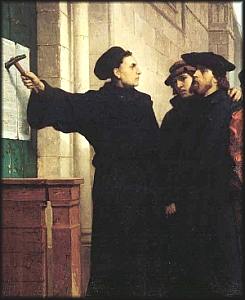
Celebrating Reformation Day, for me, is a little like remembering someone you loved dearly who has passed away. As a dyed-in-the-wool, anti-RCC Protestant, I would love to rousingly celebrate the anniversary of Luther’s pounding his 95 Theses into the cathedral door at Wittenberg. But I think we’ve squandered a lot of what the Reformation bought us.

I don’t think we practice most of the backbone concepts of the Reformation, even in the most ardent Reformed churches. I grew up Lutheran, and even so I ran into disconnects all over the place.

Take the idea of the priesthood of all believers. Nothing in our practice of our church life proves that we believe this foundational truth of the Reformation one iota. Too many of our churches have pastors who lord it over their congregations, disempowered congregants who are routinely told that only the specially trained (read “seminarians”) are equipped to minister, Martin Luther sticks it to the RCCand vicious church factions debating the same “who is greater?” nonsense that got the disciples in hot water with Jesus. Truthfully, our practice of the priesthood of all believers better resembles that classic line from George Orwell’s Animal Farm.

I know in my own life I’ve encountered that hypocrisy more times than I can count, none more glaring than my experience in the church Martin Luther founded. I worked at a Lutheran camp a couple summers and got in serious trouble with the leadership of the camp for baptizing kids who converted to Christ. Seems like a perfectly ordinary action to take with new believers, baptizing them and all. From the reaction of the leadership, though, you would’ve thought I’d killed those kids à la Jason of Friday the 13th movie fame.

At sole issue was the fact that I wasn’t a pastor. When I countered that the Philip who baptized the Ethiopian eunuch wasn’t an apostle but a guy who waited on the tables, I was lucky not to be stuffed into a canvas sack and thrown into the lake right then and there. So much for the priesthood of all believers. I guess some priests are more equal than others.

I could walk through the Reformation’s five solas and ask how we practice them in reality. Just the other day, I experimented by Googling the phrase “What must I do to be saved?” and perused the answers provided by leading Protestant Web sites. If that cursory survey is any indication, we’ve got to do a whole lot more to be saved than have faith in Christ, trust His Scriptures, and receive His grace. (Though I think soli Deo gloria still holds up in all cases.) Sadly, at the site of one prominent Reformed blogger, the list of requirements for salvation (according to the sermon by Cotton Mather posted there) included a whole lot more than what we got out of the entirety of the Reformation. Somehow, we Protestants have found a way to obscure the simple answer to that most necessary question. In many ways, we’re back where we were just prior to the Reformation.

But I guess the main reason that I’m not quite as pumped about Reformation Day as some others is my speculation about Martin Luther. I fear that some of the loudest celebrants of Reformation Day might be the very same people who would call for a good old burning at the stake for Martin Luther if he showed up today and pounded a new set of 95 Theses on the doors of our modern Evangelical churches. Love to see them Catholics squirm, but don’t tell us to give up our modern indulgences.

Too many of us Protestants have capped Christianity at the Reformation. We believe that nothing more can come out of Christ’s Church than what we got out of the Reformation nearly five hundred years ago. In some ways, we’re like the fifty-year-old shoe salesman at K-Mart who once quarterbacked his high-school team to a state championship. Our entire lives revolve around that day when we threw the winning touchdown. We relive it, revel in it, and on and on. But we let that one event in time become the be all and end all of our existence. It can never get better than that time, nor can we ever let it possibly come close.

But oh what we may be missing because we can’t see the opportunities that lie before us today!

Don’t get me wrong. I supremely value the Reformation. I also supremely value practicing what we preach and asking if we need a new reformation even better than the old one.

Now what church will let me nail that to their door today?