
One Moment in Time—and Beyond

Standard

I believe it was an International Bible Society study that showed that nearly all people who become Christians do so by age nineteen. That figure stunned me at the time. We've got to get people young, folks. That's why bringing young people to Christ is so astonishingly important.

But another figure hidden in that survey speaks just as loudly. If the average American today lives to at least eighty, the IBS survey also tells us that the person who comes to Christ at age nineteen will spend sixty years or more in discipleship.

Think about that figure—sixty years of following Christ after conversion.Real life sliced and diced
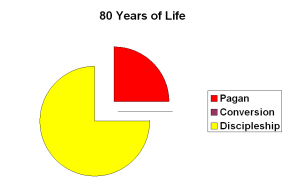
The image at right puts this in perspective. The slice of pie that comprises a person's pagan life before Christ consumes about a quarter of life. Following after Christ takes up three-quarters. The moment of conversion, though crucial, is but a mere slice.

Yet you would think that conversion, that one moment in time, is all there is to the Christian life. Given how we Evangelicals devote so much time, energy, and angst to conversion, you'd think that the sixty years afterward are a drop in the bucket. In the Godblogosphere, the handwringing over conversion (and the theology behind it) weights it even more. Discipleship may seem an afterthought.

I'm saddened when I get e-mails from folks saying all their church ever talks about is getting people saved. Don't get me wrong; it's excellent that churches preach the salvation message. But most of the people in the church are already saved, so what help do they get in actually living out their conversion if they hear the same salvation message over and over again?

The Bible says this:

And this is eternal life, that they know you the only true God, and Jesus Christ whom you have sent.
—John 17:3 ESV

And we all, with unveiled face, beholding the glory of the Lord, are being transformed into the same image from one degree of glory to another. For this comes from the Lord who is the Spirit.
—2 Corinthians 3:18 ESV

I didn't know my wife the first time I met her. In many ways, I still didn't know her even on our honeymoon. Learning who she is will take me the rest of my life because the depth of her personhood will only be revealed in time.

The same goes for Jesus Christ. Most of us have barely scratched the surface of what it means to know Him. Yet the Bible says that knowing Him IS eternal life! It's not escaping hell, it's knowing the person of Jesus Christ. Deep calls to deep. If Jesus Christ and a hundred Jesus impersonators were put into a lineup, would we be able to pick the real Jesus out of the crowd of imposters? Think hard about that question.

Likewise, our conversion to Christ does not end our growth as Christians. Too often, though, our churches act like they have no more to tell us once we say yes to the Lord. "Just don't do bad things now" is the extent of the post-conversion advice.

But the Bible says that we're supposed to be changing from one degree of glory into another, a process that will take our entire lives. That is if we surrender to that process of Christ making Himself in us. For it's His glory that shapes us over those sixty years.

Too often, our discipleship is self-centered. Life becomes nothing more than the avoidance of pain and the accumulation of comfort. But we can't walk the narrow path staring into our navels; we'll wind up in a ditch.

For we are his workmanship, created in Christ Jesus for good works, which God prepared beforehand, that we should walk in them.
—Ephesians 2:10 ESV

And as you go, proclaim, saying, "The kingdom of Heaven is at hand." Heal the sick, cleanse the lepers, raise the dead, cast out demons. You have received freely, freely give.
—Matthew 10:7-8 MKJV

For the Son of Man shall come in the glory of His Father with His angels, and then He shall reward each one according to his works.
—Matthew 16:27 MKJV 

If you're a Christian, you're a new creation. And what were you created for? Good works in Christ. The real disciple of Jesus Christ spends his or her sixty years after conversion walking out a discipleship that is other-centric. It's centered on the Lord and on the ones who are dying around us. Yes, we can read great treatises on theology, accumulate vast libraries of Christian thought, attend Christian conferences one after the other, but if we're not freely giving away what we freely received, then we'll spend sixty years wasting God's mercy. Instead, we must be focused on others to ensure that the reward we have in heaven is great.

We all know "Away in the Manger." There's not a three-year-old out there that doesn't learn this Christmas carol first. As a result, few think of it in terms of theological depth. The final stanza says it all:

Be near me, Lord Jesus, I ask Thee to stay
Close by me forever, and love me, I pray;
Bless all the dear children in Thy tender care,
And fit us for Heaven to live with Thee there.

Our sixty years of discipleship is meant for one thing: to fit us for Heaven to live with Christ eternally. What you and I are doing right now in this moment of time is shaping our eternity. Don't be deceived. Following Christ was never intended as fire insurance. Instead, it's meant to remake citizens of Earth into citizens of Heaven.

Are we giving away our life here so we can take on new life? Can we with all certainty pick Jesus out of the lineup? He may not look like an itinerant rabbi, but the homeless man drunk outside our office building. How then will we know Him unless we do the good works that encounter Him? Are we spending all our time looking at our conversion when we should be focused on our inheritance?

Sixty years is at once quite long, yet so very short in the eyes of eternity. In truth, our lives are not so much like a pie chart, but a never-ending timeline that began a breath ago. In a flash comes conversion, but then we live out the eternal consequences of our discipleship.

It's about learning to be a disciple, giving away freely what we were freely given: love, mercy, and grace. Let's not waste our sixty years.

Because We Can, We Should?

Standard

I'm not into today's CCM. The worship leader at our church must think me a pagan because I have a blank look on my face whenever she brings up the latest hot Christian band and their equally hot quasi-worship song that's blazing up the Christian charts. Who? What song? Let me guess; it has the same beat as all the others….

Today, I had one of those crazy days of endless errands. Oil change, allergy shots, soccer practice, a ten-item grocery list that necessitated trips to three different megagrocers just to get common items any ONE of them SHOULD have had. You know the drill. So desperate for a little spiritual refresher, I turned on the big Christian radio station in town to hear one of the afternoon teaching programs. Instead I got an earful of tedious music. 

Whither the teaching? Well, the station's booted all its teaching in favor of a non-stop music format. I guess every station wants to be just another vapid K-LOVE clone. In some corporate roundtable, station management decided to give the people what they want rather than what is best for them, thinking that 24/7/365 of the Pablum that passes for Christian music today better enlivens the masses than Ravi Zacharias talking about techniques for witnessing to Muslims.

Ugh. Maybe I'll call 'em up and request Keith Green's "You Love the World (And You're Avoiding Me)."

It's symptomatic of a gigantic problem. 

One of the most worldly concepts you'll find in our culture is this idea that "because we can, we should." Name a moral failing or a political ambition and I'll bet "because we can, we should" empowers it. Abortion and fetal tissue cultivation are the sick offspring of that thinking. You can probably come up with a million more.

Christians are not immune to this mistake. In fact, we rationalize a lot of  "because we can, we should" under the guise of redeeming things. Kids love Saturday morning cartoons? Well, let's make Christian cartoons! Your son wants an action figure? Why not give him a brand-spanking new Jesus action figure complete with a whip to drive out moneychangers and a glow-in-the-dark sword that springs out of his mouth to slay the wicked?

Almost all "Jesus junk" hatches from "because we can, we should."

Truth be told, I feel queasy walking into Christian bookstores. They're so utterly derivative and reactionary that if I were an unbeliever plunked down in one, I'd guess the first stage of being born again is losing one's sense of beauty, creativity, and charm.

Yet for all the WWJD paraphernalia floated over here from Shanghai, a more soul-killing expression of "because we can, we should" exists.

Mysecret.tv is a recent addition to the Web. Some Christian organization thought there weren't enough avenues for confession for Christians, Confession or Gossip?so because the Web exists and is (somewhat) anonymous, it's the perfect medium for confessing one's sins. 
Except it's not. Not in the slightest. Instead, Mysecret.tv stands as a warning to us all, the epitome of "because we can, we should"-ism in the American Church.  

The site raises my ire for a number of reasons:

1. It's pornography. Like some lurid afternoon TV talk show, the site parades sin as entertainment. By offering verbal voyeurism (consider the domain name), it's no different than a hardcore porn site. One click and you can read the details of someone else's failure before God. "But doesn't the Bible show great believers failing?" Sure, it does. But if anyone here's calling for adding Mysecret.tv to the canon, well….

2. It usurps the role of the local church. No doubt, Evangelicals have dropped the confessional ball. Too many Evangelical churches would rather judge than offer grace after a confession. But building a site like Mysecret.tv actually circumvents local churches improving their dealings with confession, sin, and grace. It provides a cheap excuse NOT to fix the problem in our local churches. It asks for none of the commitment inherent in a Christ-centered community, cheapening how we relate to each other in an age when real community in the church is already on its deathbed.

3. It asks for no repentance. Enough said. 

4. It offers no grace. Real grace doesn't come with a disclaimer. Jesus Christ gave us a model for how to dispense grace to the repentant. It's the church body of real people who hear confession, cry with the sinner, and offer grace by the Holy Spirit working through people. But Mysecret.tv expunges all face-to-face restorative human contact. Therefore, by removing the links in the chain of how grace should be dispensed, it offers no grace at all.

5. It offers no accountability. After people confess on Mysecret.tv, what follow-up occurs to help them work through the ramifications of their confession? None that I can see.

6. It offers no restitution. How does one walk out the end product of a confession on Mysecret.tv? Well, if nothing is asked of the people who confess on the site, then no restitution occurs. How that benefits the one confessing is beyond me. 

7. It demeans the death of Christ on the cross. If Mysecret.tv angles to be a Christian-sponsored site that takes confessions, yet offers none of the hallmarks of true Christian confession, repentance, accountability, and restitution, then it's not Christian in the slightest. That mocks the Lord.

I could name a half dozen more failings in Mysecret.tv, but its concession to "because we can, we should" speaks for itself. When considering this site's premise, it appears no one asked if it undermines everything the Church should be. They just plowed ahead and slapped it up on the Web. Alakazam, now you can confess to boinking your kid's babysitter and feel better about yourself for doing so. (And yes, all you grammar mavens, I intentionally wrote that last sentence for maximum {read ironic} ambiguity.)

Is anyone else disturbed that so much of what passes for Christianity in America displays the same hollow core as Mysecret.tv? A group sees a need in the Church, but instead of pursuing tough answers that might require a complete overhaul of how our churches live out the Gospel, they settle for the cheap and meaningless—because they can.

Cerulean Sanctum exists to find ways to better our churches and the people who comprise them. For this treason, I loathe cheap answers to the pernicious problems we face as Christians in America. I see a site like Mysecret.tv and my blood boils. When another blogger told me about the site, and I checked it out myself, my jaw dropped at the utter lack of discernment behind this online confession booth.

(If you're a regular reader of this site, you know I almost never single out a particular ministry or program for scorn. I don't like to name names because so much out there needs to improve, even on good sites. I know that Cerulean Sanctum lacks in some areas. I also know I'm not satisfied with cheap and easy.)

I pray this post gets us thinking about finding the narrow path, rather than the wide, destructive one behind "because we can, we should." Too many Christians trudge down that "because we can, we should" superhighway leaving the rest of us to wonder if we're the ones going the wrong way.

Our response to the problems of our day will cost us something precious. When we're not prepared to pay the price, we'll settle for the path of "because we can, we should."

But Jesus won't be waiting at the end of that road. 

Our Obsession with Labels

Standard

"Teacher," said John, "we saw a man driving out demons in your name and we told him to stop, because he was not one of us."

–Mark 9:38 NIV 

The phosphors weren't even dark on my monitor before someone challenged me to come out of my hiatus. In short turn, two more incidents cried out, begging me to post, taunting me to spurn my self-imposed break. Curiously, all three possessed a common thread: an obsession with labels.

Nathan Busenitz posted excerpts from an old interview in which the normally sane John MacArthur threw a rod and proudly declared that all Christians are dispensationalists. Just like he is. If they were truly honest with themselves, that is.

Hmm. I wonder how R.C. Sproul and Vern Poythress took that news.

Last time I checked, there wasn't a Darbyite bone in my body, but that's beside the point. MacArthur felt the need to assign a label to all of Protestantism that he uses to refer to himself. But like Lay's Potato Chips, you can't stop at one. "Dispensationalist" doesn't cover it all. Go ahead, put a label on it!In Johnny Mac's case, he's a Reformed Calvinist Cessationist Credobaptist Dispensationalist. I'm sure if we delved deeper we could determine if he's an Infra- or Supralapsarian. He probably supports the use of grape juice over wine, so add Teetotaling to the list of labels.

Boy, that's a lot of labels. 

The second confrontation with labels came inside Cerulean Sanctum, when my repost on homeschooling got a number of commenters hot and bothered. At issue was my innocent comment about homeschooling my son. "No," came the righteous response from a couple people, "you are most definitely NOT homeschooling your son. You're doing a public e-school at home, but that's not the same as homeschooling." 

Seems I can't even label myself correctly. Other people have to step in and do it for me.

Even if I should concede that the critics are correct on the jots and tittles of this particular letter of the law, still the issue of labels raised its ugly head. We have to know who's right and who's wrong. Judging by the vociferous (and verging on venomous) response my self-labeling received, "hellaciously wrong" was the correct answer.

And lastly, within hours of my final pre-hiatus post, a respected Godblogger took me to task for my hesitancy to toss labels around. He objected to the "About My Theology" portion of my "About Cerulean Sanctum" page, wherein I state the following:

I'm "Reformational," meaning I completely affirm what came out of the Reformation. Labels are difficult and I tend to eschew them, so I'm not "Totally Reformed" in the strict five-point Calvinist manner that many Godbloggers are, but I lean more toward the theology of Martin Luther.

My insistence that I don't like labels didn't sit well. The gist of this blogger's post channeled Lucy Van Pelt and labeled me the Charlie Brown of the Godblogosphere. You know, wishy washy. (Though I somehow got a few points for being honest about it!) 

What is it with the American Church's obsession with labels?

I find it nearly impossible to find much emphasis on labels in the New Testament, particularly the Gospels. Let's take a look at the disciples' attempts to label:

"Teacher," said John, "we saw a man driving out demons in your name and we told him to stop, because he was not one of us."

–Mark 9:38 NIV

Not one of us. That's a classic in the labeling community, isn't it? We use the "not one of us" label more than any other. We insist on dividing, creating schisms, and call our obsession "discernment."

But how did Jesus address John's labeling of this man?

"Do not stop him," Jesus said. "No one who does a miracle in my name can in the next moment say anything bad about me, for whoever is not against us is for us."

—Mark 9:39-40

Jesus' response: Tactful rebuke coupled with a complete overhaul of terms. Better still, he narrowed the label further (which we'll discuss further down.)

I'm sure the disciples' labeling the man taxed Jesus' patience—at least a bit—since mere verses before the disciples engaged in another common labeling practice:

They came to Capernaum. When he was in the house, he asked them, "What were you arguing about on the road?" But they kept quiet because on the way they had argued about who was the greatest.

—Mark 9:33-34

Here we have the flip side of "not one of us," the "we're the best" label. Of course, with such a label, someone must fall into the category of "not the best," or as we more commonly see it enunciated, "scum of the earth."

Any guesses as to Jesus' response? Yes, tactful rebuke coupled with a complete overhaul of terms. Detect a pattern here?

In fact, the more one looks at the labeling practices of the people Jesus encounters in the New Testement, the more we see that people do a lousy job of godly labeling. The Roman centurion labeled himself "unworthy," but Jesus labeled him "faithful." The Pharisees were dying to label the man born blind or his parents "sinners." Jesus said no, "glory of God." Most people would label the priest and the Levite "godly," but Jesus reserves that label for the hated Samaritan who stops to help the man robbers left for dead.

Jesus repeatedly turned labeling on its head. While we have a penchant for a plethora of labels we use to determine who's greatest and who's one of us, plus all the subdivisions within those, Jesus stuck with only two:

  • For Us vs. Against Us
  • Sheep vs. Goats
  • Wheat vs. Tares
  • Found vs. Lost 
  • Saved vs. Unsaved
  • Faithful vs. Unfaithful 
  • Believers vs. Unbelievers 

If Jesus stuck to such simplified labeling, what about the Church He founded? 

If we examine the early Church, we WON'T find the apostles straining for a name for the burgeoning movement of Christ followers in Jerusalem. No one's angling for a label at Pentecost. It's not till Chapter 9 of Acts that we hear the label "the Way" applied. And it's in Antioch in Acts 11:26 that the movement gets a label that sticks, Christians. That label came in 45 BC, twelve years after the founding of the Church!

You see, the early Church had a job to do. They didn't have time to waste labeling themselves or others. As far as they were concerned, the labels Jesus used met their needs. Stick to the basics.

So why is it that Christians today feel compelled to resort to so many labels—and so obsessively?

I believe part of the problem lies in our modernistic tendency to condense everything we encounter into easily knowable parameters. We take comfort in thinking we comprehend what an item is by its labels. Unfortunately, we can attach all the labels in the world to someone or something and still miss the whole picture. For instance, we can label each part of a peacock—forehead, lore, beak, wings, primaries, secondaries, tertiaries, scapulars, coverlets, feet, etc.—but utterly miss the beauty and majesty of it.

If a family member died, would we be mortified if a Reformed Calvinist Cessationist Credobaptist Dispensationalist Supralapsarian Teetotaler knocked on our door and offered to grieve with us even though we were Arminian Pentecostal Holiness Lordship-Salvation Pedobaptists who drank a glass of wine for our stomach every day just like Paul advised Timothy? I doubt it.

Why all the fuss then?

I'm sick of labels, personally. I'm a Christian; that's the only label I wish to be known by. As to other labels, Jesus offers nothing but rebuke. The older I get, the more I understand that truth.

Time to stop the obsessive labeling. We're only hurting the cause of Jesus Christ by loving our labels more than each other.