
When Parents Fumble for Answers

Standard

I had a second cousin on my dad’s side who was older than me; her name was Lois. She was a big, warm-hearted person with a nice laugh who was always nice to me. My dad, who was never the social sort, really liked Lois, too. And like many children, I wasn’t sophisticated enough to understand the whole relational thing, so Lois was always “Aunt Lois” to me.

When I was about twelve, Lois developed leukemia. I remember many nights I spent praying for Lois. In fact, I think I prayed for Lois more than anyone or anything I can remember from that time. I remember reading verse after verse about how God heals. I prayed my heart out for Lois.

She died a little more than a year later in her young thirties. I was so broken up by this that I did not want to go to the funeral because I thought it was my fault that she died. Part of my childhood died with her.

Friday, I had to take my four-year-old son to the emergency room at the local children’s hospital. Despite my constant care and attention (and only three hours of sleep each on Thursday and Friday AM), I could not keep enough fluids in him to prevent his getting dehydrated. Father & son, hand in handHe entered that vicious vomit cycle of losing so much water from his system that adding it only made him more nauseous. In the end, nothing could stay down. He awoke Friday morning looking like one of those hollow-eyed waifs you see in ads for Third World children’s charities.

Now he’s a resilient kid, and despite some bad allergies to furry animals, he’s relatively healthy. Never once have I heard him say, “Daddy, I feel really terrible,” but he did so today. He looked really terrible, too. So at 8:30 AM, I sat half-conscious beside him and said, “Let’s pray for God to heal you.” After I prayed, he looked up at me and said, “I still feel terrible. Why didn’t God heal me? Why will I have to go to the doctor?”

It was the look on his face that broke something inside of me. That look reminded me of how I felt when my dad came into my room late one night to tell me that Lois had died. The expression I must’ve given my dad then was the same one I now saw in my own son’s eyes.

In that teachable moment, I tried to distill the ideas of special grace versus common grace to him, to tell him that God heals alone and sometimes He uses doctors, but that hurt look remained. There was the chink in the armor of childlike faith in a little boy whom I wished would never lose that simple faith that children seem to be born with, the faith Jesus commends for all of us.

He didn’t say much to me the rest of the afternoon. They turned the TV on in the room they gave him at the hospital, and through much of the four hours we were there watching the electrolyte solution plump him up like air in a deflated balloon, he was glued to Nickelodeon’s snarky cartoons for adults packaged for kids. When I’d had enough of the veiled references, we switched to Nick, Jr. Me, the one with all the answers, didn’t seem too filled with them in that moment and I couldn’t compete with the TV. And though he didn’t once cry at the hospital, despite the IV dripline jabbed in his hand, he cried when he got home over a waxed paper pill cup he’d clung to during the whole ordeal; I’d thrown it away as we were leaving the emergency room.

He’s physically fine now. And though he’d already seen a brain full of TV, his mom and I had rented Singing in the Rain and wanted to watch it before we had to take it back to the library. My son laughed his head off during Donald O’Connor’s “Make ‘Em Laugh” scene, and for a while everything seemed like it had always been.

I was a sheltered child. Even at in my 20s, I was pretty naïve. I regret none of that. Yet trying to preserve childhood today is an effort I think all of us underestimated when we started having babies. I thought I knew how to handle every possible outcome, but I didn’t know what to do about the look of abject disappointment I saw in the eyes of my own child when he realized that God was not going to make him better there and then, and that a trip to the doctor, and then to the hospital, was the only outcome. In that moment was a slow leaching away of the reservoir of childlike faith that Jesus loved in the children He blessed.

Millstones. I started thinking about millstones we tie around the necks of people less spiritually mature than we are. Had I said something in the past to my son that setup the expectation that was not fulfilled? Not as far as I knew. Though I’m relentless in turning what he hears of naturalistic explanations for life back to explanations of the workings of God in Creation, I must’ve left open a chink.

Adults put on the full armor of God through the spiritual disciplines and intense discipleship. But children must don that armor through the grace of God working in their parents’ personal instruction. With so many forces of darkness attacking from untold directions, I often feel unprepared for that task. The last thing I want to see happen with my son is for me to fumble the answers, to fail to provide his cover as he moves into adulthood.

It’s that look of innocence lost in a child’s eyes that should chill every parent to the bone.
Tougher People

Standard

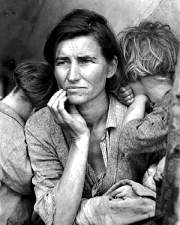
Migrant Mother by Dorothea LangeI don't usually blog about my emotional well-being, but it's been a rough week. Monday I got bad news about a serious dental problem I have that can only be resolved by drastic, painful surgery to the tune of a year's tuition (or more) at Harvard. With both of us deflated by this news, my wife asked me what people with my condition did before this kind of surgery was available. The only answer? They lived with it.
So I've been thinking since then about folks who lived long before any of the amenities we take for granted today. Amy Carmichael, missionary to India, never took a COX-2 inhibitor in her life, bedridden with constant pain for twenty years before she met her Maker. Yet her poetry and wisdom live on long after she succumbed to the affliction of living on this planet. Millions of women somehow got through childbirth without an epidural. And after suffering through the mind-numbing agony of a kidney stone late last year, I don't understand how anyone could have existed without opiates to dull the shrieking nerves.

Dentistry back in the old days consisted of a pair of pliers and a bottle of rotgut. There were no bionic limbs two hundred years ago for the soldier maimed in war; a hook or crutch would have to do. Infection took its toll on many body parts and no plastic surgery plied his trade in making torn bodies whole again. Deformity was life and you went on living it no matter how much you wanted the mirror to lie, if only for a moment.

Couples buried their children by the dozen. Mothers often accompanied their mis-born children to the grave. Life was often brutish, nasty, and short. Ask Hudson Taylor, the great Asian missionary, who returned to England—his own health shattered—after leaving his wife and several children in the cold Chinese soil. Many could tell you that living seemed much more about avoiding being in the wrong place at the wrong time. A simple handshake with the wrong person could leave a deposit of microbes for which there was no known cure, diseases like diptheria or pertussis that are rarely spoken of today.

You can't dismiss that people were tougher then. No one thought himself a victim of fate, either. One simply pressed on and that was it. There weren't scores of therapists to hear Abraham Lincoln talk about his sadness over the deaths of his children and the increasing mental instability of his wife at a time when the nation he presided over was torn in two, brother set against brother. More pressing needs begged for his allegiance, so he soldiered on.

I can't see myself crowded around Jesus, trying to clutch at His robe saying, "If only…." Instead, I would be marveling at the truly shattered people who flung themselves at him, people so broken that some of them weren't recognized as human any longer, except by the Lord Himself. I think I would have to give up whatever place I had in line if I'd seen someone like that. Those were hard days and it's a miracle to this child of the 1960s that anyone could live at all.

There aren't too many tough people in the West anymore. Perhaps this is why we are so willing to forget about the Lord; we have other answers for our problems, even the tiniest ones. A balm exists for whatever ails us as long as the price is right. And even when it isn't, the lengths we'll go to in making it right shows how easily we are bought, sold, and traded on the open market.

It's sobering to know I would've been one of those casualties a hundred years ago. I was hospitalized for two weeks at two years of age for pneumonia, a dreaded killer in the time of my great-grandfather, but not for someone born in the Camelot of Kennedy's era. Should my recovery have been only partial (and partial was what many hoped for in the fin de siecle), I would've been known as a "sickly child," a terminology we don't toss around today simply because we don't see it too often.

Jesus wants tough people who rely on Him for everything, particularly when everything is not provided without fail. If that's my prayer for myself right now, then it's my prayer for you, too. We can't live on "what if?" or "if only…." Faith demands more and asks for tougher people. On that Day, the Bride of Christ will be radiant in her beauty, but She will have gotten there bloodied and beaten—yet not defeated.

Be tougher.

{Image: Dorothea Lange's "Migrant Mother" (1936)}

The Least-Believed Verse in the Bible

Standard

In the past few days it appears the Spirit has wanted me to blog about the supernatural. I wrote about demons on Saturday, Pentecost and the Holy Spirit on Sunday, and on Monday the tendency of some Christians to believe that God no longer speaks to individuals.

Bible imageMonday’s post felt incomplete, so I feel compelled to expand it to discuss the fascination some Christians have with deflating everything supernatural, be it inside the Church or outside. And even though there are some naysayers who want to cast doubt on the very miracles that Jesus performed, I would offer that even for Christians who believe in the innerrancy of Scripture, especially those in the rarified air of nationally-known preachers and teachers, this is the least-believed verse in the Bible:

Truly, I say to you, whoever says to this mountain, ‘Be taken up and thrown into the sea,’ and does not doubt in his heart, but believes that what he says will come to pass, it will be done for him.
—Mark 11:23 ESV

From the lips of Jesus Himself and yet so many of us rush right over that verse and automatically filter it through our newfangled Western Scientific Rationalism Sunglasses, so we see it, but we don’t believe it. “Mountains cast into the sea just by believing? I know that’s what it says, but—”

Talk about big “buts!” I think for most of us who have been around for a while, Mark 11:23 merits a logical explanation that goes something like this: “You know, the Bible does contain hyperboles. Jesus was just being hyperbolic. He’s such a card! You ever see a flying mountain? C’mon!”

Now I’ll be accused of faulty exegesis by most of the people who read this blog, but I’m going for it anyway because I don’t believe the following verse has merely the traditional exegesis so often given it. I think Paul is saying something even more startling:

But understand this, that in the last days there will come times of difficulty. For people will be…lovers of pleasure rather than lovers of God, having the appearance of godliness, but denying its power. Avoid such people.
—2 Timothy 3:1-2a,5 ESV

Traditionally, the meaning of “denying its power” has solely been attributed to justification and sanctification, God’s powerful transformation of children of damnation into Children of God. I will not even begin to question that interpretation. However, I also believe that this passage is a cautionary bit of advice to Timothy by Paul concerning those people who would handcuff God’s supernatural power operating in the lives of believers. And those supernatural powers extend to raising the dead, speaking in tongues, healing, and all those other numinous manifestations of God’s power working through the lives of believers, and which operate within God’s justification and sanctification of those same believers.

I find it odd that many who would lessen God’s ability to do such things today love to equate preaching the Word with prophesying. And while I am perfectly comfortable with them believing that, I am mystified as to when preaching passed away when those other gifts supposedly ceased. Preaching/prophesying is listed as one of those supernatural gifts of the Spirit we find in 1 Corinthians 12, though I didn’t know that it or its well-loved compadre faith bit the dust with John’s last breath, yet some would have me believe that.

Although I suspect those same folks would argue they fully believe the least-believed verse in the Bible, they have a funny way of showing it by their tendency to use tangled arugments to mock anyone who might still believe that the Lord can raise the dead today just as He raised Lazarus. And while many are willing to suspend disbelief when it comes to the Earth being created in only six days, somehow a modern day Lazarus-like resurrection just ain’t possible.

I’m really getting fed up with anti-supernaturalists who want to have compartmentalized “miracles” on their own terms and not God’s. If God wants to blow through Bob Jones University and blast everyone there with the gift of tongues, well, stranger things have happened—and God was in control of those stranger things, too.

J.B. Phillips wrote a book with one of the greatest titles ever: Your God Is Too Small. I can’t help but believe that a deity who no longer speaks to people in his own voice, who can do no more miracles, who was once mighty but is now routinely outdone by Satan’s counterfeit parlor tricks is just that small. And perhaps our problem is that we so easily put qualifiers on a verse like Mark 11:23 that we’ve created for ourselves a convenient god that is pleasurable in his smallness, convenient enough so that he does not ruffle our little kingdoms more than he ought, and while a tad bit idolatrous, looks enough like the big “G” God of the Bible that few people will notice his impotence.

That is not the God of Abraham, Isaac, and Jacob. If we really wanted to know why the Church has become a joke to most people I think its largely because too many self-professed Christians believe in a handcuffed God who closely resembles the god of Deism, a god who stepped back and never again brought his superatural touch to mere mortals. This is a god easily encapsulated and who bears a too comfortable resemblance to you and to me. Who wants a god that pathetic?

I don’t know about you, but I want a big “G” in my God.