
Arrogance, Ignorance, and “I Don’t Know.”

Standard

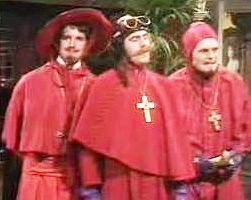
Nobody expects the Spanish Inquisition!Slice of Laodicea notes an Al Mohler article that brings up good talking points about the state of today’s Church in light of the proliferation of cults. Mohler’s basic comment is that poor doctrinal defense and an inability to nip error in the bud have resulted in Christianity being dogged by a plethora of pseudo-Christian cults all clamoring for legitimacy. Given that Eerdmans, long a stalwart in Evangelical publishing, just published a defense of Mormonism, fueling the growing desire of Mormons to be considered mainstream Christians (rather than gladhanders in bleached white Oxfords trying to dig up the remnants of a civilization as non-existent as Plato’s Atlanteans), Mohler may have a point.

But then again, nah.

Mohler’s piece is written as if no Church existed before 1800. Witness this assertion:

Writing early in the last century, J. K. Van Baalen argued that “the cults are the unpaid bills of the church.” Van Baalen’s influential work, The Chaos of the Cults, represented one of the very first comprehensive efforts to evaluate the various cults of the day from the vantage point of orthodox Christianity. Van Baalen’s survey considered movements and groups such as Spiritism, Theosophy, Christian Science, Rosicrucianism, Swedenborgianism, Mormonism, and the Jehovah’s Witnesses, among others.In Van Baalen’s analysis, orthodox Christianity had opened the door for the cults to emerge and to proliferate throughout the culture. Sidelined by pragmatism, distracted by divisions, and committed to a “smallest common-denominator faith,” the orthodox churches had left the larger culture, and even some of their own members, unprepared to meet the challenge of the cults.

If anything, the problem is more acute in our own day. The seductions of postmodernism and the complexities of a pluralistic culture compound the difficulty involved in engaging, understanding, and confronting the cults.

Is the problem more acute in our day? Well, if the Scriptures are to be believed, the first NT writings were not even dry on the page before the Church was confronting cults. We know that the Apostle John wrote to counter the nascent Gnostic heresies and that the Lord Himself called out the Nicolaitans in Revelation. In fact, as long as there has been Christianity there have been cults of Christianity. Paul was constantly squashing one heretical belief after another and even came into conflict with Peter over the Judaizers, a group that Mohler would be forced to tag as a cult if it existed today.

The list of heretical leaders and the groups that formed around them in the early days of Christianity’s spread could take up a leather-bound tome in itself. Mohler’s amnesia here is startling: Marcion, Pelagius, Apollinarius, Montanus, Arius, Nestorianus and on and on. Yes, the Church did put them down, but even today groups of pseudo-Christians cling to the remnant teachings of these heretics. Still, their ideas did not die; even a casual glance around proves Pelagianism is alive and well in the 21st century.

The issue of what constitutes a cult in the history of the Church is also difficult to ignore. To the orthodox Church (and Mohler makes much of what is “orthodox”), Martin Luther and his band of German ne’er-do-wells were a cult. Same goes for that Calvin guy and that fellow Knox. To those early Lutherans and Presbyterians, the Roman Catholic Church was a cult and plenty of Christians today still maintain that view.

In fact, you can trace every modern denomination in Christianity to a blistering reaction by that denomination’s adherents to an “apostate orthodox church.” Methodism, the Restoration Movement, the Quakers, the Puritans, all had a start as folks who came out of a church that was backslidden and given to cultic practices—at least as they saw it. How Mohler fails to consider this is beyond me.

Worse still, Mohler attributes the problem of cult proliferation in the last one hundred-fifty years solely to the Church’s inability to promote correct doctrine. To be honest, I don’t believe that this is the whole story, especially since Mohler lumps seeker-sensitive and Emerging churches in here. Again, an honest assessment shows that these two came not out of bad doctrine, but a reaction against an orthodox Church in America that simply wasn’t doing its job. A lot of denominations started out that way, but when they left their parent churches, the angry ones left behind were bellowing, “Heretics!” even as they smarted over the possible truth behind the breakaway group’s leaving. It was easier to blame them for bad doctrine than it was for being right about the status quo’s calcification and deadness.

Every doctrine of the Church is not nailed down. If we were honest with ourselves we would have to admit this. Get one hundred Christians of all “orthodox” persuasions in a room, and you’ll have at least twenty distinct eschatologies. And while some may say that eschatology makes no difference, many of the cults that arose in the mid-Nineteenth century did so because of eschatological beliefs. Nor does one’s eschatological view exist in a vacuum. The very way we live our lives every day is a reflection of how we think the world will end. If you don’t think that’s true, then compare and contrast Booth’s Salvation Army with today’s Christian survivalists.

I’m going out on a limb here and will certainly get angry comments, but even Paul didn’t have his theology crystal clear on all points—at least as many orthodox Christians might see it today. We know that Paul publicly confronted Peter over his falling in with the Judaizers, but Paul was not so sure of the issue of circumcision early on in his ministry (Acts 15), but then after it was decided that circumcision was not necessary, Paul went ahead in the very next chapter and circumcised Timothy in order to get a better opportunity to preach to the Jews who would have disqualified his testimony because of his uncircumcised co-worker in the Faith. Later on, we have Paul abiding Nazarite vows and ritual cleansings in Acts 21, acts that would drive batty those orthodox believers who eschew anything that looks like a ritual or smacks of legalism.

So just who is wrong here? And better yet, who’s willing to admit it?

It’s that latter sentence that may explain some of the reason why we have cults: dogmatism. Cults— and Christian denominations—exist in large part due to inflexibility of beliefs. They are all backlashes against a rock-solid dogma that chafed. Sometimes (and yes, I know, not always) we Christians must acknowledge some negotiables. Paul did so when he circumcised Timothy. Who here is willing to toss him out for that act? Was it a sin? Was he violating doctrine? Or was the Holy Spirit leading him outside the newly established boundaries just this once in order that some might be saved? That Paul also consented to a similar act (the vows) later on in order to win some to the Lord should give us pause.

Frankly, if Mohler were honest, he’d just skip to the punchline and say, “I’m a Baptist. From my perspective, anyone who baptizes infants is a heretic and their church is a cult.” The problem is, he can’t bring himself to say that because he mentally assents to some doctrinal “wiggle room” himself.

I’m not positive on a lot of points of established “orthodox” doctrine. I believe that because Man is made in the image of God, he’s a tripartite being, just as God is. Wayne Grudem, whose Systematic Theology is a work I deeply respect, does not share that belief. That makes one of us wrong. Applying the standard that Mohler asks, one of us is therefore a heretic.

The Holy Spirit will guide us into all Truth, as the Scriptures say, and yet we see through a glass darkly. I believe both those statements. I believe that the Holy Spirit will progressively make me more like the Lord and I will take on more of His Truth in doing so, but I also believe that I will not have all the answers in my lifetime. As Paul’s “man caught up into the third heaven” can attest, there are answers to questions we may never ask this side of eternity. And if we’ve never asked them, how then can we be perfect in our doctrine?

Arrogance led to erecting a gospel of stone, a weight that not only were the cultists not ready to accept, neither were the leaders of Christian denominations who broke off from the accepted teaching of the day and went down another path. On the other hand, there is no purity in ignorance. Certainly ignorance accounts for the cults and some of those same Christian denominations—ignorance of the Word and of sound doctrine.

Perhaps the reality we face this side of heaven is that on some issues the believer must be more humble, even to the point of saying, “I don’t know.” While I don’t ascribe to the belief that everything is a mystery, neither do I believe that everything is set in granite. I don’t believe that Jesus came to establish a set of dogmas used to crush ordinary people with, and yet He never tolerated erroneous teaching, either.

No matter what the case, we all need a bigger dose of humility when it comes to this issue of who is right and who is wrong. We use the word “heretic” far too often today. The Christian blogosphere is choking on the brutal arguing going on over who’s perfect and who isn’t. I don’t want any part of that anymore. It’s possible to call others to holiness without strangling them to death with a noose of righteousness. That’s the way I’m going to try to take, because in the end, I’m not perfect.

Now where’s my comfy chair?
Tougher People

Standard

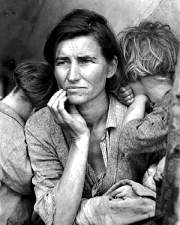
Migrant Mother by Dorothea LangeI don't usually blog about my emotional well-being, but it's been a rough week. Monday I got bad news about a serious dental problem I have that can only be resolved by drastic, painful surgery to the tune of a year's tuition (or more) at Harvard. With both of us deflated by this news, my wife asked me what people with my condition did before this kind of surgery was available. The only answer? They lived with it.
So I've been thinking since then about folks who lived long before any of the amenities we take for granted today. Amy Carmichael, missionary to India, never took a COX-2 inhibitor in her life, bedridden with constant pain for twenty years before she met her Maker. Yet her poetry and wisdom live on long after she succumbed to the affliction of living on this planet. Millions of women somehow got through childbirth without an epidural. And after suffering through the mind-numbing agony of a kidney stone late last year, I don't understand how anyone could have existed without opiates to dull the shrieking nerves.

Dentistry back in the old days consisted of a pair of pliers and a bottle of rotgut. There were no bionic limbs two hundred years ago for the soldier maimed in war; a hook or crutch would have to do. Infection took its toll on many body parts and no plastic surgery plied his trade in making torn bodies whole again. Deformity was life and you went on living it no matter how much you wanted the mirror to lie, if only for a moment.

Couples buried their children by the dozen. Mothers often accompanied their mis-born children to the grave. Life was often brutish, nasty, and short. Ask Hudson Taylor, the great Asian missionary, who returned to England—his own health shattered—after leaving his wife and several children in the cold Chinese soil. Many could tell you that living seemed much more about avoiding being in the wrong place at the wrong time. A simple handshake with the wrong person could leave a deposit of microbes for which there was no known cure, diseases like diptheria or pertussis that are rarely spoken of today.

You can't dismiss that people were tougher then. No one thought himself a victim of fate, either. One simply pressed on and that was it. There weren't scores of therapists to hear Abraham Lincoln talk about his sadness over the deaths of his children and the increasing mental instability of his wife at a time when the nation he presided over was torn in two, brother set against brother. More pressing needs begged for his allegiance, so he soldiered on.

I can't see myself crowded around Jesus, trying to clutch at His robe saying, "If only…." Instead, I would be marveling at the truly shattered people who flung themselves at him, people so broken that some of them weren't recognized as human any longer, except by the Lord Himself. I think I would have to give up whatever place I had in line if I'd seen someone like that. Those were hard days and it's a miracle to this child of the 1960s that anyone could live at all.

There aren't too many tough people in the West anymore. Perhaps this is why we are so willing to forget about the Lord; we have other answers for our problems, even the tiniest ones. A balm exists for whatever ails us as long as the price is right. And even when it isn't, the lengths we'll go to in making it right shows how easily we are bought, sold, and traded on the open market.

It's sobering to know I would've been one of those casualties a hundred years ago. I was hospitalized for two weeks at two years of age for pneumonia, a dreaded killer in the time of my great-grandfather, but not for someone born in the Camelot of Kennedy's era. Should my recovery have been only partial (and partial was what many hoped for in the fin de siecle), I would've been known as a "sickly child," a terminology we don't toss around today simply because we don't see it too often.

Jesus wants tough people who rely on Him for everything, particularly when everything is not provided without fail. If that's my prayer for myself right now, then it's my prayer for you, too. We can't live on "what if?" or "if only…." Faith demands more and asks for tougher people. On that Day, the Bride of Christ will be radiant in her beauty, but She will have gotten there bloodied and beaten—yet not defeated.

Be tougher.

{Image: Dorothea Lange's "Migrant Mother" (1936)}

Overflowing

Standard

Today is Pentecost, the birth of the Church and the fruition of the Old Testament prophecy of Joel declaring that the Spirit of God would personally indwell men and women.

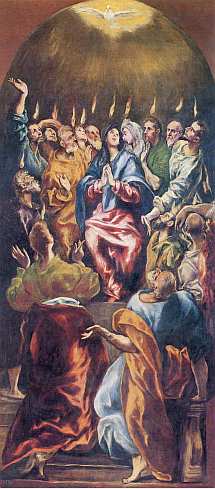
El Greco's PentecostHow sad then that the Holy Spirit is barely a presence at all in our meetings or in American believers in general.

Yesterday, I wrote to a faithful reader of this blog about my experiences in camping ministry. Ruminating further on what I wrote her, I want to literally and figuratively talk about two camps. I'll let you decide which one was more Spirit-filled and had a more effective ministry.

The camp in Southern Wisconsin had everything that an Evangelical camp could want—multi-million dollar budget, national recognition, much-copied programming, an enormous staff filled with well-known names in camping, and superior food and accommodations. They had all the right doctrinal stances and perfect theology. The director of the camp was also the sitting director of Christian Camping International.

The camping program in Southern Ohio had a minute fraction of that money and was part of a Mainline denomination that had been losing members to churches like the one that supervised the Evangelical camp. They didn't own their own campgrounds and the camping program was largely funded by one church. There was no national recognition and the leaders, while respected, weren't being asked to speak at Christian Camping International conventions.

The Wisconsin camp was a stickler for rules, even those that made it hard for summer staff members to attend church on Sundays. The camp didn't provide for the spiritual needs of the staff, going so far as to oppose a volunteer, staff-run, mid-week church meeting (organized by yours truly.) Year-round staff made it clear to summer staff that they were just there for a few weeks and the camp really didn't belong to them in the same way that it did for the resident year-rounders. Resident staff almost never let summer staff into their homes.

The Ohio camp made every allowance for the spiritual lives of staff. When leadership saw that the staff was getting tired, they poured their lives back into the staff and made certain that each staff person was getting fed by the Lord. Although many of the summer staff were not local, almost everyone on staff decided to attend the sponsoring church and time was made for staff to attend church and even enjoy fellowshipping afterwards. People from the church housed the staff in their own homes when camp was not actually in session. Relationships were forged for a lifetime.

The Wisconsin camp believed that God came first, campers came second, and staff came third. The Ohio camp believed that God came first, staff came second, and campers came third.

The Wisconsin camp poured out their staff until they were bone-dry and used-up. The Ohio camp got their staffers into the waterfall of the Holy Spirit and let them minister out of the overflow.

By summer's end, the Wisconsin camp staff had nothing more to give, while the Ohio camp staff was still ready to serve. The staff of the Wisconsin camp limped out of camp with long faces and few tears. The Ohio camp staff walked away empowered for service, and there were long farewells and many tears. Many of the people from the Ohio camp are still friends almost twenty years later.

I tell the tale of those two camps because today's Church in America falls into the same two camps. Our ministry is either a pouring out of people until there is nothing left to give or it happens out of the overflow of the hearts of people filled with the Holy Spirit.

Unfortunately, I believe that too much of our ministry today is taking what little of the Spirit of God is in those ministering and pouring Him out until people are dessicated.

A simple look around the United States will reveal the following:

1. We have more seminarians than ever and yet people are starving for good preaching.
2. More people have taken evangelism courses than ever and yet there is no revival in this country.
3. We have more books on Christian topics than ever, yet the ignorance of the Word of God is growing.
4. We have more Christian conferences and seminars than ever, and yet the world around us thinks Christians have nothing to offer.
5. We have snazzier, more consumer-oriented programming in our mega-mall-churches than ever before and yet every poll shows more and more people staying away from our churches.

Folks, we cannot do this by our own strength and yet that is all we seem to offer people. Is it any surprise that people stuck in this kind of dry, manmade Christianity are bored and restless? And for those who labor within those congregations, should we scratch our heads when they burn out and go elsewhere?

There is no substitute for the Spirit of God! We cannot build Christ's Church by any other means than by His Spirit! Our programming won't do it, our happy faces won't do it, our seminaries won't do it, our bookstores won't do it. Nothing builds the Church but the Spirit. We're wasting our efforts and wasting God's time if we think otherwise.

I've said here before that you never have to advertise a fire. If each believer in Jesus was filled to the brim until they overflowed with the Spirit we'd have people begging us to know what our secret is! We'd sit down on a plane and the people in the seats next to us would be clamoring to know how it was possible that they could actually sense our contentment and inner joy. Anyone who is empty would want a piece of Who we have!

I wish that everyone who reads this blog will take time today to read the entire Book of Acts in one sitting. Read it all the way through—your translation doesn't matter. Just read it. Now ask yourself if what you read there bears any resemblance to your own experience. If not, then why not?

The simple answer is that we are not serious about ministering out of the power of the Holy Spirit. But can I tell you something? You will burn yourself to a cinder of you minister to others in the way that most of you have been taught. But if you minister out of the overflow of the Holy Spirit, ministry becomes so effortless that you'll wonder why you wasted so much of your sweat trying to do it by your own strength!

My favorite passage in the Bible is Acts 4:23-31:

When [Peter and John] were released [from prison], they went to their friends and reported what the chief priests and the elders had said to them. (24) And when they heard it, they lifted their voices together to God and said, "Sovereign Lord, who made the heaven and the earth and the sea and everything in them, (25) who through the mouth of our father David, your servant, said by the Holy Spirit, "'Why did the Gentiles rage, and the peoples plot in vain? (26) The kings of the earth set themselves, and the rulers were gathered together, against the Lord and against his Anointed'— (27) for truly in this city there were gathered together against your holy servant Jesus, whom you anointed, both Herod and Pontius Pilate, along with the Gentiles and the peoples of Israel, (28) to do whatever your hand and your plan had predestined to take place. (29) And now, Lord, look upon their threats and grant to your servants to continue to speak your word with all boldness, (30) while you stretch out your hand to heal, and signs and wonders are performed through the name of your holy servant Jesus." (31) And when they had prayed, the place in which they were gathered together was shaken, and they were all filled with the Holy Spirit and continued to speak the word of God with boldness.

Did you catch that last verse? The place they were in was shaken! When was the last time that the Holy Spirit showed up so powerfully on Sunday morning or Wednesday night that your gathering place was shaken? Or how about you? When was the last time the Spirit go so ahold of you so fully that you were shaken? Those folks in that place already had the Holy Spirit in them since it was a gathering of believers, but look how God filled them to overflowing. And notice what follows from that massive empowering of the Spirit: the people went out filled with the Spirit, ministering the word of God boldly out of that overflow of their hearts! Do you think that they could NOT talk about the Lord after being filled like that? They didn't go out timidly, nor by whipping themselves into an emotional frenzy, nor by whatever they'd learned in a two day Evangelism Explosion session, but they went out in the utter confidence of the Holy Spirit! How could they NOT impact their environs if God Himself was dwelling in them so richly?

You can't buy the Holy Spirit; people have tried unsuccessfully (Acts 8:18-24.) The only way we can experience that filling is to humbly repent of our sins, travail before the Lord in prayer (and I don't mean for five minutes, either), praise His Holy Name by the Spirit already living in us, and wholly offer up our lives as a living sacrifice to Christ—our spiritual worship. We also need to surround ourselves with others who have the same single-minded devotion to Christ. And lastly, we need to be around mature Christians who have tasted the Lord in His fullness. They know what is possible and they believe, even when others don't.

The Lord never intended us to live any other way than overflowing with His Spirit. His promise in Joel was not half-hearted; He promised radical lives, radically changed, and radically equipped by Him to radically speak to shattered people in a shattered world. He alone makes this happen. And no matter how hard we try to manufacture results, without Him we can do nothing. N-O-T-H-I-N-G.

Now do we believe that?

{Image: "Pentecost" by El Greco, 1600. One of my favorite artists.}