
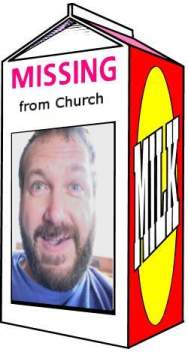
Another Look at the Church’s Missing Men

Standard

Dan is Missing!Last June, I blogged about the George Barna report that showed that the American Church’s face was largely female, with many men skipping church altogether. Since that time, another male-centric book has appeared on the market, David Morrow’s Why Men Hate Going to Church. This tome joins the mania created by John Eldredge’s Wild at Heart in seeking to find out why men feel bored in the pews on Sunday. Morrow even has a website www.churchformen.com that delves deeper into the mystery of the church’s missing men.

Like John Eldredge before him, Morrow’s solution focuses on recovering lost masculinity. While Eldredge aims to recover a masculine “adventure,” Morrow looks at masculinizing the Church:

We have to give men opportunities to use their strengths and their gifts in the service of God instead of trying to squeeze them into roles that they feel are feminine or emasculating. We need to start valuing masculine traits such as aggression, boldness, and competitiveness and figuring out ways that we can integrate that into every area of church life.

But are these assertions the real reason behind the church’s missing men?

Having been a part of two churches with extensive ministries that were strongly male focused, I contend that Morrow’s response does not play out in reality. One of those churches had a popular sports ministry and brought sports illustrations into nearly every sermon. The pastor of the church served as chaplain to a number of professional sports teams and was a well-known author. Still, that church was about 60% women. Again, in the second church, wacky humor, Eldredge’s reliance on movies to pitch the Gospel, numerous men’s groups, and plenty of ministries that called on uniquely male gifts did not budge the number of men. They were still only 40% of the attendees.

So what is the problem?

I alluded to this earlier in my post “Advertising Ashes.” The main reason that men are not in church is that they simply are not seeing the Holy Spirit move in power. At the risk of alienating the many women who read Cerulean Sanctum, I want to make a bold point: even if the Holy Spirit were not present in a supernatural way in our churches, I still believe women would still show up on Sundays. The Church has no problem attracting women because women are naturally drawn to the community and relationships that a church provides. However, this attractor does not work for many men. Men need a profound experience of God in order to get them to sit up and take notice. If the Holy Spirit doesn’t fall on them in power, then the positives a church can provide outside of the supernatural make little difference. A church can hypermasculinize itself to death and still not break that three women to every two men ratio if the Spirit is barely discernible on Sundays. Men have a better built-in B.S. detector than women do and function more out of the rationale of “prove it to me.” Without the manifest presence of the Holy Spirit in our gatherings, we have little to combat a set of crossed arms and a raised eyebrow.

The second problem is also one I have mentioned in the past, the issue of a man’s career. You almost never hear any sermons about jobs. Most churches have nothing in place to help the unemployed within their ranks. And the Church in America no longer speaks to the business world on issues of cut-throat downsizing, outsourcing, discrimination against older employees, and the relentless expectation that employees put in longer hours at work. In short, the Church in this country has almost nothing to say about the one thing men spend more hours doing than anything else in their lives. That silence speaks volumes to men.

In an e-mail I received from David Morrow in response to this, he wrote that as many women work today as men, yet despite their jobs and greater limitations on their time, women still make it to church. To this, I have a few counters:

  • Our society still defines men by their jobs. Introduce a man to a group and the first question he’s asked is, “So what do you do for a living?” This emphasis on work is taken to extremes because the gold standard espoused in Evangelicalism is that the husband is the sole breadwinner while the wife stays at home with the kids. A man without a job has no place in society’s eyes, but a place is still available to women who do not work.
  • A caste system still exists for men. Men are categorized by their work and valued accordingly. The doctor and the mechanic are not viewed as having the same worth, even within many churches. Again, this system does not plague women to the same extent. The man making minimum wage is perceived in a far worse light than the woman who works for the same pay. No one ridicules women in traditionally male jobs, but a man who performs what has traditionally been a female job is usually held up for scorn—particularly by other men.
  • Women marry with an eye to financial security, but this is not the case for men. Therefore, the onus is always on the man to bring in money. To meet this need, the man is usually the one striving to succeed in his career. Our society continues to reinforce this for men, while placing less burden on women to reach the pinnacle of success in their field.

A woman’s job and a man’s job, therefore, are not the same. To treat them as such is to ignore cultural mandates that simmer beneath everything a man does in his life. If the Church in America cannot grasp this, then we should not wonder why men see the Church as having little to say about how they define themselves using the cultural constructs placed on them in our society. With this paucity of wisdom about the key role a man plays for eight to ten hours a day, why should men abide church at all?

I believe that the reason the message of Eldredge and Morrow resonates with many men is that those men can’t put a finger on what they are truly missing. If you’ve never tasted champagne, why would you miss it? In this way, if our church gatherings are not filled with the Holy Spirit and our churches are not speaking to the one thing we still use to define a man, then the loss of both cannot be fully appreciated by the man who feels empty after the church service is over. All he knows is “Well, that wasn’t it.” So he goes off to hunt bear with a pointy stick or to climb mountains like Eldredge says. And while that might captivate him for a while, it does not fill the vacuum in his soul. His expectation then becomes that of simply muddling through the day. He can’t even look forward to the gold watch at retirement because the company he works for now fires (or forces into an early retirement with subsequently diminished benefits) everyone over fifty before the watch can be attained. At sixty-five and with his funds cut short, the job as a greeter at WalMart never looked so good.

We as the Body of Christ have got to do better than this or we may someday look around our churches and see no men at all.

Advertising Ashes

Standard

Man on fire

You never have to advertise a fire. —Leonard Ravenhill

Are you growing increasingly distressed by the worldly attempts by many churches today to market their church? Does the latest church fad sweeping the nation leave you cold? Are you growing nostalgic for "the olden days" when a preacher would walk into the pulpit and by the unction of God set the place ablaze?

Now that everyone in the United States has a blog—it seems like it, doesn't it?—I read an increasing number of sites that are advertising that they have the solution to whatever the Church's problem is. We all know what the problems are. Just a glance at the Top 25 bestselling Christian books in your local Christian bookstore will tell you:

  • Your church needs better marketing.
  • Your church needs to understand community demographics better.
  • Your church needs to have purpose/mission.
  • Your church needs to be relevant.
  • Your church needs to be authentic.
  • Your church needs to reach out to whatever group of people it's failed to reach in the past.
  • Your church needs to be concerned with end-times prophecy.
  • Your church needs to have a better men's/women's/youth/children's ministry.
  • Your church needs __________.

In a charismatic age, when even the crustiest Presbyterians are raising their hands in worship, how is it that we have forgotten the only thing the Church needs? Why have we forgotten the Holy Spirit?

You never have to advertise a fire. That's the answer to all these books clamoring for attention, trying to get you to buy to find out the "Super Secret Christian Formula" that will suddenly take you, your family, and your church to the absolute pinnacle of Christian experience.

Yet nothing draws people like a fire. You see a fire, you immediately start wanting to linger, to see what is burning, to watch what happens next. Fire evoke memories of stories told while camping, the community around bathed in the amber glow of timelessness and wonder. Fire heals, cleanses, and illumines. It spreads and envelops.

If there is any one characteristic of the Church in America in 2005 it is that for all our bluster, our bestselling fixes, and our introspection over the failure of believers to rise above the secular mire, no other answer can come but that we need the fire of God poured out on us.

John Eldredge, bestselling author of Wild at Heart, claims that men find church boring. David Morrow recently wrote Why Men Hate Going to Church. I have the simple answer for that: they are not encountering the Holy Spirit in the churches they attend. Someone who regularly attends a church that is filled with people overflowing with the Holy Spirit and who experiences the Holy Spirit in power in those meetings will NEVER be bored and will NEVER hate gathering.

But this is not most churches.

Ever heard of the aviator cults? These were primitive people who lived in remote areas untouched by modernity. As aviation grew, these tribal people started seeing huge, unusual birds in the sky. They were a sign. And some of those tribesmen were startled when a metal bird descended from the clouds and tall, white people emerged from their bellies. These people were like the gods themselves. So when the gods got back into their metal birds and flew away, the tribesmen were compelled to erect effigies of them and the odd bird they came in. Totemic planes built of reeds were set up in hopes that the gods would some day return and bless the people. This persisted for generations.

Today, our churches resemble aviator cults. We have a vague memory of generations ago when God showed up in our churches in power. But as time goes on, the story breaks down, the reason for it becomes muddied, and we start dancing around trying to make the aviator gods return. Churches do this in a variety of ways. Most churches entertain, rely on clever marketing campaigns to put posteriors in the pews, or scour the demographic data to tailor their message to what the neighborhood wants to hear. They advertise the ashes of the fire that might have once burned brightly, but is no more. They'll sculpt the ashes into amusing shapes and toy around with the properties of the ashes until they've mined all the ashes are worth—but on reflection, the ashes remain ashes and the fire is eventually forgotten.

You never have to advertise a fire. The Holy Spirit's fire in a church will obliterate whatever feeble gains a marketing campaign can create. The Holy Spirit's fire in a church catches in the community and changes lives profoundly. The Holy Spirit's fire cleanses, renews, and empowers.

For all too many churches today, there is no fire, only ashes. This is the dirty little secret that no one can utter. And when the Sunday service is over, it's the nagging doubt in every person's mind as they walk out wondering why they feel so empty even though they just spent all that time in church.

Everything besides the Spirit will fail to change this condition. The Christian pundits out there are misdirecting people into thinking there are other ways to get there, but there aren't. Only the Spirit of God satisfies. And once you have the Spirit, all that other dross is burned away.

It's time to stop pretending. For too many the Holy Spirit has become a dim memory in a dim church filled with dim people. God, send us your Fire!

The Superficial vs. The Supernatural

Standard

A church without the supernatural is superficial. —Leonard Ravenhill

It cannot be about numbers. If our churches are only concerned with how many people are packed into the seats rather than being concerned about the power of the Spirit of the Lord made manifest in our meetings, then we have lost the war and we should all go home and wait to die.

If the people who run our churches do not understand that the measure of spiritual depth in those who show up on Sunday can only be the presence of the Holy Spirit indwelling in fullness, then we will never see revival, only irrelevance.

We can jabber on about church models, worldviews, programs and such, but none of those ever raised the dead and never will, no matter how hard we work to refine them.

But when you talk with most people who claim to be Christians about this, more often than not you can count on a glassy-eyed stare. This is usually accompanied by the inevitable question, "But how do you measure that?"

No one who has encountered the shekinah glory of God ever asks that question. That the question is so prevalent is a shameful mark of our abominable lack of seriousness about what we believe.

I am not satisfied with my own spiritual state. And while I only have myself to blame, I am disheartened that the leaders of our churches today have aspired to so little, looking for plastic trinkets when the storehouse of heaven is ready to be poured on us. Why are we aiming so abysmally low?

Personally, I've had it with all the debates over process, programs, and progress. It's a lie from the enemy of our souls to keep us away from the One who can accomplish it all through us if we only submit to His workings and not our own.

Does anyone out there get this? If you do, how do we band together and seek to revive the dead thing the Church in America has become?

My promise to you is that it will start with me. I cannot endure this powerless thing we have made from the vital, living, fire-breathing Church Jesus set in motion more than two thousand years ago. If what we have now is the best it can ever be then Jesus take me right this second.

I know this blog doesn't get much readership. I don't care. I can only pray that it gets the right readership, people who feel the same way and are angered by what is happening to the Church in this country. You have to have your head in the sand not to see how we are failing, but where are the prophets who are calling us back to repentance and prayer and weeping between the horns of the altar? We've had our eyes gouged out by the worldly, just like Samson, but he prayed, "Lord, just one more time strengthen me." Before the Lord comes again, let that be our prayer.

Oh, Most Holy God, send the Fire! Your people are content with smoke when we need your Fire! Spirit of God, descend upon the altar of our hearts and make us again a supernatural people, a people to whom the lost can look and say, "Truly, God is among them." May your glory burn brightly in the breast of each of us who name you, that we take up our holy calling that is our destiny, tearing down the pillars of hell by the blood of the Lamb and the word of our testimony. Make us content with nothing less than the fullness of your indwelling, Lord Jesus, that the works you have set aside for us to work from the foundation of the world be made manifest in these last days, that none should perish, but all come to knowledge of you. Kindle again in us your Fire before your great and final day. For your glory and honor, always in the name of the Lord Jesus, Amen.