If you don’t know by now, I’m a charismatic. I let that get out from time to time online, but some might consider it my dirty little secret and immediately write me off.
My journey to the charismata was inspired by a man I could not explain. If ever there was a man around whom a halo flowed, it was this man. He knew things about people that they did not tell him. He laid his hands on people and they were made well. He prayed big prayers that asked for big answers from God and he got them more often than not. He knew the Scriptures in such a way that every time he opened his mouth to speak, wisdom flowed out that set people on fire. He disarmed every person who got close enough to be hugged by him. He could even call to birds and animals and they would come to him. And he was a Lutheran.
Quite apart from him, but because of his influence in the lives of so many people, I started asking God what made this man this way. So God began teaching me. How appropriate that this same man who had led me to the Lord years before just happened to be around the night I was baptized in the Holy Spirit so fully that I felt more alive than at any moment in my life to that point. Like warm oil, the Holy Spirit was poured out on me and He was life more abundant in a way that I pray everyone who comes to Cerulean Sanctum experiences at least once in their life, if not every day. That touch from God changed everything for the better in my life.
That’s my story in a nutshell.
Now that the blogosphere is loaded lately with commentary about all things charismatic, I feel I must comment. Being one of the few active charismatic bloggers almost necessitates that I say something. This post is part of that something.
Being a defender of the truth of the charismatic gifts for today is tough. Not because I’m fighting from a position of weakness, but because the astonishing reality of the gifts is too often buried by over-the-top charismatic excess, or as Chuck Smith dubbed it, “charismania.”
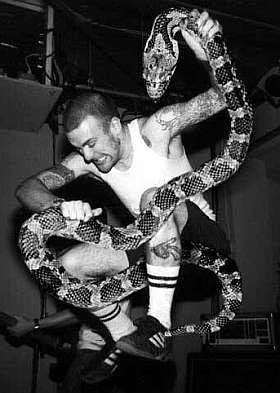 I hate charismania. It’s one of the things I loathe most of all. If the devil is in the details, then charismania is an in-depth laundry list of heresy and stupidity. Pyromaniac Phil has posted several things on charismania lately (1, 2, 3, 4) and reading the comments from an infertile couple rung through the ringer by clueless charismaniacs had me seething. I wish some people knew how brutally they dishonor the Lord when they engage in charismania.
I’ve been around the American Church in a variety of denominations, parachurch organizations, and individual churches enough to know that every sector of what passes for the “Church” here has enough people who long ago went off the deep end to fill book after book with nonsense passing for Christian expression. No denomination is exempt and neither is any individual church. Craziness is out there everywhere, and with that craziness comes error and omission, whether it be in doctrine or in practice. Yet nothing gets the big guns locked and loaded than a bunch charismatic headcases.
I’ll be the first to admit that far too many self-labeled charismatics cashed in their orthodoxy cards a long time ago and deserve all the criticism they pass off as persecution.
No post on Cerulean Sanctum has generated more hits and links than one of the first I posted two years ago called “Charismatic Churches and the Cult of the New.” I would encourage everyone to read that post because a lot of what follows here stems from that entry. What grieves me is that too many ardent Christians looking to bash all modern expressions of the charismata and charismatics love to cite that post as a reason why charismatics have been deceived by the Enemy. That was never my intent, nor is it my intent for this post to continue to add kindling to their arguments.
Nevertheless, I press on and offer this post as a warning to all charismatics. If you love the Lord, if you desire to see the Holy Spirit honored, if you long to see other Christians stop bashing charismatics, if you want to see the Spirit of God sweep through our churches with revival, then these admonitions are for you.
1. Stop being so undiscerning
The gift of discerning of spirits is a favorite charismatic gift, yet how terrible that so few actually practice it as God intends. Charismaniacs long ago excised 1 John 4:1 from their Bibles, so how can they not pass off every spiritual manifestation, no matter how deviant from the Scriptures it may be, as an act of God? “Look before you leap” may not be in the Bible, but I would love to see more charismatics just sit still for a few moments and lift what they may be hearing before God Himself before they rush to deliver some “word from the Lord.” I almost never speak anything out to anyone until I’m absolutely sure it’s of God. As a result, I speak out far less than I could. If only more charismatics had that kind of restraint.
2. Stop letting immature people minister to others “charismatically”
Nothing bothers me more than this. I don’t know a single church, charismatic or not, that perfectly practices the discipline noted in the Scriptures when it comes to correcting the wayward. Yet for some reason charismatic churches are worst of all when it comes to dealing with people who are blowing it. Too many charismaniacs are pronouncing bogus words of knowledge, wisdom, and prophecy over people. Too many people who are ministering to others have a vaunted opinion of their “giftings” and should instead be told to sit down and stifle it until they have a solid grounding in Scriptural knowledge and proper church practice.
A couple years ago, I felt compelled to start telling the leadership in charismatic churches that people were giving false words to people. The list of false things people have said to me (and people I know well) over the years dwarfs the number of correct words people have relayed. Like 100:1.
Anyone looking to discredit modern charismata need look no further than this kind of abuse to find a reason to lay a blanket condemnation over it all. That kills me, but we charismatics have only our astonishing lack of discipline of the immature to blame for this.
Personally, I think all charismatic “word gifts” should be run past the pastors and elders. (God help that church if the leadership is just as undisciplined.) A credible accuracy of words and actions need to be established in anyone. You simply don’t give a howitzer to a baby to play with, and neither should church leaders allow people whose spiritual lives have not been tried by fire to abuse spiritual gifts.
3. Stop overemphasizing the gifts and the people who have them
One the greatest reasons for abuse of the charismata is that too many charismatics have made possessing those charismatic gifts the ne plus ultra of faith. As a result, people are led to conjure up those gifts just to fit in. Those folks, desperate to seem mature in the Lord, are practicing phony gifts—end of story. Frankly, that should bring immediate correction from church leadership, but more often than not it is simply written off without any disciplinary action.
Most charismatics don’t want to hear this, but I believe the true gifts are far more rare in the Western Church than we see in actual expression. That means a lot of people are trying to maintain a false image of being a fount of charismatic experience when they may not be. The damage that is done as a result of that fakery is astonishing. When we put so much emphasis on the charismata and “moving” in them, we create this problem. It’s time we regained some sense and put our emphasis on knowing the Scriptures, prayer, and holiness, rather than putting all our eggs into the gift basket.
4. Stop living in a charismatic ghetto
All people who call themselves charismatics would do well to read authors and teachers outside charismatic ranks. Not only would this go a long way in cutting down on some of the bizarre practices of charismania, it would aid charismatics in all aspects of ministry.
All Christians have their blind spots theologically and charismatics are no different. Too many Christians stay within their theological comfort zones and never grow deeper in Christ as a result. Certain charismatic churches are especially prone to this, particularly those that trace their lineage back to Azusa Street.
Along with a tendency to stay in the charismatic ghettos, the rabid anti-intellectualism I see in some charismatic circles is especially disturbing, as if if the Holy Spirit is quenched by a sharpened mind. Nonsense! Again, discernment is needed constantly in the Christian life, but if we can’t engage ideas that are outside our realms of experience, then we are not living up to the potential that God holds out for us.
5. Stop practicing magic
Nothing dishonors God more than attributing His power to objects, words, or certain rituals. The essence of witchcraft is to imbue things with power that radiates from within them. It is the very mark of idolatry.
Prayer hankies, rugs, and flags; “holy water”; certain repetitions of phrases and actions—they have no power. When charismatics start treating the manmade as if it has the power to bring about change for the Kingdom, then we have replaced the Holy Spirit with those objects and actions.
The charismaniac fringe is rife with such magic. This one issue bothers me tremendously when I see it espoused or practiced. Some charismatic churches base prayers prayed for others on odd little vocal tics, phrases, and chants as if God is being conjured up somehow. I’ve seen and heard of all sorts of excesses using items and actions, like placing numerous Bibles on people when praying for them, playing musical instruments around people while ministering them, and on and on. Folks, that’s magic being practiced. Other churches may not play around with magic in their services, but many of their members do privately. We need to cut out this cancer now.
If you’re a charismatic, I hope this post has made you think. If you’re not, I hope you understand that there are certainly problems in your church and denomination that may very well be just as deviant as some of the things that afflict charismatic churches and believers. If that’s you and this is just all grist for your particular mill, then you’ve missed the entire point.
I believe with all my heart that the Church of the 21st century should be no different than the Church of the 1st century in its expression to the dying world around it. Nor should it be any different between the brethren. That’s why all this is so important. The abuse of the charismata today is no more a proof against them than a lack of love expressed to hurting people negates the Gospel.
And we all know how easily each of us falters in displaying the love of Christ to our neighbors and our brothers in Christ, don’t we?

 Rob Wilkerson, a charismatic Reformed pastor, has compiled a running list of this current conversation between charismatics and cessationists. It's the kind of resource that would have taken me five days to put together—it's that thorough.
 This is a response to Steve Camp’s post “