
Better Than You

Standard

This last week proved exceptionally busy, as it seemed I had to be in about eight different places at once every day. With no time to do grocery shopping, I put things off until the last second. On Saturday, I finally hit Kroger for replacement sundries.

Standing in the coffee and tea aisle, I heard a commotion, looked left, and witnessed a red-faced mother yelling to her child, “If you don’t shut up, I’m going to smack you in the mouth!”

On hearing this, I looked over at my son and thought, Thank God I’m a better parent than….

Then it hit me.

It doesn’t take much for us to compare, does it? The senses take in data and the judgmental wheels start grinding. Too often, they grind up others Jesus said are my neighbors.

I see an out-of-control parent fighting an out-of-control child and I think of that parent in terms of “I’m better than you.” 'Giving Alms to a Beggar' by AnonymousI talk with a baby Christian who doesn’t have his doctrine down right and “I’m better than you” rattles around in my head, bouncing off every slightly off statement that newbie pronounces. I consider all the things I own, then look to some poverty-stricken soul in Africa, and I start singing the “I’m better than you” song.

Only that tune grates on the ears. Maybe not mine, but the Lord’s.

It’s easy to call it pride, but it’s more than pride. Even someone who considers herself a loser can still find someone to be better than. The poverty-stricken guy in Africa looks at the poverty-stricken child who lost a leg to a landmine and thinks, Well, at least I’m better than he is.

Isn’t this “Better than you” mantra the source of many of our problems in our churches? Get to the root of any church split and “Better than you” grows like a fungus. I wonder if the Godblogosphere promotes a lot of this poisonous “Better than you” smack that gets talked up on this blog and that. All it does is ruin people in their souls, though.

The Bible says this:

Do nothing from rivalry or conceit, but in humility count others more significant than yourselves. Let each of you look not only to his own interests, but also to the interests of others. Have this mind among yourselves, which is yours in Christ Jesus…
—Philippians 2:3-5

When I considered that yelling mother in Kroger, did I have the mind of Christ when I trotted out the comparison? Not at all. Did I look to her interests in any way? Hardly. What I looked to was my own need to feel better about myself by judging another human being.

What is the mind of Christ in this regard? Humility—plain, unadulterated humility.

It pains me to say that I don’t know many truly humble people. Seems to me that the ones that overflow with this most godly of traits sport plenty of gray hair, as if being around long enough qualifies one to grasp humility. Perhaps it’s the fading of the flesh’s power that renders us more humble. All I know is that I could learn a few things from those senior saints.

What would a truly humble church look like? I would suppose that most persecuted churches know humility. Kind of hard to swagger with a boot heel on your neck. If that’s what it’s going to take to make for a humble Church in America, then perhaps we should be joining in prayer with our Chinese brothers who are praying that persecution comes to this country so that the Church here wakes up.

As for me, I would hope instead that our humility comes by another means, that the Spirit might change us from the inside. For all this talk of “Better than you” starts on the inside in the natural man, a straggler unwilling to budge save that Christ budges him for us.

This “Better Than You” talk kills us in the long run, makes us impervious to grace, blackening our souls. I suspect if we truly did esteem others better than ourselves, someone outside the Church might sit up and take notice.

I pray that’s sooner rather than later.
God’s Kindness through Christ

Standard

Justin Taylor of Between Two Worlds offers a profound quote from Martin Luther:

People don’t earn God’s approval or receive life and salvation because of anything they’ve done. Rather, the only reason they receive life and salvation is because of God’s kindness through Christ. There is no other way.

Many Christians are tired of hearing this teaching over and over. They think that they learned it all long ago. However, they barely understand how important it really is. If it continues to be taught as truth, the Christian church will remain united and pure — free from decay. This truth alone makes and sustains Christianity. You might hear an immature Christian brag about how well he knows that we receive God’s approval through God’s kindness and not because of anything we do to earn it. But if he goes on to say that this is easy to put into practice, then have no doubt he doesn’t know what he’s talking about, and he probably never will. We can never learn this truth completely or brag that we understand it fully. Learning this truth is an art. We will always remain students of it, and it will always be our teacher.

The people who truly understand that they receive God’s approval by faith and put this into practice don’t brag that they have fully mastered it. Rather, they think of it as a pleasant taste or aroma that they are always pursuing. These people are astonished that they can’t comprehend it as fully as they would like. They hunger and thirst for it. They yearn for it more and more. They never get tired of hearing about this truth.

Amen.

(HT: Jollyblogger)

The Cornelius Factor

Standard

At Caesarea there was a man named Cornelius, a centurion of what was known as the Italian Cohort, a devout man who feared God with all his household, gave alms generously to the people, and prayed continually to God. About the ninth hour of the day he saw clearly in a vision an angel of God come in and say to him, “Cornelius.” And he stared at him in terror and said, “What is it, Lord?” And he said to him, “Your prayers and your alms have ascended as a memorial before God. And now send men to Joppa and bring one Simon who is called Peter. He is lodging with one Simon, a tanner, whose house is by the sea.” When the angel who spoke to him had departed, he called two of his servants and a devout soldier from among those who attended him, and having related everything to them, he sent them to Joppa.
—Acts 10:1-8

I don’t normally reiterate here at Cerulean Sanctum what I hear in the previous Sunday’s sermon at my church, but my pastor mentioned a passing point that struck me, so I’d like to expound on it.

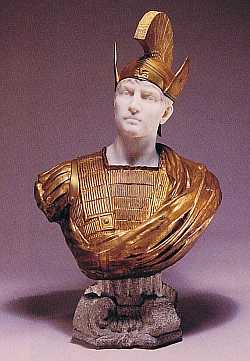
In the Acts 10 passage above, the Roman centurion Cornelius receives mention. Roman Soldier by Luigi BelliThe Scriptures describe three distinctives of this soldier:

  • He feared God (as did the rest of his household).
  • He gave generously to the needy.
  • He prayed continually.

Luke goes on to write that an angel appeared to Cornelius and prepared a way for his family to go down in history as the first Gentile believers. As a result, his name is forever enshrined in the Scriptures.

Let’s concentrate on those three distinctives of Cornelius. Because he proved faithful, God looked upon him and decided to use him in a special way to forever change the course of human history. This man’s dedication and humility marked him as the perfect choice for receiving the Holy Spirit apart from any Jewish lineage. It’s not hard to align the manner in which Cornelius conducted his life with this well-known verse:

He has told you, O man, what is good; and what does the LORD require of you but to do justice, and to love kindness, and to walk humbly with your God?
—Micah 6:8

Sounds like Cornelius, doesn’t it?

Note what caught the Lord’s eye about this man:

Your prayers and your alms have ascended as a memorial before God.

Prayers and giving to the needy.

I think we miss how easy it is to live out a life faithful to the Lord. We add rules and subtract others. We get sidelined in the kind of affairs that would never distract a true soldier of Christ. We can’t spend one hour in prayer. We can’t do without our wants so that others can receive their needs. We fear not keeping up with the Joneses, we fear what the neighbors might think, and we fear the wrong party will see their candidate become the next president, but we don’t truly fear God.

So we don’t receive visions. Angels don’t deliver messages to us. And perhaps God chooses to use a more faithful believer on the other side of the world to alter the course of history.

In the end, we say that visions are passe. Angels don’t come around anymore. The tongues that Cornelius and his family spoke were for another time, but not ours.

And our faith grows smaller for our dismissals.

Is it really that hard to fear God in America 2007? Or to pray continually? Or to put down the mail-order catalog long enough to meet the needs of someone dashed on the rocks by the vicissitudes of life?

Is it?

Lord, I pray that you would mold each and every person reading this into the kind of believer Cornelius was. Bless us as you did Cornelius, and use us to change the world.