
Why Men Don’t Pray

Standard

Let’s listen in on the end of a Christian men’s group meeting:

Guy 1: Great Bible study! Now who has prayer requests?

Guy 2, raising a hand: I inherited a couple thousand dollars from an aunt who died, and I need prayer to know how to best handle the money.

Guy 3: Put it in a stock index fund. Tracks the stock market and since it’s always going up over time, you win.

Guy 4: Have you looked into a 529 account? Little Joey will be going to college some day. Gotta remember that.

Guy 5: There’s the upcoming mission trip for the youth. I hear a lot of the kids don’t have enough money to go. You could write it off. Advance the Kingdom and all that.

Guy 3 to Guy 5: But if he invests it, he could make money and still turn some over in the future. Let his interest fund the mission trip five years from now.

Guy 6: This is a blessing from God. He means it to meet your needs. Your car’s not lookin’ all that hot right now. Didn’t you say the transmission needed work?

Guy 2 to Guy 6: True, but…

{Twenty minutes later…}

Guy 4: College, man. I’m telling you. It’ll cost a quarter million for four years the way things are going. Save now.

Guy 1: It’s almost 9:30, guys. Looks like we’ve pretty much shot our time, so anyone want to close in prayer?

{Guy 2 raises his hand}

Guy 1: Go for it.

Guy 2: Thank you, Lord, for this time. We pray you’d bless us and all our families. Help us to know you more. Amen.

All the Guys: Amen.

Sound familiar? I’d say that’s an eerily close script for just about every group of Christian men I’ve ever been a part of. Mention praying for each other’s needs and for the needs of the Body and you’ll hear 99 percent advice and 1 percent prayer.

I don’t remember it being that bad in my ancient past, though. And as much as it’s easy to blame men for this (to say they just aren’t spiritual enough today), I have another theory.

Consider all the changes wrought in our society in the last fifty years.

  • Companies fire men at the drop of a hat, even if they do good work.
  • Women now fight them for their jobs—and win.
  • The feminist movement questioned men’s very raison d’être, and that questioning trickled down into society as a whole.
  • TV went from Father Knows Best to showing dad routinely outsmarted by everyone, including the family dog.
  • Men aren’t reading the lay of the society’s land well. Too many changes happening too fast. Even in church on Sunday, they hear the message they’re not doing it right.

In short, I believe many men—many Christian men—struggle with feelings of incompetence. They wonder if they do anything well. GaggedThey fear that the future will somehow reveal their inadequacies, and they’ll be made a laughingstock.

I’m no psychiatrist. I’m down on psychology. But when I talk to other men, I see them struggling with these issues. It’s like watching Death of a Salesman or Glengarry Glen Ross looping in the lives of many men.

I believe this comes out in the way men approach prayer today.

A problem arises as expressed through a prayer concern. Suddenly, a chance to show competence—to let someone else know that I’ve heard what he said and I might be able to resolve it then and there, as if God had miraculously touched my mind with the answer! I can be helpful! I can make a difference!

I can be competent!

A more disturbing side exists to this, too. Intellectual competence in providing the winning solution to someone’s problem isn’t the only competence issue at stake here. Prayer becomes a comptetence issue, as well.

To many men, providing a common sense answer to a prayer need means not running the risk that prayer may not work. We prayed about Steve’s inheritance and he wound up getting taken by some shyster financial advisor. Then who’s wrong? Maybe our prayers failed the competency test. Maybe our faith failed that test, too. Maybe we’re not godly enough for God to take our prayers seriously. We’ve botched everything else, so why not this, too?

That fear of being shown incompetent doesn’t afflict women as much as men. I think the main competence issue women struggle with concerns raising their kids. Yes, that’s a leaden weight, too, but I think men tend to struggle with competence in every aspect of their lives. It’s why shows of bravado empower men. To be king of the hill carries some meaning.

Now we can inject all sorts of spiritual advice into this. We can talk about dying to self. We can talk about grace. But men simply aren’t experiencing those in their lives because what they get from the church on Sunday doesn’t have enough steam to get them past the gauntlet of potential incompetence they must run through the rest of the week. The car breaks down, and it’s so complex they can’t fix it. When their kids ask for help on algebra, they can’t do it. They can’t work enough hours in the week to avoid the offshoring due to hit their company. They can’t meet all the requirements the parachurch ministry says they must meet to be a Christian husband. They don’t even know where to start in prayer to address all these lacks. So they don’t even try.

And that’s my take on why men today don’t pray.
Mysticism, Part 3

Standard

Simon Peter answered him, “Lord, to whom shall we go? You have the words of eternal life, and we have believed, and have come to know, that you are the Holy One of God.”
—John 6:68-69

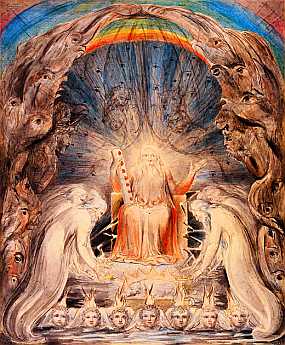
Too many people today search for Jesus where He cannot be found. They dabble in practices that only distract them from the real truth. 'The Four and Twenty Elders Casting Their Crowns before the Divine Throne' by William BlakeUnlike Peter above, they’ve opened their minds to too many foreign sources of supposed truth, only to stumble into error.

You won’t find Christ in a labyrinth. No dervish dance will reveal Him. No shortcut exists to where He’s to be found. He’s to be found where He’s always been and that place isn’t trendy, quick accessed, or “spiritual.”

With so many people seeking experiences versus seeking Christ, is it any wonder that mysticism of all kinds returns to vogue? Christians possess a rich history of mysticism, so we shouldn’t reject it outright. But in an age when the practice becomes the ends, why should we not expect a new Gnosticism to arise?

Knowledge for knowledge sake puffs up. Even supposedly Christian knowledge can do this if we miss the point of why we’re doing what we’re doing. To whom shall we go? To Christ alone. If He is not the sole reason and the sole obsession for why we end up on the mystic path, then we descend into a kind of neo-paganism with a Christian veneer.

Creatives and high-fantasy folks will suffer the most for failing to ask the same question as Peter. Tolkien won’t get you to heaven, yet no lack of travelers down the Middle Earth road exist. The allure of the otherworldly burns strong in us, yet that desire for something just slightly unearthly—if it misses the ultimate point—makes for a dangerous longing. One day you’re a simple, orthodox Christian, the next you’re Bishop Pike.

If we’re not grounded in the Scriptures, in prayer, in consistent discipleship, and in strong community, then mysticism won’t help us one iota. In fact, it may actually send us down the wrong path. For the mature Christian, mysticism’s not its own path, either. It’s not something one pursues. The pursuit has always been Jesus alone. If the Lord should decide to catch you or me up to the third heaven, then let’s enjoy the journey. But by all means, let’s not make the goal that journey or we’ll wind up someplace far worse.

Mysticism, Part 2

Standard

And this is eternal life, that they know you the only true God, and Jesus Christ whom you have sent.
—John 17:3

We don’t emphasize that verse enough. Eternal life is knowing the Lord. The great Christian mystics of the past had one goal: to know the Lord. And not just on a surface level, but as deeply as He might reveal Himself to them.

I don’t know how you see it, but I don’t see any conflict there. Nor do I see any problems here:

And after six days Jesus took with him Peter and James and John, and led them up a high mountain by themselves. And he was transfigured before them, and his clothes became radiant, intensely white, as no one on earth could bleach them. And there appeared to them Elijah with Moses, and they were talking with Jesus. And Peter said to Jesus, “Rabbi, it is good that we are here. Let us make three tents, one for you and one for Moses and one for Elijah.” For he did not know what to say, for they were terrified. And a cloud overshadowed them, and a voice came out of the cloud, “This is my beloved Son; listen to him.”
—Mark 9:2-7

For the three disciples, witnessing Jesus’ transfiguration exceeded the first laser light show, the U.S. Bicentennial fireworks display, the 2002 Super Bowl halftime show, and the reunion of The Police—combined. Huge. Mind-blowing. Even terrifying.

And downright mystical.

All across the world and through the ages, people have encountered God alive and moving, speaking into their lives in supernatural ways. 'The Christ of St. John of the Cross' by Salvador DaliPeople like Saul on the road to Damascus. Guys like St. Patrick, whose ministry to hundreds of thousands of people sprang from a dream he received as he slept. Or Dwight Moody, one of America’s great evangelists, who encountered God in a mystical, overwhelming way as he walked the streets of New York City, and his ministry immediately transformed in that meeting from good to great.

So this mysticism thing is awesome, right?

Well, maybe.

Christian mysticism perpetually runs the risk of deviating from the intended target. Aiming for God and hitting something (or someone) entirely different is possible. The wise way to open oneself to God requires a series of personal firewalls intended to keep out anything not of God.

To that end, some have asked me for a list of great Christian writers since 100 AD who’ve written flawless works that can be trusted 100 percent of the time. I’ve included that list below:
Nil, zero, zip, nada

Kind of empty isn’t it? That’s for a reason. God never intended for us to swallow everything we hear out of the mouth of someone who self-labels as a Christian. I don’t care if we line our bookshelves with the most orthodox writings known to Man, those books will contain errors. I hope I’m not bursting anyone’s bubble by saying this, but your favorite Christian author/teacher/pastor makes mistakes. True, some make more mistakes than others, but the point remains: we must ALWAYS be discerning in ALL encounters with ideas and practices, be they “Christian” or not.

One of the first posts I wrote for Cerulean Sanctum applies to this issue of Christian mysticism. “Charismatic Churches and the Cult of the New” outlines several flags we must always apply when dealing with anything we encounter presented in the name of the Lord. The following cautions should be considered whenever we approach “new moves of God” within the Church. I originally intended these flags to pertain to charismatic practices, but I believe these also apply to any practice or concept that relates to mysticism:

Flag #1 Cannot be squared with Scripture or is based on a single verse of Scripture (usually taken out of context.) If we’re doing something that violates Scripture, we need to stop. End of story. If we don’tknow what Scripture says about some mystic practice we wish to employ, better to actually KNOW the Scriptures first before we get all mystical.

Flag #2Is pronounced by direct revelation through a single individual or a small group of people. The Church today doesn’t lack for individuals and small groups speaking some strange things. I don’t believe that the Lord speaks “unusual” truth through one person or a small group alone. He may speak to you for your needs, but the whole “mystic secrets of divine union for select disciples who pay $200” thing isn’t going to wash with the Lord.

Flag #3Is considered relevant for today, yet has no historic precedent in the Church. Nothing new under the sun, folks. If the Church through the ages didn’t practice or teach it, it probably ain’t kosher.

Flag #4Attempts to make a New Testament practice/theology of an Old Testament practice/theology rendered moot by the finished work of Christ. While this plagues certain aspect of the charismatic movement more so than the mystic community, it’s still something to watch for.

Flag # 5Involves “Restoring or the “Restoration of a practice or theology. Some things died out for a reason. Yes, a few good practices have been neglected by us hypermoderns, but we must be careful.

Flag #6Is a “redeemed version of a secular/occult concept or practice (usually which has been abandoned or discredited by secular/occult practitioners.) A huge flag when dealing with anything deemed mystical. (I’ll unpack this more below when I talk about syncretism.)

Flag #7May produce immediate results, but does not move the Church or individual into a deeper, biblically-based relationship with Christ in the long run. Practicing mysticism for mysticism’s sake will get us nowhere. All too often, a fascination with mysticism reflects failing to pursue God in approved, traditional ways. Those must always be addressed first. All the mysticism in the world’s not going to make an infant in Christ into an adult. Got to make it to the teen years of the Faith before reaching adulthood.

Critics of contemporary mysticism in the Church have good reason to point out troubles. Any two of the flags above in combination should entail a gut check about the practice or idea we’re attempting to incorporate into our spiritual lives.

With Christianity in the West so heavily compromised by syncretism, if we wish to be a holy Bride, then we can’t keep whoring around. Too many Christians who are looking into mysticism don’t have the spiritual maturity or common discernment sense to know what’s genuinely of God and what’s not. Since the critics of Christian mysticism love to blanket condemn, clashes will be constant. For the chucklehead who wonders how well astral projection and Christianity work together, good for the critics for calling him on his folly. We’ve got so many Christians lacking in even basic discernment skills that perhaps a place may exist for the blanket condemnation. A sad state of affairs, but given the tendency to let all the garbage in 24/7/365, possibly warranted. We have only ourselves to blame for the critics’ hypersensitivity.

The thing about the old Christian mystics? They’d already gone through all the steps of growth and maturity. And that’s the key point here. The Cloud of Unknowing may very well grow us deeper in God. But if we’re not reading and meditating on the Scriptures, cultivating a consistent prayer life, making disciples, or laying down our lives for others, we’ve got no right to pick up that book and start yammering about how deep it is and how it’s going to take us to “the next level.” You don’t give an infant a powerful weapon like an AK-47 to play with, because if you do, someone’s going to get killed. And for the purposes of this illustration, it’s usually the infant.

The riches of the Lord are His and His alone. Looking into Buddhist (or any other non-Christian) mysticism to apply what one my find to Christianity is like panning for gold in a field of manure. God’s already got a river flowing with gold, no need to wade through the crap. Yet all too often we try to find truth in places it doesn’t exist. If we truly believe that Jesus is the Way, the Truth, and the Life, searching for Him by syncretizing rituals gleaned from the places He’s not couldn’t be a bigger waste of time. All too often, those dabbling in Christian mysticism do just that.

Get the basics of the Faith down first. Stay away from syncretistic practices that attempt to join Christ and Belial. Test every spirit to see if it’s of God (the flags above are a good start). Be as wise as snakes and as innocent as doves—not the other way around.

Yes, sometimes the critics are off-base. But then again, once in a while they’re not. It pays to listen to them and weigh what they have to say against the Scriptures and the Spirit.

I’ll conclude this mini-series in my next post.