 It took me a minute to figure out the plastic emblem on the car I saw this afternoon. Where one would normally see an “ICHTHUS” or “DARWIN” sat an iconic piece of vehicular propaganda altogether different. Emblazoned with an “FSM” in its center, it looked vaguely crab-like. And then it hit me: Flying Spaghetti Monster .
If you’re not familiar with the Flying Spaghetti Monster, it’s the creation of anti-Intelligent-Design folks who say that the Designer advocated by ID supporters could just as well be a Flying Spaghetti Monster and not the God of the Bible. While some of us may bristle at the notion that a Flying Spaghetti Monster created the world we now live in, that particular form of idolatry isn’t far from what many ardent Christians believe—if their reaction to the created world is any indication.
I worked in Christian Camping ministry for a number of years in various roles. My first job was as a counselor. I’ll never forget that first cabin of sixth-grade boys from the Cleveland area. They embarrassed a girl I was crazy about who also worked there, but I shrugged that one off. But when they removed a bird’s nest (cardinals, if I remember correctly) from my cabin’s porch rafters and smashed the newborn birds underfoot, “livid” could not describe my emotional state. As an avid birder with a long life list and several years of teaching outdoor education to children, I revealed the full wrath of Dan and scared those boys so much that afterwards they pretty much flinched whenever I looked at ’em the wrong way.
Boys who nonchalantly kill birds God gave us to enjoy in plumage and song grow into men who cavalierly bulldoze the prairies to put in another WalMart. (“Because we all have to have more cheap stuff.”) Sadly for us, those boys of summers long past may have grown to become the pillars of our churches today. What else explains the rampant disregard so many Christians have for the world God created ?
It’s beyond my ken, frankly. I don’t understand why I’ve chalked up at least a dozen instances in the last three years of occupants of Jesus-bumper-stickered cars plastered with every form of Christomemorabilia tossing garbage out their windows on the highway near my home. I don’t get how an Evangelical politician whose plank is “God, Guns, and Good Government” can be touting care of the natural world one day and advocating strip mining the next.
No matter how you slice that kind of throwaway mentality, it comes down to one thing: self-centeredness.
The narcissist who tosses his full load of McDonald’s leftovers out his car window thinks nothing of others. And it’s not just the ignored people whose properties become the final resting place of his trash. It’s the God he supposedly serves, too. The first command of God to man is to steward the Creation. Depositing trash all over that Creation spits in the face of the Creator by questioning God’s calling of that Creation “good.” Choosing to despoil Creation says, “God may have called it ‘good,’ but since when is He the arbiter of what is good? Aren’t I the master of my surroundings?”
The litterbug is an easy target, though.
The person who believes that the natural world exists only to satisfy our cravings, on the other hand, is a more subtle monster. I see him all the time in church settings. He’ll fully acknowledge that God is the Creator but then turns God into a figurative Flying Spaghetti Monster by insisting that the created has no purpose other than its economic value to us. In other words, the value of God’s created world is found not in any intrinsic value God bestowed upon it, but only what it can give us monetarily.
The value of the meadow lies only in the oil underneath it. The value of the walnut tree is only in its expensive wood. A chicken’s value is only in the eating. A dog’s value is only in protecting the household valuables. A great horned owl’s value is…well, does it have any monetary value? What does owl taste like? (For a satirical look at the end result of this kind of thinking, consider this classic.)
When we consider only what something can do for us, ignoring any other value that God might give it, that’s called utilitarianism. The meaning for a Christian is “Jesus Christ is Lord.” The meaning for a utilitarian is “The ends justifies the means.” Look how often Christians, particularly those in positions of authority, function out of utilitarian thinking and not a godly worldview that sees meaning at a deeper level. The inherently self-centered worldview of utilitarianism is at extreme odds with a truly Christian worldview that believes that created things have worth beyond their economic value because God invested them with worth and meaning.
The end result of utilitarianism is euthanasia of the unnecessary elderly, the aborting of useless unborn children, the wholesale pillaging of natural resources just because they’re there, and a coarsening of all societal constructs and culture that do not provide immediate, personal gratification.
Does anyone else find it strange that Christians protest euthanasia, abortion, and the coarsening of our nation, but bring up caring for the natural world and it’s “Hey, is that going take money out of my wallet?”
Think about the following verse in light of our stripping of the natural world of any value except the monetary:
For the love of money is a root of all kinds of evils.
—1 Timothy 6:10a ESV
By nature utilitarians are consumers, not producers. We Christians decry utilitarianism, but the fact that so many of us are sitting in church asking “What’s in it for us?” exposes the utilitarian underbelly in modern Christianity, especially in churches that identify with man-centered, “Gospel-lite” Church Growth Movement principles.
Oddly enough, though, many of the strong opponents of the Church Growth Movement are ridiculously utilitarian when it comes to Creation. They may quote truckloads of Scriptures that include references to the created, but they too take a utilitarian approach by opposing anyone who questions whether we should conserve the natural or not. To even think about environmental issues is to take too much time away from spreading the Gospel. This kind of foolish one-dimensional thinking leads those folks into maddening inconsistencies, though. They certainly find time to take a shower several times a week, but to give two seconds to choose recycling over tossing something in the garbage can is too much to ask—as if it’s somehow okay to be clean on the outside while the world around us becomes a dump.
You’ll also find that same blasé attitude in Christians who say it’s all going to burn in the end, so let’s roast ivory-billed woodpeckers over campfires made from old-growth forests. Again, we see a utilitarian approach that finds no inherent meaning in anything God made.
Earlier in this series, I noted that Satan opposes God by seeking to destroy meaning. If the typical Christian’s belief on Creation care is any indication, he’s done a superior job.
Yet what do the wise say about Creation?
Solomon, who petitioned God for wisdom and had it granted, says this:
My beloved is to me a sachet of myrrh that lies between my breasts. My beloved is to me a cluster of henna blossoms in the vineyards of Engedi. Behold, you are beautiful, my love; behold, you are beautiful; your eyes are doves. Behold, you are beautiful, my beloved, truly delightful. Our couch is green; the beams of our house are cedar; our rafters are pine.
—Song of Solomon 1:13-17 ESV
Song of Solomon is replete with images from the bounty of nature. Read it sometime. (And not just for the erotic parts.)
The wise king continues:
Go to the ant, O sluggard; consider her ways, and be wise. Without having any chief, officer, or ruler, she prepares her bread in summer and gathers her food in harvest.
—Proverbs 6:6-8 ESV
Consider anything from an ant? The only thing good about ants is the fun one gets from frying them with a magnifying glass, right?
If not Solomon, then how about Agur:
Four things on earth are small, but they are exceedingly wise: the ants are a people not strong, yet they provide their food in the summer; the rock badgers are a people not mighty, yet they make their homes in the cliffs; the locusts have no king, yet all of them march in rank; the lizard you can take in your hands, yet it is in kings’ palaces. Three things are stately in their tread; four are stately in their stride: the lion, which is mightiest among beasts and does not turn back before any; the strutting rooster, the he-goat, and a king whose army is with him.
—Proverbs 30:24-31 ESV
No, there’s no inherent value in that lizard. Ever eat a lizard? Tastes like chicken way past its expiration date.
Or David:
O LORD, our Lord, how majestic is your name in all the earth! You have set your glory above the heavens. Out of the mouth of babes and infants, you have established strength because of your foes, to still the enemy and the avenger. When I look at your heavens, the work of your fingers, the moon and the stars, which you have set in place, what is man that you are mindful of him, and the son of man that you care for him? Yet you have made him a little lower than the heavenly beings and crowned him with glory and honor. You have given him dominion over the works of your hands; you have put all things under his feet, all sheep and oxen, and also the beasts of the field, the birds of the heavens, and the fish of the sea, whatever passes along the paths of the seas. O LORD, our Lord, how majestic is your name in all the earth!
—Psalms 8:1-9 ESV
Certainly, Dan, you’re not implying that there’s a revelation in Creation that speaks to the majesty of God, or to Man’s place in the universe! Stars just twinkle; they can’t enhance our 401k. And we went to moon! Nothing but rocks there.
And what of the parables of the Lord Himself, who spoke of the mustard seed, the pearl of great price, the sower who sowed the good seed, the lilies of the field who are clothed in God’s raiment, or the wheat and tares? What of God’s final discourse with Job, wherein He silences the most righteous man on the planet by regaling him with the natural wonders He created?
We do God a disservice by refusing to wonder in light of all He’s put around us. We castigate those out of Romans 1 who ignore God’s revelation of Himself by what He’s made, yet we eagerly join those same fools by carelessly stripping the Creation of wonder and mystery. A supposed Christian who—without wondering— can pass by a downy woodpecker hunting for insects in a dead tree is the same person who can later pass by his fellow man and not care one wit about him. In the soul of that passerby, a deadness dwells, a necrotic region God never intended His people to possess.
As for me, I never desire to see anything dead in the hearts of people who call themselves Christians. It’s time we become people in tune with God’s view of meaning by delighting in and treasuring the good world He gave us. Otherwise, we are no better than those who believe in a Flying Spaghetti Monster or a Darwinian universe ultimately bereft of all meaning.
***
Previous posts on this topic:
Warring Evangelicals Make Iron Eyes Cody Cry
Out in the Country
Creation in the Heart of the Christian
It’s Not Easy Being Green
***
Other posts in the “Unshackling the American Church” series:

 Strong’s Concordance lists that troubling word mammon as “avarice (deified).” A better definition one cannot possibly hope to unearth. Unearthing a Church buried under layer after layer of avarice deified, on the other hand, poses a challenge to us American Christians, so inured are we to the materialism that masquerades as legitimate culture in this country.
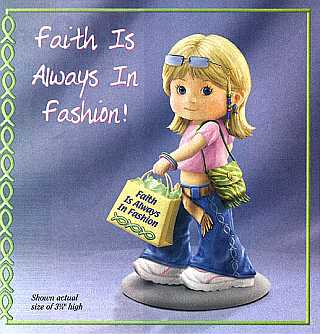
 What I cropped out of the picture is the sickening description for this figurine. You can find it at left. As a freelance commercial writer who’s a Christian, I’d rather be dragged over a pile of broken glass with an alcohol bath chaser than write what you see reproduced here.