
Boomerang Prayer?

Standard

I’m not a “personal journal” blogger, but occasionally I talk about my own life. Though readers may get the impression from my posts that I have all the answers—because I tend to write like I do—there are still many things in life I struggle with. This post is about one of those things. It’s also a call out to readers of Cerulean Sanctum to help me grow as a Christian by understanding something about prayer and life I just don’t get.

In the last few years, my family has been through a lot. We’ve perservered amid some incredibly tough times and I think my wife and I are stronger people for it. We truly learned how to trust God to provide for every need and realized how much we need the community of faith.

We have a comfortably-sized home on thirteen acres of rural Ohio land. Due to some of the struggles we’ve had since we moved in here, we haven’t done a lot of decorating or making it ours. In many ways it is the exact house that the previous owners left behind.

Given that we seem to be past some of the hardships, in the last few months we’ve done some fixing up of our kitchen, probably the one part of the house most in need of updating. The folks who lived here before us left behind major kitchen appliances that were older than the house; when we bought it, I knew the refrigerator, range, and dishwasher had to go.

After being here four years next month, we finally replaced all three with very nice Kenmore units. As the cook and stay-at-home parent, I’ve been ecstatic about these new appliances and extremely grateful that we were able to buy them. We gave the old appliances—they still worked—to a family in our church who could put them to good use.Missing puzzle piece

Here’s where it gets odd for me.

When the new appliances showed up, I thanked God for them and prayed that, given their cost, we would not have any expenses come up that would hurt as a result of their purchase. Specifically, I prayed that we would be spared from two major expenses: hospital visits and emergency car servicing.

Well, within two weeks of this prayer, my son had to go to the hospital (and despite our insurance, we will still pay a lot for the visit) and my wife’s car starting stalling. Then came the check engine light. Yesterday, we forked over $1000 to have the fuel injectors replaced on what is only a five-year old Corolla. The coincidence of this—with a son who hasn’t seen the inside of a hospital since he was born and a car that’s run pretty much flawlessly—is just too much.

What troubles me is that I have a history of this kind of thing in my life. In fact, it occurs so regularly that I am tempted not to pray for (or against) certain things simply because I know that if I do, those very things are going to boomerang in a bad way. Prayers like, “Lord, keep me healthy so we can enjoy this weekend out of town,” (I get sick the day we leave), or “Please God, don’t let this client push up their due date right now because I’m slammed” (the two week due date suddenly becomes two days), or “Lord, I just managed to tighten our belts in such a way that I saved $100 off our monthly budget, thank you!” (and the next day we’re informed our insurance is going up—you guessed it—a $100 a month), seem to work against me far more often than not.

Now before someone tells me I should trust God and not give in to “fearful” prayers, I give you this:

…do not be anxious about anything, but in everything by prayer and supplication with thanksgiving let your requests be made known to God. And the peace of God, which surpasses all understanding, will guard your hearts and your minds in Christ Jesus.
(Philippians 4:6-7 ESV)

That’s pretty much my operating verse here. That’s how I do it. I lay all those things before the Lord and move on.

So why so many outcomes like this?

I’ve been a Christian for almost thirty years, so I’ve got a pretty holistic perspective in general, but this kind of “prayer that goes awry” is one I’m not sure I get. Everything seems to be a bit too coincidental.

You could:

  • Chalk it up to Satan, but then that seems to make him more powerful than God.
  • Say it has to do something with sin in my own life, but if you know me, you’ll know I confess things so as not to be burdened by them.
  • Say it’s just coincidence and that’s life, but it’s too coincidental for my liking.
  • Claim I’m not praying in faith, but honestly, I certainly don’t want those things to happen—and isn’t the Philippians passage the cover here? If we start purposefully holding back requests, where does it end?

Am I the only one who experiences this sort of thing routinely? It’s weird to me and bothers my wife, too. Anyone out there with more wisdom is certainly welcome to shed some light on this for me. After this latest incident, I’m a bit cowed to even open my mouth for requests like this.
The Christian & the Business World #6: The Industrial Church Revolution, Part 3

Standard

World War I stuck a dagger in the heart of Christian triumphalism and capped the rise of postmillennialism. The war over, America was ready to party for any and all reasons, yet it was the intellect that took the fore.

Freud, Marx, Nietzsche, Sanger, Huxley, Russell and Darwin were in vogue. It was all the rage to talk “high and mighty,” and name-dropping of this theorist or that philosopher was commonplace. By now, German higher criticism of the Bible was catching on in the “enlightened” theology departments at the oldest Christian colleges in the nation—Harvard, Yale, and others founded before 1800—and was crushing the life out of true biblical thought there. (Today, it’s hard to believe that schools such as these were founded to produce godly pastors. We’ve learned the lesson of our lack of vigilance the hard way.) Science and philosophy provided every answer and there wasn’t a major city that didn’t feature some form of “World of Tomorrow” exhibit for the residents to explore. Old ideas died or foundered and new ones took their place. It was an age of rationalism in the midst of dance marathons.

Again, the Church had a response to the rationalism, but it was not the measured response of earlier days founded on solid biblical principles. The post-WWI Church found itself in the grip of a Jesus never before considered.

By the 1920s, it was possible to carry a business card and have it say nothing more than “Businessman” and no one would think twice about such a title. Investing in the stock market was a rich man’s habit and a lesser man’s gamble. More than a hundred years of the Industrial Revolution and the rise of corporate America had so benumbed the Church that when President Calvin Coolidge remarked, “The man who builds a factory, builds a temple. Jesus, CEOThe man who works there, worships there,” it wasn’t given much fuss.

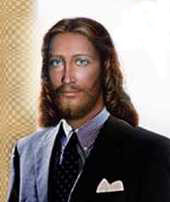
Part of the reason for this lack of condemnation from the Church (apart from the fact that most conservative theologians were busy fighting the battle against higher criticism) was the runaway success of a peculiar little book written by one of the age’s most noted advertising experts, Bruce Barton. His 1925 title The Man Nobody Knows: A Biography of Jesus portrayed the Lord as the “founder of modern business.” And if Jesus Himself had been co-opted, neither would the apostles escape the grasp of the syncretism of business and Christianity, for Barton called them “the greatest sales force in history.”

Looking at Jesus more as CEO than Lord reflected an age when the front pages of newspapers were dedicated to the lifestyles of families such as the Rockefellers, Mellons, Carnegies, and Gettys. Heirs and heiresses to these fortunes commanded center stage. The captains of industry were the role models for the little man. After all, the history of America was the history of pioneers and men who pulled themselves up by their own bootstraps. Each of those wealthy families was headed by a self-made man who had cornered a market by going against the flow. They had a destiny to fulfill, power to grasp, and a dominant will that could take them anywhere. Some of them even went to church on Sundays, and churches were often the beneficiaries of their trusts and philanthropy. In many ways, they were portrayed as the saviors of their times.

Barton’s book was a phenomenon. The fourth bestselling book of 1925, it climbed to number one the following year. Ultimately, The Man Nobody Knows spent more than two years in the top ten. So popular was it that it’s still available for sale today—a rare feat for a non-fiction title from the 1920s. In the end, millions of men and women were intrigued by the “Business Jesus.” Their fears that Corporate America might just be rolling over them were allayed by the fact that Jesus Himself was a businessman. And so the faithful partnership the modern Church in America extended to business was set in stone, a permanence we still feel today.

1925 was a watershed year for another reason, except this one took place far from the reaches of the big city. John Scopes, a high school biology teacher in Dayton, Tennessee, violated the Volunteer state’s constitutional ban against teaching Darwinism in public schools. His trial garnered massive media attention when William Jennings Bryan, failed three-time Democratic candidate for President, signed on as the prosecutor in the case. Bryan became the champion of Christian fundamentalism when pitted against the defendant’s legal counsel, the avowed atheist Clarence Darrow. The trial was broadcast live and radio audiences ate up every second of legal chicanery and posing wrought by both sides.

We all know how the trial ended, but the battle had been lost years before. Darwinism had come to flower in Britain more than fifty years previous, so America was just another step in the long parade. In fact, Social Darwinism, the idea that evolutionary theory explains sociological constructs, had found its perch long ago in business practices. Some people had and some didn’t; prosperity was a function of superior breeding, intellect, and other less classifiable “genetic predispositions.” Natural selection supposedly explained this fact. The witness of the newspapers and their constant trailing after the Rockefellers, Mellons, Carnegies, and Gettys cemented this in the minds of average Americans.

There were other depths reached by Social Darwinism during this time. The growing eugenics movement championed by noted psychologist Havelock Ellis, Margaret Sanger (the founder of what became Planned Parenthood), and a large swath of Catholic and Protestant leaders (either frustrated postmillennialists or those who had succumbed to the liberal theology that had formed from higher criticism), openly worked to separate the genetically pure from the corrupted. The “corrupted” in this case were the usual suspects: immigrants, blacks, and the “lower classes,” in general. Those lower classes were usually determined by one thing: their business status. The vile classism that Social Darwinism fostered had started all the way back in the factories of Britain and had now come to signify the vile racism behind a “Master Race.”

It would be hard to imagine that eugenics and the Social Darwinism that had cultivated it would have been possible without the drastic changes wrought by the Industrial Revolution. If the United States had remained a home-based economy (and free of slavery uniformly), proponents of Social Darwinism would have found it harder to draw the distinctions they promoted simply because any imagined underclass would not have existed.

Instead, the disconnect between what the Bible said about God’s view of Man and what Social Darwinism proclaimed began to tear at the fringes of the Church. A typical churchgoer would mouth the words of hymns, recite Bible verses, and read the Scriptures, but when Monday rolled around it was off to work and the Darwinian dynamic that had subsumed most business practices took over. Some climbed the corporate ladder and some didn’t—to those with a conflicted worldview, the supremacy of Darwin over Christ seemed clear. Better to be a wealthy Darwinian than a poor Christian.

Even today, the fallout of this mentality reigns in Corporate America. People work eight or more hours a day in an environment controlled by a worldview that is, quite simply, anti-Christian, yet few understand the pernicious nature of the worldview governing most of our work. Most of today’s business buzzwords have a distinctly Darwinian source when examined closely. In Christian circles, particularly in men’s groups, the business mantra is to be a “leader.” However, more often than not, “leader” does not mean “servant,” but rather “the one who made it to the top of the food chain.” Jesus is looking for disciples and it is the nature of disciples to be followers. But the average Christian bookstore would quickly fold if it sold Christian business books that claimed to teach people (men especially) how to be good followers.

And so we come to 2005. The troika of the Industrial Revolution, Social Darwinism, and a Church crippled by biblical higher criticism, rationalism, and a dulled reaction time to the sociological changes occurring around it, have spawned the business environment we work in every day. Most folks are oblivious to the insidious nature of Darwinism at work and its stranglehold on most company cultures and practices. That stranglehold extends to the Church, too, as “Jesus, CEO” continues to be the predominant thinking among Christian business leaders and authors who write business books for the Christian market, their failure being the inability to question if the foundation upon which today’s work world exists is actually the wrong foundation. Worse still, if they’ve supported the wrong foundation for business, why are they co-opting that foundation for the Church itself?

In the next installment of The Christian & the Business World, we’ll examine modern business assumptions and what they mean for all of us who work. Look for Binding the Business Strongman in the next day or so.

Previous post in the series: The Christian & the Business World #5: The Industrial Church Revolution, Part 2

Next post in the series: The Christian & the Business World #7: Binding the Business Strongman