I’ve ignored writing on all things Harry Potter over the years, but this weekend forced me to change my mind. With my wife’s sister’s family down for the weekend, we were looking for things to do. Unfortunately for us, the city we live near was in the grip of Pottermania and half the activities in town were geared to the release of the latest book.
I’ve written a few posts about the world of fiction in the last couple weeks, but this isn’t going to be a diatribe about J.K. Rowling’s billions or the quality of her writing. The problem is not one of literary aspirations. To me, Harry Potter is a symptom of the much larger problem.
When I was a kid I watched Bewitched, I Dream of Jeannie, and any host of shows that featured magic. Some Christians would say that I was leaving myself open to all sorts of negative spiritual forces for doing so, but what no one could claim then is that they knew real witches. I certainly didn’t at that time. There weren’t any girls in my school that fancied themselves to be a witch (or even sympathetic to the witch’s cause.) The worst thing you could say about some young woman was that she had the lousy ’70s and ’80s fashion sense to dress just a little too much like Stevie Nicks. But witches? Nah. In fact, it was more likely that guys could be accused of witchcraft because Dungeons & Dragons was insanely popular by the time I graduated from high school. At Carnegie Mellon University in the early 80s I knew guys who skipped all their classes just to play D&D, sitting around getting high and drawing arcane symbols on the walls of their dorm rooms.
While some of the signs for a groundswell were in place even when I was a child, it can be argued that the later syndication of those TV shows I mentioned above lowered the defenses for witchcraft for the generation that came after mine when added to later societal changes. Today, everywhere you look, you can’t seem to get away from all things Wiccan or pagan. In fact, I have to believe that the fastest growing religion in the United States is not Islam, but the same one that has captured so much of the British population in recent years, Neo-paganism. Sorcery, vampire cults, an affinity for the goth lifestyle, even postmodernism—all of it has roots in paganism. Couple this with a societal outlook that is rational but growing more irrational by the day, and Neo-paganism looks ready to explode in the West.
Why? Nature abhors a vacuum. Especially human nature. With Christianity on the down side in the Western world, people who are searching for answers, particularly those answers that cater to humanity’s fallen need to have power and control, are finding what they want in paganism.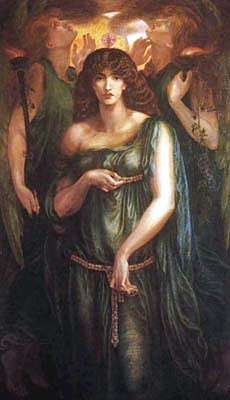 Earth religions are picking up adherents left over from the New Age movement, the children of the Haight-Ashbury crowd, and the rise of “organic culture.” (My wife and I are trying to get an organic farm going and it is shocking how much the “religion” of some organic farmers is rooted in goddess worship and fertility cult thinking.)
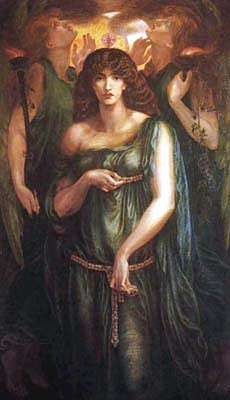
Earth religions have been around nearly as long as there has been a planet with that name. The Bible contains numerous commands of God to keep trees and natural distractions away from His altars lest they be construed to have anything to do with the worship of nature (Deut. 16:21 is an example.) The entire religion of Astarte/Ashera/Ishtar that bedeviled the prophets and kings of the Old Testament is the same earth goddess worship we see today (much of it penetrating Christianity in the form of the Roman Catholic Church’s Marian cult.) There truly is nothing new under the sun.
With the desire to worship the creation rather than the Creator comes the desire to control the creation; this leads us to witchery and the rise of Wicca as a religion to be reckoned with in the United States. While the number of self-identified witches, pagans, and Wiccans is wildly variable (anywhere from 100,000 to over three million adherents in the United States), the one truth is that their numbers are growing rapidly.
But nowhere has there been greater capitulation to Neo-paganism than in the UK. With studies showing that less than 3% of the population of Great Britain attends church on the weekends, Neo-paganism has filled the void left behind by the abandonment of Christianity. Even some high-ranking church officials in that country have been linked to the ancient Druid religion, and druid gatherings have been picking up in number, with more and more people flocking to see druidic ceremonies performed.
So it comes as no surprise that Britain gave Harry Potter to the world. Say what you will about the books, they are certainly a phenomenon we’ve never seen before. The problem here lies in the fact that Harry Potter could very well be the poster child for Neo-paganism. As a recruiting tool par excellence, nothing will break down the walls to the further acceptance of Neo-paganism than a boy sorcerer intent on saving his friends, his school, and the confused, non-“gifted” Muggles from evil machinations that threaten the world.
The problem then of Harry Potter that separates him from other books featuring magic is not only the craze that has developed around the books, but that reality is being blurred. When I was watching Bewitched I knew that witches weren’t real. People didn’t go around saying that they were witches. It put a kibosh on anyone thinking that being a witch was a likely choice of religion. But not so today. In my county alone there are several recognized covens. Elsewhere I had mentioned that a young couple came into the Christian bookstore I worked in many years ago and told us they had just left a coven that was actively attacking the bookstore via prayers and incantations. Needless to say, I was naive to this modern reality.
We cannot afford to be naive. If Harry Potter had hit the scene in the 1940s, I believe his impact would have been negligible compared with today. But given that the environment into which he’s flown is primed for his brand of Neo-paganism, I believe the influence of Rowling’s books is far more dangerous. While some might claim that I’m cutting my own throat as a writer of speculative fiction, I can’t keep silent while a generation’s defense against Neo-pagan thought is being systematically disabled by what many Christians consider a harmless story. Fantasy novels of all kinds are some of the bestselling books in bookstores and it is safe to say that the most rabid fans are the ones who are most likely to self-identify not as Christians, but something more akin to Neo-paganism.
Although this may seem like a broad brush, the fact remains that the Harry Potter generation will be the backbone of Neo-paganism in the next dozen years. They’ve been groomed with what on the surface was a mere gripping read, but which planted a seed that will grow into a noxious fruit that we Christians of 2020 will have to confront. We must fight it now and work to deprogram kids before they grow up as enemies of the Lord.

 fellow professional writer (and drummer) Matt Self of The Gad(d)about.