
How Would Jesus Blog?

Standard

I’ve been on the Internet since the time when it was the ARPANET defense network linking universities and the military.

I was emailing people in 1981.

I was at Carnegie Mellon University when the smiley was invented there.

I owned a 300 baud modem.

I watched USENET spring into being, with its rec dots and alt whatevers.

I played in a band with one of the guys who developed the Netscape browser.

I had my own domain name in 1997.

I beta-tested Google.

I was blogging in 2001.

In other words, my cyberspace geek cred is pretty high.

I say all that to say this: Online discourse is only getting worse.

One could say that this is because the intellectual elites have ceded the Web to the great unwashed. Cyberspace is now a commodity. And as with most commodities, anything now goes.

One could argue that the Second Law of Thermodynamics applies even to human conversations, and if the Internet is any reflection, no rebuttal would be forthcoming.

Let’s play a game.

Let’s pretend to be aliens from another dimension who happen to gain access to the Internet. And let’s say that we start reading about this thing called Christianity and the people who adhere to it.

What would our general impression be of Christian people?

If the Internet is the well of information from which we draw, then would it be unfair to characterize Christianity as a religion of anger and dissension?

I’m no alien, but I’ve been around long enough online to answer that question with a reluctant yes.

And it’s not just on the Internet. The general level of anger and dissension among Christians has reached a level that resembles nothing I can recall in my younger Christian days. Jesus weptIt’s like we’ve had our skin torn off and we think anyone and everyone is ready to throw salt on us.
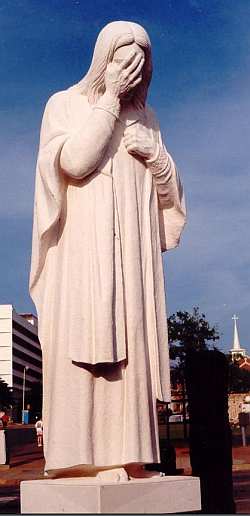
I don’t understand the glee with which some Christians tear into others. I don’t understand respected pastors, who should know better, making smug tweets about this person or that. I don’t get it when people use online forums to gather wood for figuratively burning other Christians alive. I don’t get it that no one seems to ask if it’s wise to post that wicked barb before they hit the Enter key.

I don’t get the massive pride among some who feel they are always the best person to administer the corrective beat down. I don’t know where people get their imprimatur to verbally assault incomplete, imperfect brothers and sisters in the faith. And I don’t know why all this must occur online for the world to see.

The bent reed is broken. The smoldering ember snuffed.

Is anyone else grieved? God knows that I am. And if I am, I wonder what the average person who hasn’t been a Christian for almost 35 years thinks. That figurative “alien.”

I’m grieved that when I see Christianity represented on the Web by the ordinary adherents of that faith, so much of the discourse is angry. Angry at politicians. Angry at cultural leaders. Angry at Christian leaders. Angry at other Christians of extreme ordinariness. Angry at every perceived foe. Anger everywhere one turns, and especially on the Web.

Honestly, why would anyone want to be a part of that?

I’ve reached the point where I think we are doing the Lord a great disservice by all this anger. American Christians are now defined by what ticks us off. Or who ticks us off. And there’s not a lot of Jesus at the core of that.

The words of Jesus:

And he opened his mouth and taught them, saying:

“Blessed are the poor in spirit, for theirs is the kingdom of heaven.

“Blessed are those who mourn, for they shall be comforted.

“Blessed are the meek, for they shall inherit the earth.

“Blessed are those who hunger and thirst for righteousness, for they shall be satisfied.

“Blessed are the merciful, for they shall receive mercy.

“Blessed are the pure in heart, for they shall see God.

“Blessed are the peacemakers, for they shall be called sons of God.

“Blessed are those who are persecuted for righteousness’ sake, for theirs is the kingdom of heaven.

“Blessed are you when others revile you and persecute you and utter all kinds of evil against you falsely on my account. Rejoice and be glad, for your reward is great in heaven, for so they persecuted the prophets who were before you.

“You are the salt of the earth, but if salt has lost its taste, how shall its saltiness be restored? It is no longer good for anything except to be thrown out and trampled under people’s feet.

“You are the light of the world. A city set on a hill cannot be hidden. Nor do people light a lamp and put it under a basket, but on a stand, and it gives light to all in the house. In the same way, let your light shine before others, so that they may see your good works and give glory to your Father who is in heaven.”
—Matthew 5:2-16

Blog Post Printing Re-Enabled

Standard

At one point, individual posts here could be printed in their own print page, which included the full list of embedded links within a post.

That feature, which broke when I restyled the site last year, is now repaired.

You can’t print from the front page, but if you click on a link to an individual post, the print option is available near the end of the single post.

Sorry that the text is a bit bunched together. The CSS for the text indents works, but I can’t seem to get it to work right for line spacing between paragraphs (margin and padding CSS aren’t working, for some reason). But hey, it saves paper, right?  😉

YOU Feed Them

Standard

Now the day began to wear away, and the twelve came and said to him, “Send the crowd away to go into the surrounding villages and countryside to find lodging and get provisions, for we are here in a desolate place.” But he said to them, “You give them something to eat.” They said, “We have no more than five loaves and two fish–unless we are to go and buy food for all these people.” For there were about five thousand men. And he said to his disciples, “Have them sit down in groups of about fifty each.” And they did so, and had them all sit down. And taking the five loaves and the two fish, he looked up to heaven and said a blessing over them. Then he broke the loaves and gave them to the disciples to set before the crowd. And they all ate and were satisfied. And what was left over was picked up, twelve baskets of broken pieces.
—Luke 9:12-17

I’ve probably heard more sermons on the feeding of the 5,000 than just about any other miracle in the Bible. That said, I don’t think I’ve ever heard a sermon on the aspect of it I’m going to write about today.

Some people will contend that I’m critical of the Church. Fact is, I love the Church. I want to see the Church be all she can be, because I know that when she walks in the fullness of her beauty, she takes on the transcendence of her Lover and the world around her transforms.

Which is why I am so crestfallen when I hear Christian people tell me how they are suffering in the midst of the plenty that is their own local church. Basket of breadI hear from people with basic needs that any person in the church could meet with a modicum of effort, yet that need goes unfulfilled.

Honestly, I can think of few things more crushing to the spiritual life of another than to sit in church on Sunday and hear a sermon on God’s bounty, surrounded by people who are abounding, but not being one of them.

Increasingly, there exists a Christian rhetoric that states, I don’t have to do anything to help you because God will help you on His own, if someone prays hard enough. The problem is that the more I read the Scriptures, the more I’m convinced that mentality is the exact opposite of what God is trying to tell us about the way He works.

In the feeding of the 5,000 in Luke, Jesus makes—what is to me, at least—one of the most startling statements in the New Testament. The disciples, sensitive to the growing need of the crowd for food, alert Jesus to the problem, but He responds that the disciples should feed them. Almost instantly, the excuses start.

How the rest of the miracle unfolds is also telling. It happened while the disciples finally did the work that Jesus requested. As they handed out the food from the baskets, the miracle progressed. It didn’t happen before the work. In other words, Jesus didn’t make extra baskets of food materialize at His feet before the dazzled onlookers. Only as the disciples walked from person to person handing out food did the true nature of the miracle unfold. Jesus asked them to feed the crowd, and they did.

We gloss over that the disciples were active participants in the work of meeting the needs of others. The disciples were partners in the miracle.

Paul writes:

How then will they call on him in whom they have not believed? And how are they to believe in him of whom they have never heard? And how are they to hear without someone preaching? And how are they to preach unless they are sent? As it is written, “How beautiful are the feet of those who preach the good news!”
—Romans 10:14-15

In short, the Lord wants the Gospel to go out, and it goes out because a real person delivers it. No one will hear unless a flesh and blood human does the work.

Paul also writes this:

Therefore, we are ambassadors for Christ, God making his appeal through us.
—2 Corinthians 5:20a

The king empowers an ambassador to be his full representative. An ambassador can make decisions and perform actions as if the king himself were making or performing them. The king’s decree and charge make that power possible.

This comes by the Holy Spirit living in us. A couple verses before, Paul wrote this:

Therefore, if anyone is in Christ, he is a new creation. The old has passed away; behold, the new has come. All this is from God, who through Christ reconciled us to himself and gave us the ministry of reconciliation; that is, in Christ God was reconciling the world to himself, not counting their trespasses against them, and entrusting to us the message of reconciliation.
—2 Corinthians 5:17-19

Note well that final phrase.

Paul also writes:

And we all, with unveiled face, beholding the glory of the Lord, are being transformed into the same image from one degree of glory to another. For this comes from the Lord who is the Spirit.
—2 Corinthians 3:18

The new birth and our transformation into Christ’s fullness make it possible for us to be ambassadors.

2 Corinthians 5 concludes with this amazing statement:

For our sake he made him to be sin who knew no sin, so that in him we might become the righteousness of God.
—2 Corinthians 5:21

Christian, you are the righteousness of God! Wherever you go, you are His salt, His light, His full representative, His very image.

All Scripture is breathed out by God and profitable for teaching, for reproof, for correction, and for training in righteousness, that the man of God may be competent, equipped for every good work.
—2 Timothy 3:16-17

…for it is God who works in you, both to will and to work for his good pleasure.
—Philippians 2:13

For we are his workmanship, created in Christ Jesus for good works, which God prepared beforehand, that we should walk in them.
—Ephesians 2:10

Are we walking in those good works that God prepared beforehand?  Are we seeing the need and filling it because God has equipped us to meet needs because He Himself lives in us? Or are we reading the Bible just to fill our heads with more knowledge about work we aren’t doing?

This passage is telling:

And a man lame from birth was being carried, whom they laid daily at the gate of the temple that is called the Beautiful Gate to ask alms of those entering the temple. Seeing Peter and John about to go into the temple, he asked to receive alms. And Peter directed his gaze at him, as did John, and said, “Look at us.” And he fixed his attention on them, expecting to receive something from them. But Peter said, “I have no silver and gold, but what I do have I give to you. In the name of Jesus Christ of Nazareth, rise up and walk!” And he took him by the right hand and raised him up, and immediately his feet and ankles were made strong. And leaping up he stood and began to walk, and entered the temple with them, walking and leaping and praising God.
—Acts 3:2-8

What is notably absent from that healing and the way Peter and John worked? I’ll let you think about that for a while.

God intends for us Spirit-filled believers to do the work. We’re already equipped. We’re already charged.

But Dan, what about these?

I am the vine; you are the branches. Whoever abides in me and I in him, he it is that bears much fruit, for apart from me you can do nothing.
—John 15:5

But he said, “What is impossible with men is possible with God.”
—Luke 18:27

Folks, these two verses are the poster children for misapplying Scripture and for making excuses for dumping all the responsibility back on God to make anything happen.

The truth is that God lives in you. He is always in you. Where you go, He is. You are the righteousness of God. Anything is possible because God is working through you.

There is NEVER a reason for a fellow believer to be in want. NEVER. If a local church contains people with plenty and people in want, there’s only one word for that church: Ichabod. The glory has departed.

This issue makes me angry. It makes me furious when the Church has been equipped, approved, and charged with the task by God, yet the people in the Church won’t do the work. They throw it back in God’s lap and ask Him to do the work for them instead. As I see it, that’s a complete dismissal of our identity in Christ and a rejection of the Holy Spirit in us.

How ironic that we abort our responsibility when confronted with people in need, yet what follows are the first things the newly Spirit-filled Church did:

And they devoted themselves to the apostles’ teaching and the fellowship, to the breaking of bread and the prayers. And awe came upon every soul, and many wonders and signs were being done through the apostles. And all who believed were together and had all things in common. And they were selling their possessions and belongings and distributing the proceeds to all, as any had need.
—Acts 2:42-45

If God puts someone with a legitimate need before me, there’s nothing for me to pray about. I already know what to do. I’m to do the work and meet the need as best I can in light of all that Christ has given to me and done for me. And if the need is too great, then I pull the rest of the Church in and we meet the need. When we do the work because we have the faith and the equipping for it, then the miracle will progress through us because of what Christ has already done in us.

If we learn no other truth this year, that one will be enough.