
For 2006: The Church’s Brave New Brain—Part 2

Standard

In the previous segment of this mini-series, we left off with the Church grappling with the transition from the Information Age (and its emphasis on data and logic) to the Conceptual Age (with its emphasis on design and empathy.) The fundamental switch here aligns with the move from left-brained to right-brained thinking.

Where the Church gets steamrolled in this transition is that it's been stuck in the tar of left-brained mode for a couple hundred years. When the Enlightenment made it all about what we thought rather than did, the Western Church bought into living totally out of its left hemisphere. The result has been an entire group of people within society disenfranchised by the one group tasked with disenfranchising no one.

If we were honest with ourselves, we Christians of 2006 should question where all our creative types vanished to. How many Christians do we know who make their entire living as full-time artists, novelists, musicians, and actors? Compare that with how many Christians we know who are middle managers, accountants, engineers, or computer IT gurus.

Two hundred years ago, Christians not only created the art, they supported it. I would dare say that the vast majority of art in Christian households today is not only NOT created by Christians, it's barely passable as art. Our slide to the left brain over the right created a dearth of Christian artists and their lack left us stuck with whatever was most easily mass-marketed. The result? Today's Christians are too often the people responsible for much of the kitschy garbage passed off as "art" that we see today. A gut-check is needed here. Compare what hangs on the wall of your local museum with that of your local Christian bookstore. I don't think I'm stretching when I say the artistic output of today's Evangelicalism might represent the nadir of artistic expression in all of Christian history.
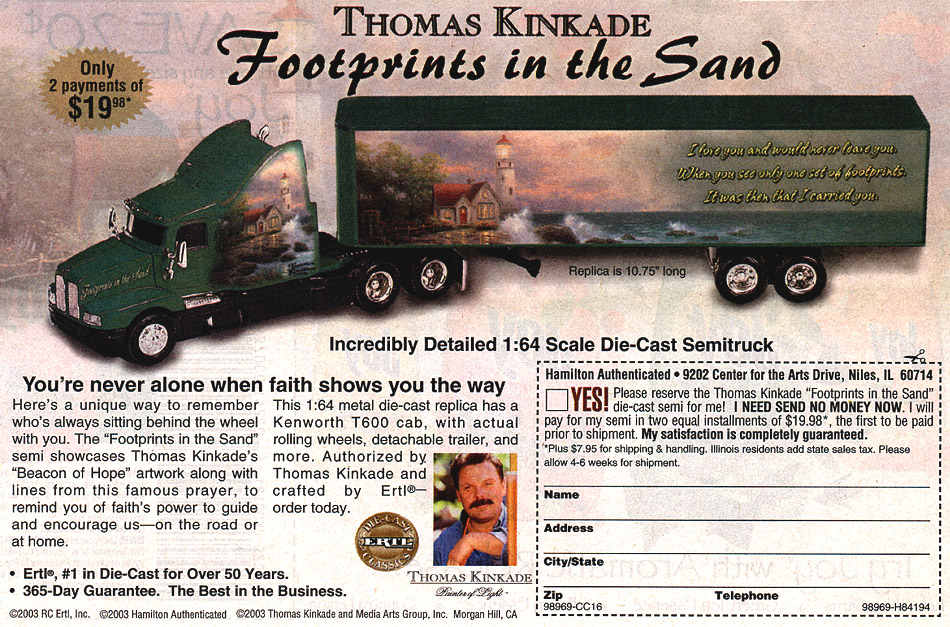
Kinkade keeps on truckin'!

{Click on image to appreciate the full-sized horror of it all (pops)}

If we don't like the art that artists make today, we have our lack of patronage to blame for this, in part. Christian artists found the rising anti-art backlash in the Church meant that they could no longer afford to make a living as artists creating art solely for Christian crowds. As a result, Christian artists were stuck between putting food on the table selling art that appealed to secular crowds or starving to death trying to sell to an increasingly fickle Christian audience. Yes, many of them gave in to the prevailing nonsense that passes itself off as contemporary art today, but in the end we didn't support them and they had to eat. (Not trying to make excuses, just trying to point out reality.)

You know why the artist is different? Simple: he sees the world through a different part of his brain. Where the Church in America absolutely fumbled the Gospel here is that we automatically equated his different way of thinking with error. Not only that, but we painted (ugh!) the artist and all his friends as the very thing that is wrong with the world today. Strangely enough, he was thinking the same thing about us.

Now, as we enter 2006, we have an impasse. We decided we liked our churches stripped of anything that resembles art, good or otherwise. (I don't mean to pick on the Baptists here, but could there be anything more soul-anesthetizing than the architecture and interior decoration of your typical Baptist church of the last thirty years? Honestly, why can't our congregations inspire artists in their midst to create beautiful church art to offer up to God the artistic gifts He bestowed on those folks? It seems every kind of service is appreciated in our churches except the artistic.) The message to the artist was clear: your paintbrush is the devil's instrument.

Think what our churches would be like if we thought that everyone involved in the computer industry was creating the Beast's pathway. What if the engineers were building the antichrist's throneroom? And the accountants were only presiding over the one world money system and that infamous mark? Do you think that any of those left-brainers would hang around our congregations? Yet, in many cases, this is what happened to the right-brainers.

But guess what, left-brained Christians? Artists are the new power class in the Conceptual Age. You know, the bohemian with the soul patch. And guess what again? We drove his kind out of our churches with our total emphasis on left-brained thinking and our complete inability to appreciate what his right hemisphere (and his musical, empathic, theatrical, artist's bent) brought to our congregations.

But now that empathic artist is the one in charge. Left-brained Christians are gnashing their teeth over this. I see it every day. And the gnashing is only going to increase unless left-brained and right-brained Christians bury the hatchet—and not in each other. God created both left-brained and right-brained thinkers; it's about time the Church honored both.

In the next installment of this mini-series, we'll see how the Church needs to adapt to this cultural change and what it means for how we do ministry in 2006 and beyond.

Stay tuned!
For 2006: The Church’s Brave New Brain—Part 1

Standard

This final post of 2005 begins a short series that examines what I believe to be a pressing issue that is flying under the radar of the American Church. If we do not address it humbly and prayerfully in the coming year, I believe we American Christians will preside over a Church (and societal) implosion of our own making.

The thought that I cannot escape is about just that: thought. Our brains consist of two hemispheres, each with a God-imparted function. The left hemisphere handles language and logic, the right, narrative and art. The left excels in processing the batting averages of the 1927 Yankees and understanding that pigs can't fly, while the right finds wisdom and beauty in a poem or painting.

If Christianity in 2005 can be examined in any light, I would offer that the battles we are now seeing for the heart, mind, and soul of our Faith are those of the right and left hemispheres.

Some reading this will view what I have to say as nothing more than the ongoing tussle between modernism and postmodernism, or the Enlightenment and the post-Enlightenment. On some levels, this would be true. However, I do not believe it is necessary outcome that one or the other of those labeled sides should win, but that God's mind about our minds holds the key to where His will for us as a Church dwells.

Talk to anyone who studies trends and you'll hear them proclaiming that we are moving from the Information Age into the Conceptual Age. Where the Information Age's hallmark is the processing of data, the sine qua non of the Conceptual Age is design. Now that even a six-old can jump on a computer and find out facts about dinosaurs that paleontologists of thirty years ago had to spend months unearthing, data is cheap. The Information Age's attempt to make it exclusive to drive profits failed. It is no longer enough to have data. The power center has moved away from data-crunching to creating what machines cannot: objects of beauty. The new ruling class has shifted from computer systems analysts to graphic designers.

What has been commodified in the process is the very heart of the last Age. There are dozens of MP3 players on the market, but despite the fact that each is a technological marvel undreamed of twenty years ago (and with a price point that is startling), only one of those players has captured the zeitgeist of the transition from the Information Age to the Conceptual Age. Why is Apple's iPod outselling all the other MP3 players combined? Design. There are more-powerful MP3 players on the market, some selling for less than the iPod, but Apple's MP3 player dominates all others because Apple understood that design matters. As a result, the iPod is now iconic.

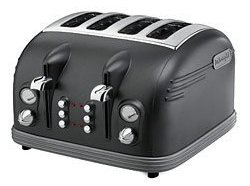
Design has triumphed as a result of the wealth of our day. A hundred years ago, a toaster was remarkable. Just having one of those expensive devices put you in the swanky minority. Yep, it's a toasterToday, though, it is no longer enough to build a toaster that toasts bread. We've seen toasters. Virtually every Western home has a toaster. Because a $7 toaster is possible, the companies that make toasters can't operate on the hope that people want their bread toasty. Something as humble as a toaster has to make a design statement or it will not sell. That's a profound paradigm shift. (Take a few minutes to marvel at what toasters look like today if you don't believe me. Note also the price paid for cutting-edge toaster design.)
The fallout of the design explosion that heralds the Conceptual Age is the ascendancy of the design-rich right hemisphere of the brain over the left. This, too, marks a sea change. Most of us did not grow up in a time that placed right-brain thinking over left. Our heroes are thinkers, not artists. Our educators drilled into us the truth that facts won out over concepts, our elders belaboring the reality that diagnosticians were the cream of society, able to follow a well-memorized flowchart to whatever answer was desired. There was the future! We had the data to prove it.

But they were wrong.

What is most frightening about the audacity of our elders to so drastically miss the future is what that failure has meant for the Church. So stay tuned for the second part of this post—next year—to find out how Christians must live in our brave new Conceptual Age world.

Tags: Artists, Designers, Design, Thinking, Feeling, Brain, Church, Faith, Christianity, Jesus, God

Hidden Messages of American Christianity: Kneeling at the Altar of Excellence

Standard

The Happy PrinceThis is the second in a series of posts covering the hidden messages that sneak into American churches’ proclamation of the Gospel. For more background, please refer to this post.

Fourteen years ago I sat among the throngs at Willow Creek Community Church and heard Bill Hybels talk about Christian excellence. Taking time to note that all their musicians were professionals, Hybels went on about the fact that unchurched Harry and Mary couldn’t tolerate a church service that wasn’t excellent and just as slick as anything you’d find on TV.

To a student of Christian Education looking to make church programming better, those words were true and right. Too often we church people had put up with off-key singers, monotone Scripture readers, and SAG-card-lacking actors in our church dramatic productions. It was all kind of tacky. Of course non-Christians would flee our little exercises in indulging the talentless.

But then a thought got the better of me.

As a pimply-faced teenager, I’d more than once walked out on stage in my old Lutheran Church and offered up my less than accomplished skills to the people of that church and to the Lord. I wasn’t Buddy Rich back then (or now), but I was encouraged to use my meager drumming ability for the youth productions we put on during Easter and Christmas. I’m almost positive I played way too loud. When I picked up a guitar later, the organist/youth minister encouraged me to play that instrument, too, and to even solo, playing songs I’d written.

Here at Willow Creek, though, they probably had armed guards with M-16s barring the stage from the likes of me. I’d certainly play or sing to the best of my ability, but it would never be good enough for “Christian excellence.”

I can’t really point to a time when Christianity turned professional. Researching older books has not turned up the first occurrence of this idea of excellence. Yet I have to believe that we lose something when we insist that only the remarkably gifted be allowed to share their talents with the family of God.

I also suspect that on any given Sunday, the truly remarkable people are in short supply in most churches. Sure, Willow Creek has a mid-size city’s worth of people from which to draw upon reserves of excellence (or they pay outsiders to come in and do what they do so excellently), but your average church does not. Still, that message that everything has to be perfect continues to trickle down from the brightest and best churches to those that are jealous to mimic churches of excellence.

How many churches today are more stringent in just who gets to do what on a Sunday? Growing up, I had the luxury of people who understood that encouraging youth to perform with the burgeoning talents they possessed was essential to a healthy church. I fear that today more and more churches are loathe to ratchet down their insistence on excellence to allow that.

The doppelganger of excellence is success. Success means reducing failure, and nothing spells excellence more than eliminating mistakes. The inroads that business practices made into our churches through the Church Growth Movement have enshrined success as the be all and end all. The only problem is that now there is no room for true grace for the fallen. Just as a company can’t go to shareholders and confess they had a bad quarter without paying the penalty, so our churches are becoming places where failure isn’t tolerated for very long. (We’ve all heard the aphorism that the Church in America is the only place where we bury our wounded, right?) If recent bestselling “Christian” book Your Best Life Now by Joel Osteen is any indication, success is the new goal of the Christian faith. So much for all those martyrs. Horrible failures all.

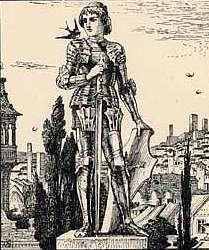
One of the most moving stories I have ever read is Oscar Wilde’s “The Happy Prince.” Despite his being jailed for debauchery by order of Queen Victoria, Wilde at least understood that the Gospel isn’t pretty. It’s not about success or excellence, but about the bloodied remains of the Messiah nailed to rough lumber. If you are not familiar with Wilde’s lovely story, I would heartily encourage everyone to read “The Happy Prince” at this link (pops) before going on.

The story tells of a gilded statue dubbed “The Happy Prince” erected in honor of a long-dead prince who was known for his lightheartedness. As winter approaches, the bejeweled statue befriends a stray swallow on his way to the warmth of Africa. The swallow is concerned at the statue’s sadness over the plight of the downtrodden in the city, so at the statue’s request, the bird begins stripping all the gems and gold leaf off the Happy Prince and giving them away to the needy. In time, there is nothing precious left of the statue, and the dedicated swallow who once told exotic tales of Egypt to the statue, is chilled and exhausted.

Wilde concludes the story:

The poor little Swallow grew colder and colder, but he would not leave the Prince, he loved him too well. He picked up crumbs outside the baker’s door when the baker was not looking and tried to keep himself warm by flapping his wings.

But at last he knew that he was going to die. He had just strength to fly up to the Prince’s shoulder once more. “Good-bye, dear Prince!” he murmured, “will you let me kiss your hand?”

“I am glad that you are going to Egypt at last, little Swallow,” said the Prince, “you have stayed too long here; but you must kiss me on the lips, for I love you.”

“It is not to Egypt that I am going,” said the Swallow. “I am going to the House of Death. Death is the brother of Sleep, is he not?”

And he kissed the Happy Prince on the lips, and fell down dead at his feet.

At that moment a curious crack sounded inside the statue, as if something had broken. The fact is that the leaden heart had snapped right in two. It certainly was a dreadfully hard frost.

Early the next morning the Mayor was walking in the square below in company with the Town Councillors. As they passed the column he looked up at the statue: “Dear me! how shabby the Happy Prince looks!” he said.

“How shabby indeed!” cried the Town Councillors, who always agreed with the Mayor; and they went up to look at it.

“The ruby has fallen out of his sword, his eyes are gone, and he is golden no longer,” said the Mayor in fact, “he is little better than a beggar!”

“Little better than a beggar,” said the Town Councillors.

“And here is actually a dead bird at his feet!” continued the Mayor. “We must really issue a proclamation that birds are not to be allowed to die here.” And the Town Clerk made a note of the suggestion.

So they pulled down the statue of the Happy Prince. “As he is no longer beautiful he is no longer useful,” said the Art Professor at the University.

Then they melted the statue in a furnace, and the Mayor held a meeting of the Corporation to decide what was to be done with the metal. “We must have another statue, of course,” he said, “and it shall be a statue of myself.”

“Of myself,” said each of the Town Councillors, and they quarrelled. When I last heard of them they were quarrelling still.

“What a strange thing!” said the overseer of the workmen at the foundry. “This broken lead heart will not melt in the furnace. We must throw it away.” So they threw it on a dust-heap where the dead Swallow was also lying.

“Bring me the two most precious things in the city,” said God to one of His Angels; and the Angel brought Him the leaden heart and the dead bird.

“You have rightly chosen,” said God, “for in my garden of Paradise this little bird shall sing for evermore, and in my city of gold the Happy Prince shall praise me.”

When we are in the grips of the message of excellence and success we become like the Mayor and Town Councillors in the story. Our ability to see true beauty in the less than perfect is stymied and along with it the beauty of the Gospel.