In the previous installments of this series (#1, #2), we examined the increasing role that right-brained thinking will take in our era and what that means for an American Church largely given to operating out of the left hemisphere.
Having been increasingly disenfranchised by Evangelicalism in America, right-brained thinkers fled to other non-Evangelical Christian sects or abandoned the Church altogether. 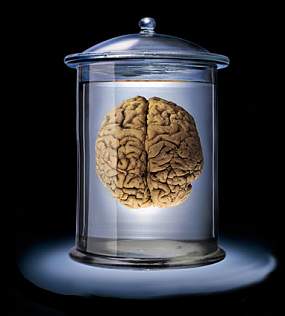 The irony of this flight is that conservative Christians have lamented the death spiral of our culture, fighting tooth and nail against the threat of degraded culture, a culture largely derived from the vacuum created by the same conservatives' inability to keep the right-brainers in the pews.
Now the world is changing and left-brainers aren't adapting well. The transition from the left-brained Information Age to the right-brained Conceptual Age is creating a paradigm shift so extraordinary that churches in this country will need to adapt or find themselves increasingly marginalized as what is deemed essential in communication shifts from data, facts, and logic to relationships, art, and narrative. The problem facing the Church in this dramatic shift is that the whole of Christendom can't find a balance point from which to address this change. We've been so long in the left-brained aspect of Christianity that incorporating right-brained thinking in our message smacks of compromise to some. But right-brained people, long disenfranchised both inadvertantly and calculatingly, want to know Christ, too. And in many cases, our heavily left-brained presentation of the Gospel hasn't gotten through to them. Jesus is our model. Note his teaching method in the following:
Then the Pharisees went and plotted how to entangle him in his talk. And they sent their disciples to him, along with the Herodians, saying, "Teacher, we know that you are true and teach the way of God truthfully, and you do not care about anyone's opinion, for you are not swayed by appearances. Tell us, then, what you think. Is it lawful to pay taxes to Caesar, or not?" But Jesus, aware of their malice, said, "Why put me to the test, you hypocrites? Show me the coin for the tax." And they brought him a denarius. And Jesus said to them, "Whose likeness and inscription is this?" They said, "Caesar's." Then he said to them, "Therefore render to Caesar the things that are Caesar's, and to God the things that are God's." When they heard it, they marveled. And they left him and went away.
—Matthew 22:15-22 ESV
What we find in Matthew 22 is a classic case of logical teaching addressed to the left-brained intelligentsia of the day. The Pharisees, Sadducees and scribes who were constantly trying to trap Jesus into saying something that violated the Law were operating out of their tendency toward facts, data, and logic. Most times in the Gospels when we see people marveling at what Jesus said, more often than not it is a left-brained teaching He has given; He's trumped the intelligentsia at their own game.
But that is not the only way He taught:
And he told them many things in parables, saying: "A sower went out to sow. And as he sowed, some seeds fell along the path, and the birds came and devoured them. Other seeds fell on rocky ground, where they did not have much soil, and immediately they sprang up, since they had no depth of soil, but when the sun rose they were scorched. And since they had no root, they withered away. Other seeds fell among thorns, and the thorns grew up and choked them. Other seeds fell on good soil and produced grain, some a hundredfold, some sixty, some thirty. He who has ears, let him hear." —Matthew 13:3-9 ESV
Here we have narrative, the backbone of right-brained teaching. The images, in stark contrast to the Matthew 22 passage, are metaphorical. Jesus ends by saying that those who can understand should understand—not a left-brained summation at all. In most cases we do not see Jesus teaching the intelligentsia using parables—those are usually shared with the common people.
Jesus taught both ways: literally and metaphorically. If He truly is our model, we need to understand the balanced model He gave us. The pendulum is swinging from left-brained to right-brained. Where we Christians need to be wise is that we can't jump all the way over to the right-brained side, even if the world goes that way. But neither should we hoot about being dragged to the middle because, frankly, we need both approaches if we are to model the Gospel to the world in the same way that Jesus did.
"Change" becomes the word of agony and ecstacy here. Left-brainers have long viewed change as meaning that the Gospel will be changed. They have every right to fear losing the heart of the Gospel to overly nebulous and metaphorical language. On the other hand, I would offer that our failure in America (and other parts of the West) is that we've presented the Gospel in a way that is too left-brained. The result is that we've inoculated many people against Jesus.
Where this comes into play is when we start talking about changing the way we present the Gospel in 2006 and beyond. Large swaths of our culture are inoculated against the Gospel because they've heard it as nothing more than a set of facts for so long that they're immune to it. In the days of the early Church, no one had heard the message of Jesus. Today, though, people in America who have not heard of Jesus are a rarity. Because of this, the way we present the Gospel to that inoculated group must change to add more right-brained presentation. This does not mean that the Gospel is changed or compromised! Only that we consider enhancing our message with narrative, empathy toward others, the arts, and the other hallmarks of the right brain.
No longer can we rely on left-brained methodologies alone. The left-brained approaches worked okay (but not perfectly) in a culture skewed toward left-brained thinking. But as we've seen, the left-brained world is surrendering its crown to a brave, new, right-brained world.
We must also raise up the next generation of Christian right-brain thinkers to take back the cultural lead in the arts. Christians once dominated the arts, but do so no longer. Our lack in this area is telling to the lost. We've inadvertently sent the message that Christianity is the antithesis of all that is beautiful and creative. This clearly dishonors the Lord! Why should the lost be attracted to a warped Christianity that has so fervently stomped on the creative community the last hundred and fifty years? We look like we hate life.
Sadly, we look like we hate each other, too. I've blogged many times in the last year about the Traditional Church/Emerging Church war. That this war is left-brained versus right-brained should be obvious to anyone who is willing to stand back and look at the two sides objectively. The selling points of the Emerging Church are directly out of the right-brained handbook: community, arts, relationship, sensory experience, and mystery. Likewise, the Traditional Church's talking points have long been doctrine, knowledge, tradition, individuality, and certainty. Where the two sides cannot agree is that their strengths are both good! And the weaknesses on both sides are terrible—easily ignored by the afflicted side, too.
If the Church is to be all Christ desires of it, then we must take action to resolve this battle of the left and right hemispheres. One of the most memorable ads of the 20th century went like this:
{While eating their favorite food, two people walking down the street collide.} "You've got chocolate in my peanut butter!" "And you've got peanut butter on my chocolate!" Two great tastes that taste great together…
Reese's Peanut Butter Cups, right? We all know that one. Many of us will agree that chocolate and peanut butter blend nicely for a taste that's more than the sum of its parts. I like peanut butter and I like chocolate—but I'm crazy about them together. When the Traditional Church and the Emerging Church fight, it's a little bit like "I love my peanut butter and hate your chocolate!" and "Oh yeah? Well I love my chocolate and hate your peanut butter!" Meanwhile, we're missing how well they go together when mixed properly. It's like that with our brains, too.
I got the idea for this series from the story of Jon Sarkin in Reader's Digest (January 2006). Sarkin, a chiropractor (left-brained), suffered brain damage after a botched surgery. Part of the left side of his brain was destroyed. What was unleashed in the aftermath of his trauma was a buried artistic skill that has since been featured in The New Yorker and snapped up by art collectors. Yet while he gained something post-surgery, he also lost something.
The Church is not meant to live like a stroke victim. We can't gain a skill at the expense of another. God made each of us with two hemispheres. I believe that Adam expressed himself well out of both sides of His brain. More to the point, the Second Adam, Jesus Christ most certainly did. Not only did He teach to both sides of the brain, but His chosen profession, carpentry, is expressed through the rigor of facts and the grace of creativity.
The corpus callosum is a band of nerves that connects the left and right hemispheres of the brain. If ever we needed someone to be that part of the Body of Christ, it's now. We need people who can bridge that gap and bring doctrine and beauty, facts and mystery, and community and individuality together. Those might sound completely incompatible, but to a bridge person, they're not. The Church's brave new brain must work completely out of both sides if we are to fully reach the world for Christ and live in the fullness of what Christ gives us.
With the world shifting toward the right hemisphere in the way it thinks, we better beef up that side of our own if we are to bring the whole Gospel to the whole Man. Even then, just being in our right, earthly minds is not enough. We need to incorporate the mind of Christ, a mind that goes beyond earthly thinking into the realm of faith, the invisible, and the impossible.
But that's a whole 'nother series.
Thanks for sticking with this one. Hopefully it challenged both sides of your brain!

 I met with a friend the other day for lunch. He's a good man with plenty of God-given vision for the Kingdom, but he's discouraged.