
The Inevitable Tsunami

Standard

I had two intriguing posts I could’ve filled this spot with today. One riffs on the Kirk Cameron exhortation to SBC pastors, while the other deals with the balance of Word and Image in Christian faith and practice.

But I won’t be writing on either one today.

Being a blogger means coming up with penetrating commentary day in and day out. Some people can blog every day, but I simply could not produce quality posts if I did so. I need to ruminate on topics for Cerulean Sanctum. Most of the posts you read have stewed in my mind, heart, and spirit for days. Readers get genuine fermented thoughts, in other words.

When the Pacific tsunami hit just after Christmas a few years ago, stories came out of folks seeing the wave swell coming, then running and running, What if you don't want to catch the wave?but succumbing in the end because they could not escape the inevitability of that punishing wall of water.
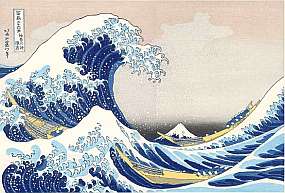
Try as I might over the years, I’ve thought and thought about a theology of the tsunami, but I can’t seem to come up with any spiritual advice, any wisdom at all, to shed on the subject. I guess I’ve never quite understood what good it is to see the tsunami coming but have no ability to avoid it.

The Bible says this:

For man does not know his time. Like fish that are taken in an evil net, and like birds that are caught in a snare, so the children of man are snared at an evil time, when it suddenly falls upon them.
—Ecclesiastes 9:12

That captures the idea, in part, but the evil net that rises up to ensnare comes unseen. The comparison doesn’t work.

Acts offers a better portrait:

While we were staying for many days, a prophet named Agabus came down from Judea. And coming to us, he took Paul’s belt and bound his own feet and hands and said, “Thus says the Holy Spirit, ‘This is how the Jews at Jerusalem will bind the man who owns this belt and deliver him into the hands of the Gentiles.'” When we heard this, we and the people there urged him not to go up to Jerusalem. Then Paul answered, “What are you doing, weeping and breaking my heart? For I am ready not only to be imprisoned but even to die in Jerusalem for the name of the Lord Jesus.” And since he would not be persuaded, we ceased and said, “Let the will of the Lord be done.”
—Acts 21:10-14

Agabus’s prophecy only clouds my understanding of this issue. He saw the wave about to hit Paul. What I find odd about this prophecy is that it is one of an unchangeable inevitability. It told of a tsunami that could not be outrun. Yet if it had not been told, the outcome would have been the same: Paul would have gone about his business, wound up imprisoned, and ultimately executed all the same, prophecy or not. Why let everyone see the inevitable tsunami? All it seemed to do is distress the rest of the believers.

I’ve experienced seeing the tsunami coming before it hits, yet at no point have I been able to outrun it or witness others outrun theirs. Why then? The knowing only creates distress long before the wave crashes onto land.

Cerulean Sanctum gets some of the best readers of any blog out there. I was talking with a reader today and noted how blessed I’ve been to have such astute people join in the conversation here.

Have you experienced the “inevitable tsunami” in your life or the life of someone else you know? Why do you think God allows us to see the tsunami from afar if there’s nothing that can be done to escape it?
Murder in My Backyard

Standard

And to Adam [God] said, “Because you have listened to the voice of your wife and have eaten of the tree of which I commanded you, ‘You shall not eat of it,’ cursed is the ground because of you; in pain you shall eat of it all the days of your life; thorns and thistles it shall bring forth for you; and you shall eat the plants of the field. By the sweat of your face you shall eat bread, till you return to the ground, for out of it you were taken; for you are dust, and to dust you shall return.”
—Genesis 3:17-19

I turn into a brutal murderer this time of year. Ask the tens of thousands of victims I killed just this week. I’ve got a bucketful of rotting corpses sitting on my patio that I’ll be adding to in just an hour or so.

My preferred method of dispatching my victims? Suffocation. They trash around for a couple minutes and then its lights out—forever. And nothing gives me more pleasure.

Hey, it’s them or me.

You see, it’s Japanese Beetle season here at Edelen Acres.

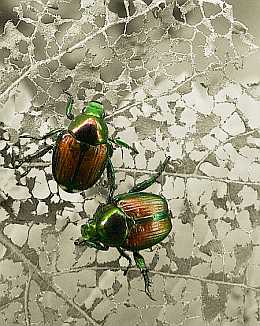
Being organic fruit farmers ain’t easy. About the only things that kill Japanese Beetles outright are pesticides strong enough to kill a motorcycle gang or the traditional method of dealing with them by hand. So that’s what we do. Lacemaking, the Japanese Beetle wayWe pick many of them by hand and dump them into a jar of soapy water. The soap plugs their breathing holes and that’s that. It’s a lot of work, but weirdly satisfying, too.

We divert many of the beetles by stationing a couple pheromone traps far away from the trees. The first year we used the traps, we had them too close to our trees and they ate the trees anyway. This year I put them in the middle of nowhere on our land and that seems to work far better.

I’m using a natural kaolin clay mixture to coat our cherry trees, the hardest hit of our fruit varieties. The first year we had the trees in, we took a day trip over to the county next to us to visit the Amish general stores, only to get home and find that in one afternoon the beetles had eaten our tender cherry trees leaves down to lace. One day. We tried natural pyrethrin (as opposed to synthetic) powders that summer, but the bugs ate the leaves and then died. Didn’t see the point in applying pesticides, even organic ones, if the beetles eat the leaves and then die. The end result is still a bunch of eaten up leaves and a highly distressed plant. You’ve got to stop the beasts before they eat anything and pesticides are not going to work when you’ve got several hundred Japanese beetles coating your tree. If each one takes a hundred bites before the pesticide does them in, your tree’s done for.

We put up netting last year. However, the trees grew so fast the branches deformed against the netting. Now we’ve got a few trees with branches that look like something out of a Dr. Seuss book. Plus, netting a big tree is a lesson in futility. Beetles will find the smallest gaps in the netting and they’re in by the droves.

So I’m trying the kaolin clay barrier. It seems to work well. We’ve been under assault by the beetles for about ten days and my cherries have hardly been touched. When it rains, though, it has to be re-applied. Still, it’s natural and washes right off. They use kaolin in makeup. Obviously not a health threat. I suppose you could use it to thicken gravy, but it has a certain yuck factor. 😉 But if the beetles don’t like eating it, that’s fine by me.

Talk to me about that curse in Genesis and I’ll tell you just how much a curse it is. Weeds. pests, drought, even fire. We’ve had a drought going on in this area and the farmers all have that anxious look. Sure, it’s rained, but five minutes of sprinkling followed by a clear blue sky and a hot sun ain’t gonna do it. Downpour. That’s what we need right now. Don’t need more stinking non-native Japanese Beetles or any other non-native beasties. Ask me about the non-native, invasive weeds we get around here, too.

God had a plan and we threw a huge wrench in it didn’t we? We had our own ideas, but consider the outcome.

That kind of arrogance lives on. You can see it in farming. Pesticides coat our food and pool in the fat stores in our bodies. They linger for decades in the soil. They run off into our water supplies and poison the fauna. Haven’t seen a frog or salamander lately? They’re the canaries in the coal mine, folks. Our man-made pesticides killed them off. And now the true pests are resistant to what we spray. We thought we had an answer but it’s not a very good one.

Scientists splice jellyfish genes into corn and then tell us nothing’s wrong with that. Then those jellyfish genes wind up moving into the genetic structure of other grasses surrounding our corn fields. We solve one problem to create another, another that may well be far worse than the original.

God’s given us natural ways to combat problems. We just need to trust them.

It’s like that in every aspects of our lives, isn’t it? Sometimes the old, simple ways are the best ways. But we don’t trust them. Science tells us otherwise and we get paranoid that we won’t keep up with the times. Well, the times they might well be a-changin’, but the wise man doesn’t give up wisdom to suit the age. Remember, Adam listened to the wrong voice in a certain situation and look where it got us.

Our churches launch some guaranteed program backed by the slickest marketing and the best sound bites from the hottest church leaders and we hope and hope. A couple years later, that program stands forgotten. Sure, it was billed as the pesticide for whatever plagued us, but it wasn’t God’s way, was it? No fruit.

It’s all about the fruit. If all our work produces no fruit, then we’re just being wasteful. Sadly, that’s what a lot of churches are doing, just wasting time, money, resources, and people’s patience.

I think our problems with patience underlie the greater issue here. Yes, people get upset when the newfangled program bears no fruit, but it was sterile from the get-go. What people need is patience for the simple ways that work, the real discipleships that spans decades, not months. You try too hard to rush the fruit and you wind up with tasteless fruit. Think your typical grocery store here. Sure, you bought a package of mass-produced, industrial-strength strawberries. But they taste more like straw than berries.

We may be doing the same with our disciplemaking process. Better to go local, go organic, be patient with the old ways that served us for eons—even when it comes to making disciples.

God knows we have enough spiritual pests out there, but we can’t poison our young “plants” in our attempts to kill the weeds or wipe out the bugs.

“Religion vs. The Gospel.” Yes, But…

Standard

On the heels of yesterday’s “The Half-Born” comes a similar post on the Acts29 network from Mark Driscoll. I don’t normally quote an entire post, but this one requires it:

Religion says, if I obey, God will love me. Gospel says, because God loves me, I can obey.

Religion has good people and bad people. Gospel has only repentant and unrepentant people.

Religion values a birth family. Gospel values a new birth.

Religion depends on what I do. Gospel depends on what Jesus has done.

Religion claims that sanctification justifies me. Gospel claims that justification enables sanctification.

Religion has the goal to get from God. Gospel has the goal to get God.

Religion sees hardships as punishment for sin. Gospel sees hardship as sanctified affliction.

Religion is about me. Gospel is about Jesus.

Religion believes appearing as a good person is the key. Gospel believes that being honest is the key.

Religion has an uncertainty of standing before God. Gospel has certainty based upon Jesus’ work.

Religion sees Jesus as the means. Gospel sees Jesus as the end.

Religion ends in pride or despair. Gospel ends in humble joy.

I think that’s exactly right.

But…

I also know that nearly every Christian will say that he or she is on the side of Gospel.  You did, didn’t you?

That makes me wonder how useful this truth is. In fact, I think it reiterates the lies we tell ourselves. If you read “The Half-Born,” you’ll know what I mean.

As I see it, we tend to place Religion at the letter A in the alphabet and think that by getting to letter B we’ve somehow attained the Gospel. Yes, we may no longer be at A, but the truth is that B isn’t really the full Gospel, either. The Gospel’s out way past letter Z. We’ve hardly taken a baby step toward Z and yet we’re crowing that we’re no longer at A. Sad to say, for too many of us, we get to B, think we’ve arrived, and therefore never get out beyond Z where the deep well of the Gospel lives.

That failure to get out past Z is what “The Half-Born” is all about.

So yes, we may not be entirely mired in Religion, but neither are we abandoned to the Gospel. We get a good feeling by saying we’ve arrived, but…