Thoughts on Halloween and Reformation Day

Standard

We interrupt this Cerulean Sanctum “Being the Body” series to bring you the ubiquitous Godblogger posturing on Halloween and Reformation Day. I’ve seen scads of previous analyses of the former over the last few years, but now there’s a push to bring the latter out from under the covers. Better discuss both.

***

As to Halloween, last year I wrote a piece detailing why I now opt out even though I was raised in a Christian household that had no problems with the “holiday.”

The Obligatory “Halloween Is Bad” Post

Rob Wilkerson over at Miscellanies on the Gospel is one of my favorite bloggers. His recent post on Halloween is outstanding:

A Gospel Perspective on Halloween Horror

I don’t know what it is about folks from charismatic and Pentecostal backgrounds, but they seem most leery of Halloween, almost without exception. Meanwhile, Christian folks on the far, far side away from that perspective seem to be more tolerant of trick or treating.

***

Celebrating Reformation Day, for me, is a little like remembering someone you loved dearly who has passed away. As a dyed-in-the-wool, anti-RCC Protestant, I would love to rousingly celebrate the anniversary of Luther’s pounding his 95 Theses into the cathedral door at Wittenberg. But I think we’ve squandered a lot of what the Reformation bought us.

I don’t think we practice most of the backbone concepts of the Reformation, even in the most ardent Reformed churches. I grew up Lutheran, and even so I ran into disconnects all over the place.

Take the idea of the priesthood of all believers. Nothing in our practice of our church life proves that we believe this foundational truth of the Reformation one iota. Too many of our churches have pastors who lord it over their congregations, disempowered congregants who are routinely told that only the specially trained (read “seminarians”) are equipped to minister, Martin Luther sticks it to the RCCand vicious church factions debating the same “who is greater?” nonsense that got the disciples in hot water with Jesus. Truthfully, our practice of the priesthood of all believers better resembles that classic line from George Orwell’s Animal Farm.

I know in my own life I’ve encountered that hypocrisy more times than I can count, none more glaring than my experience in the church Martin Luther founded. I worked at a Lutheran camp a couple summers and got in serious trouble with the leadership of the camp for baptizing kids who converted to Christ. Seems like a perfectly ordinary action to take with new believers, baptizing them and all. From the reaction of the leadership, though, you would’ve thought I’d killed those kids à la Jason of Friday the 13th movie fame.

At sole issue was the fact that I wasn’t a pastor. When I countered that the Philip who baptized the Ethiopian eunuch wasn’t an apostle but a guy who waited on the tables, I was lucky not to be stuffed into a canvas sack and thrown into the lake right then and there. So much for the priesthood of all believers. I guess some priests are more equal than others.

I could walk through the Reformation’s five solas and ask how we practice them in reality. Just the other day, I experimented by Googling the phrase “What must I do to be saved?” and perused the answers provided by leading Protestant Web sites. If that cursory survey is any indication, we’ve got to do a whole lot more to be saved than have faith in Christ, trust His Scriptures, and receive His grace. (Though I think soli Deo gloria still holds up in all cases.) Sadly, at the site of one prominent Reformed blogger, the list of requirements for salvation (according to the sermon by Cotton Mather posted there) included a whole lot more than what we got out of the entirety of the Reformation. Somehow, we Protestants have found a way to obscure the simple answer to that most necessary question. In many ways, we’re back where we were just prior to the Reformation.

But I guess the main reason that I’m not quite as pumped about Reformation Day as some others is my speculation about Martin Luther. I fear that some of the loudest celebrants of Reformation Day might be the very same people who would call for a good old burning at the stake for Martin Luther if he showed up today and pounded a new set of 95 Theses on the doors of our modern Evangelical churches. Love to see them Catholics squirm, but don’t tell us to give up our modern indulgences.

Too many of us Protestants have capped Christianity at the Reformation. We believe that nothing more can come out of Christ’s Church than what we got out of the Reformation nearly five hundred years ago. In some ways, we’re like the fifty-year-old shoe salesman at K-Mart who once quarterbacked his high-school team to a state championship. Our entire lives revolve around that day when we threw the winning touchdown. We relive it, revel in it, and on and on. But we let that one event in time become the be all and end all of our existence. It can never get better than that time, nor can we ever let it possibly come close.

But oh what we may be missing because we can’t see the opportunities that lie before us today!

Don’t get me wrong. I supremely value the Reformation. I also supremely value practicing what we preach and asking if we need a new reformation even better than the old one.

Now what church will let me nail that to their door today?
One Moment in Time—and Beyond

Standard

I believe it was an International Bible Society study that showed that nearly all people who become Christians do so by age nineteen. That figure stunned me at the time. We've got to get people young, folks. That's why bringing young people to Christ is so astonishingly important.

But another figure hidden in that survey speaks just as loudly. If the average American today lives to at least eighty, the IBS survey also tells us that the person who comes to Christ at age nineteen will spend sixty years or more in discipleship.

Think about that figure—sixty years of following Christ after conversion.Real life sliced and diced

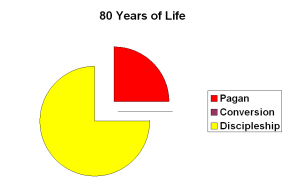
The image at right puts this in perspective. The slice of pie that comprises a person's pagan life before Christ consumes about a quarter of life. Following after Christ takes up three-quarters. The moment of conversion, though crucial, is but a mere slice.

Yet you would think that conversion, that one moment in time, is all there is to the Christian life. Given how we Evangelicals devote so much time, energy, and angst to conversion, you'd think that the sixty years afterward are a drop in the bucket. In the Godblogosphere, the handwringing over conversion (and the theology behind it) weights it even more. Discipleship may seem an afterthought.

I'm saddened when I get e-mails from folks saying all their church ever talks about is getting people saved. Don't get me wrong; it's excellent that churches preach the salvation message. But most of the people in the church are already saved, so what help do they get in actually living out their conversion if they hear the same salvation message over and over again?

The Bible says this:

And this is eternal life, that they know you the only true God, and Jesus Christ whom you have sent.
—John 17:3 ESV

And we all, with unveiled face, beholding the glory of the Lord, are being transformed into the same image from one degree of glory to another. For this comes from the Lord who is the Spirit.
—2 Corinthians 3:18 ESV

I didn't know my wife the first time I met her. In many ways, I still didn't know her even on our honeymoon. Learning who she is will take me the rest of my life because the depth of her personhood will only be revealed in time.

The same goes for Jesus Christ. Most of us have barely scratched the surface of what it means to know Him. Yet the Bible says that knowing Him IS eternal life! It's not escaping hell, it's knowing the person of Jesus Christ. Deep calls to deep. If Jesus Christ and a hundred Jesus impersonators were put into a lineup, would we be able to pick the real Jesus out of the crowd of imposters? Think hard about that question.

Likewise, our conversion to Christ does not end our growth as Christians. Too often, though, our churches act like they have no more to tell us once we say yes to the Lord. "Just don't do bad things now" is the extent of the post-conversion advice.

But the Bible says that we're supposed to be changing from one degree of glory into another, a process that will take our entire lives. That is if we surrender to that process of Christ making Himself in us. For it's His glory that shapes us over those sixty years.

Too often, our discipleship is self-centered. Life becomes nothing more than the avoidance of pain and the accumulation of comfort. But we can't walk the narrow path staring into our navels; we'll wind up in a ditch.

For we are his workmanship, created in Christ Jesus for good works, which God prepared beforehand, that we should walk in them.
—Ephesians 2:10 ESV

And as you go, proclaim, saying, "The kingdom of Heaven is at hand." Heal the sick, cleanse the lepers, raise the dead, cast out demons. You have received freely, freely give.
—Matthew 10:7-8 MKJV

For the Son of Man shall come in the glory of His Father with His angels, and then He shall reward each one according to his works.
—Matthew 16:27 MKJV 

If you're a Christian, you're a new creation. And what were you created for? Good works in Christ. The real disciple of Jesus Christ spends his or her sixty years after conversion walking out a discipleship that is other-centric. It's centered on the Lord and on the ones who are dying around us. Yes, we can read great treatises on theology, accumulate vast libraries of Christian thought, attend Christian conferences one after the other, but if we're not freely giving away what we freely received, then we'll spend sixty years wasting God's mercy. Instead, we must be focused on others to ensure that the reward we have in heaven is great.

We all know "Away in the Manger." There's not a three-year-old out there that doesn't learn this Christmas carol first. As a result, few think of it in terms of theological depth. The final stanza says it all:

Be near me, Lord Jesus, I ask Thee to stay
Close by me forever, and love me, I pray;
Bless all the dear children in Thy tender care,
And fit us for Heaven to live with Thee there.

Our sixty years of discipleship is meant for one thing: to fit us for Heaven to live with Christ eternally. What you and I are doing right now in this moment of time is shaping our eternity. Don't be deceived. Following Christ was never intended as fire insurance. Instead, it's meant to remake citizens of Earth into citizens of Heaven.

Are we giving away our life here so we can take on new life? Can we with all certainty pick Jesus out of the lineup? He may not look like an itinerant rabbi, but the homeless man drunk outside our office building. How then will we know Him unless we do the good works that encounter Him? Are we spending all our time looking at our conversion when we should be focused on our inheritance?

Sixty years is at once quite long, yet so very short in the eyes of eternity. In truth, our lives are not so much like a pie chart, but a never-ending timeline that began a breath ago. In a flash comes conversion, but then we live out the eternal consequences of our discipleship.

It's about learning to be a disciple, giving away freely what we were freely given: love, mercy, and grace. Let's not waste our sixty years.

Because We Can, We Should?

Standard

I'm not into today's CCM. The worship leader at our church must think me a pagan because I have a blank look on my face whenever she brings up the latest hot Christian band and their equally hot quasi-worship song that's blazing up the Christian charts. Who? What song? Let me guess; it has the same beat as all the others….

Today, I had one of those crazy days of endless errands. Oil change, allergy shots, soccer practice, a ten-item grocery list that necessitated trips to three different megagrocers just to get common items any ONE of them SHOULD have had. You know the drill. So desperate for a little spiritual refresher, I turned on the big Christian radio station in town to hear one of the afternoon teaching programs. Instead I got an earful of tedious music. 

Whither the teaching? Well, the station's booted all its teaching in favor of a non-stop music format. I guess every station wants to be just another vapid K-LOVE clone. In some corporate roundtable, station management decided to give the people what they want rather than what is best for them, thinking that 24/7/365 of the Pablum that passes for Christian music today better enlivens the masses than Ravi Zacharias talking about techniques for witnessing to Muslims.

Ugh. Maybe I'll call 'em up and request Keith Green's "You Love the World (And You're Avoiding Me)."

It's symptomatic of a gigantic problem. 

One of the most worldly concepts you'll find in our culture is this idea that "because we can, we should." Name a moral failing or a political ambition and I'll bet "because we can, we should" empowers it. Abortion and fetal tissue cultivation are the sick offspring of that thinking. You can probably come up with a million more.

Christians are not immune to this mistake. In fact, we rationalize a lot of  "because we can, we should" under the guise of redeeming things. Kids love Saturday morning cartoons? Well, let's make Christian cartoons! Your son wants an action figure? Why not give him a brand-spanking new Jesus action figure complete with a whip to drive out moneychangers and a glow-in-the-dark sword that springs out of his mouth to slay the wicked?

Almost all "Jesus junk" hatches from "because we can, we should."

Truth be told, I feel queasy walking into Christian bookstores. They're so utterly derivative and reactionary that if I were an unbeliever plunked down in one, I'd guess the first stage of being born again is losing one's sense of beauty, creativity, and charm.

Yet for all the WWJD paraphernalia floated over here from Shanghai, a more soul-killing expression of "because we can, we should" exists.

Mysecret.tv is a recent addition to the Web. Some Christian organization thought there weren't enough avenues for confession for Christians, Confession or Gossip?so because the Web exists and is (somewhat) anonymous, it's the perfect medium for confessing one's sins. 

Except it's not. Not in the slightest. Instead, Mysecret.tv stands as a warning to us all, the epitome of "because we can, we should"-ism in the American Church.  

The site raises my ire for a number of reasons:

1. It's pornography. Like some lurid afternoon TV talk show, the site parades sin as entertainment. By offering verbal voyeurism (consider the domain name), it's no different than a hardcore porn site. One click and you can read the details of someone else's failure before God. "But doesn't the Bible show great believers failing?" Sure, it does. But if anyone here's calling for adding Mysecret.tv to the canon, well….

2. It usurps the role of the local church. No doubt, Evangelicals have dropped the confessional ball. Too many Evangelical churches would rather judge than offer grace after a confession. But building a site like Mysecret.tv actually circumvents local churches improving their dealings with confession, sin, and grace. It provides a cheap excuse NOT to fix the problem in our local churches. It asks for none of the commitment inherent in a Christ-centered community, cheapening how we relate to each other in an age when real community in the church is already on its deathbed.

3. It asks for no repentance. Enough said. 

4. It offers no grace. Real grace doesn't come with a disclaimer. Jesus Christ gave us a model for how to dispense grace to the repentant. It's the church body of real people who hear confession, cry with the sinner, and offer grace by the Holy Spirit working through people. But Mysecret.tv expunges all face-to-face restorative human contact. Therefore, by removing the links in the chain of how grace should be dispensed, it offers no grace at all.

5. It offers no accountability. After people confess on Mysecret.tv, what follow-up occurs to help them work through the ramifications of their confession? None that I can see.

6. It offers no restitution. How does one walk out the end product of a confession on Mysecret.tv? Well, if nothing is asked of the people who confess on the site, then no restitution occurs. How that benefits the one confessing is beyond me. 

7. It demeans the death of Christ on the cross. If Mysecret.tv angles to be a Christian-sponsored site that takes confessions, yet offers none of the hallmarks of true Christian confession, repentance, accountability, and restitution, then it's not Christian in the slightest. That mocks the Lord.

I could name a half dozen more failings in Mysecret.tv, but its concession to "because we can, we should" speaks for itself. When considering this site's premise, it appears no one asked if it undermines everything the Church should be. They just plowed ahead and slapped it up on the Web. Alakazam, now you can confess to boinking your kid's babysitter and feel better about yourself for doing so. (And yes, all you grammar mavens, I intentionally wrote that last sentence for maximum {read ironic} ambiguity.)

Is anyone else disturbed that so much of what passes for Christianity in America displays the same hollow core as Mysecret.tv? A group sees a need in the Church, but instead of pursuing tough answers that might require a complete overhaul of how our churches live out the Gospel, they settle for the cheap and meaningless—because they can.

Cerulean Sanctum exists to find ways to better our churches and the people who comprise them. For this treason, I loathe cheap answers to the pernicious problems we face as Christians in America. I see a site like Mysecret.tv and my blood boils. When another blogger told me about the site, and I checked it out myself, my jaw dropped at the utter lack of discernment behind this online confession booth.

(If you're a regular reader of this site, you know I almost never single out a particular ministry or program for scorn. I don't like to name names because so much out there needs to improve, even on good sites. I know that Cerulean Sanctum lacks in some areas. I also know I'm not satisfied with cheap and easy.)

I pray this post gets us thinking about finding the narrow path, rather than the wide, destructive one behind "because we can, we should." Too many Christians trudge down that "because we can, we should" superhighway leaving the rest of us to wonder if we're the ones going the wrong way.

Our response to the problems of our day will cost us something precious. When we're not prepared to pay the price, we'll settle for the path of "because we can, we should."

But Jesus won't be waiting at the end of that road.