
The man whose soul is “growing” takes more interest in spiritual things every year…. The ways, and fashions, and amusements, and recreations of the world have a continually decreasing place in his heart. He does not condemn them as downright sinful, nor say that those who have anything to do with them are going to hell. He only feels that they have a constantly diminishing hold on his own affections and gradually seem smaller and more trifling in his eyes.
—J.C. Ryle
When amusement is necessary to get people to listen to the gospel there will be failure. This is not the method of Christ. To form an organization and provide all kinds of entertainment for young people, in order that they may come to the Bible classes, is to be foredoomed to failure.
—G. Campbell Morgan
One can only conclude that God’s professed children are bored with Him, for they must be wooed to meeting with a stick of striped candy in the form of religious movies, games and refreshments.
—A.W. Tozer
I’m writing two positive posts this week on what the American Church is doing right. In fact, I was going to start those posts today, but before the story got cold, I felt I had to tie in last Friday’s post “The Church of ‘Tomorrow? What Tomorrow’” with a press release from George Barna.
Barna’s announced that he’s now heading up a new Christian media company that promises to deliver even MORE entertainment to Christians everywhere. (Barna labels this “spiritainment.”) The argument here is that Christians NEED quality entertainment that looks and believes just like them. (Read the press release. I’ll wait right here….)
Beyond the obviously insulting, syncretistic name that combines the precious Holy Spirit with entertainment, 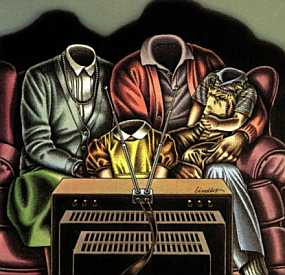 I’ve just got to ask the obvious: Do we Christians need to be any more entertained?
I struggle with this immensely as a Christian seeking to write novels. Does the world need another novel right now, Christian or otherwise? To lift a book title from the late media critic Neil Postman, aren’t we already amusing ourselves to death ?
This plays into my last post on the expediency plaguing the American Church. Too much of our thinking is short-term. Our dependency on short-term fixes is due in part to our inability to break out of a media-induced five minute attention span. Because we’re so focused on entertaining ourselves, long-term goals are out because they don’t meet our craving for instant feedback gained through our perpetual need for entertainment. The result? We’ve made boredom the ultimate spiritual enemy.
What better explains the megachurchianity so rampant in this country? We’ve substituted a dog and pony show to keep people entertained, but at the cost of their souls. Who can plan for any thing long-term if the mildly-satiated crowd demands another quick fix to keep the experiential buzz going? If God’s not going to rend the sky and rain manna down on us at our beck and call, then why hold prayer meetings? Why slave for years as a missionary in a foreign land if you only get a few converts? Your Powerpoint won’t be all that interesting when you share in church next Sunday. People might yawn—the evidence needed to show that your act needs some refining.
Revival isn’t going to come through movies, no matter what George Barna thinks. Nor books, though it pains me to say so. The Spirit of God isn’t all that interested in entertainment, Christian or worldly. He’s calling out to you and me to die to self so that others might live for Him.
We North American Christians…
…watch too much TV.
…waste too much time at the movies.
…drop too many dollars on music.
…spend too many hours trying to stave off boredom.
…spend too little time before the Lord living out the Gospel.
In short, we need “spiritainment” like we need an electric dog polisher. All this entertainment is a drug that keeps us numb to what we should truly be doing: serving the Lord Jesus until there is nothing left of us.
I’m not against Christians having fun once in a while. However, I believe that in the United States of 2006 the pursuit of fun has completely overtaken the pursuit of God, even among Christians.
Speaking of the pursuit of God, I’ll let A.W. Tozer speak eloquently here:
No one with common human feeling will object to the simple pleasures of life, nor to such harmless forms of entertainment as may help to relax the nerves and refresh the mind exhausted by toil. Such things, if used with discretion, may be a blessing along the way. That is one thing; however, the all-out devotion to entertainment as a major activity for which and by which men live is definitely something else again.
The abuse of a harmless thing is the essence of sin. The growth of the amusement phase of human life to such fantastic proportions is a portent, a threat to the souls of modern men. It has been built into a multimillion dollar racket with greater power over human minds and human character than any other educational influence on earth.
And the ominous thing is that its power is almost exclusively evil, rotting the inner life, crowding out the long eternal thoughts which would fill the souls of men, if they were but worthy to entertain them. The whole thing has grown into a veritable religion which holds its devotees with a strange fascination; and a religion, incidentally, against which it is now dangerous to speak. For centuries the Church stood solidly against every form of worldly entertainment, recognizing it for what it was—a device for wasting time, a refuge from the disturbing voice of conscience, a scheme to divert attention from moral accountability.
For this she got herself abused roundly by the sons of this world. But of late she has become tired of the abuse and has given over the struggle. She appears to have decided that if she cannot conquer the great god Entertainment she may as well join forces with him and make what use she can of his powers.
So, today we have the astonishing spectacle of millions of dollars being poured into the unholy job of providing earthly entertainment for the so-called sons of heaven. Religious entertainment is in many places rapidly crowding out the serious things of God.
Many churches these days have become little more than poor theaters where fifth-rate “producers” peddle their shoddy wares with the full approval of evangelical leaders who can even quote a holy text in defense of their delinquency. And hardly a man dares raise his voice against it.
I haven’t read too many critical voices of Barna’s call for “spiritainment.” Add mine; I see this as little more than a solution to a problem that doesn’t exist. Don’t label me a prophet here, but I can’t help but think this “spiritainment” is all going to turn out very badly in the end.
 I mostly read dead authors, at least when I’m considering Christian theology. Call me crazy, but I find more truth in those writers than what I read in modern ones. My personal library reads like a big list of dead guys: Lloyd-Jones, Schaeffer, Tozer, Lewis, Bounds, Ravenhill, Edwards, Nee, Murray, Torrey, and Bonhoeffer.