
Knowing Jesus and the Death of Self-Help

Standard

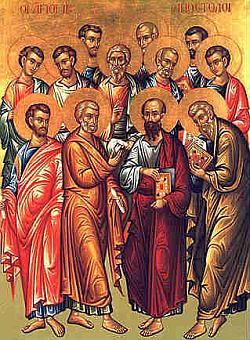
12 ApostlesIt was turning out to be the worst meeting Matthias had attended.

Yes, the worship had been exemplary, as usual. No doubt the Lord was present in their midst. But then, so it seemed was a spirit of bureaucracy—and Matthias hated bureaucracy. Hadn’t he been chosen by a casting of lots? How much easier could it have been?

And why DID the Gentiles have to receive the Gospel? Why couldn’t it have stayed among the Jews only? What a bureaucratic nightmare.

So there he sat, hoping against hope that Peter was not going to chime in again.

Oh, heavens no. Here we go.

Peter stood up.

“Brothers,” the apostle announced in his bass voice that shook the flimsy meeting room furniture, “having weighed this question in my soul after much placement before the Lord, I conclude that there are actually only seven steps to a God-honoring sex life.”

“We weren’t talking about sex, Peter,” Silas said. “Were you asleep—again?”

“The question was the title of Levi’s preaching series,” Barnabas reminded, “The 10 Principles of Financial Success.”

He had a gift for reading lips, and Matthias swore that James mouthed,  It’s a baker’s dozen, not 10. That James’s little brother then punched him in the arm meant the youngest attendee at the meeting had heard him too.

A man with a pained expression on his face stood and asked, “How are the Gentiles going to live a life of fullness in our Lord if we who are appointed their leaders can’t decide these simple issues?”

Matthias shook his head. Thomas again. Always stirring the pot.

“Everything depends on our hammering down what is necessary for the Gentiles to live,” Peter agreed.

“You remember that our Lord said I was an Israelite without deceit—” Nathanael started.

Matthias rolled his eyes. Always the same prelude from Nathanael.

“—and I think that we never settled on the take-away points of my series, Raising Godly Children in an Ungodly World.”

“Hey, Mr. Honesty,” someone yelled from across the dimly lit room, “why not be truthful with the Gentiles and tell them you don’t have any children?”

Matthias thought that was worth a good chuckle. He wasn’t alone.

“Now listen here—” Nathanael began, before he was cut off again.

Five Biblical Ways to Reach Your Neighbors for Christ,” Philip said. “I mean, c’mon, guys. Isn’t that what we’re all about? I used those five when I spoke to that eunuch, and you all know how effective that was. Shouldn’t the Gentiles know them? Just five simple ways?”

Andrew leaned over to Matthias and said, “I tuned out after they kicked out Martha. I kind of liked her Beat Busyness the Bible Way.” He then turned pensive and asked, “Do you remember how many steps her method had?”

“I think it was five,” Matthias answered.

Andrew glowered. “No, I think you’re thinking about Philip’s five ways.”

“Maybe I am,” Matthias said. “Maybe I am.”

***

That meeting in Jerusalem among the leaders of the young Church actually happened. It just didn’t happen that way. The question of how to live a godly life wasn’t found in principles or spiritual To-Do lists. Here’s that meeting’s conclusion:

After they finished speaking, James replied, “Brothers, listen to me. Simeon has related how God first visited the Gentiles, to take from them a people for his name. And with this the words of the prophets agree, just as it is written, “‘After this I will return, and I will rebuild the tent of David that has fallen; I will rebuild its ruins,  and I will restore it, that the remnant of mankind may seek the Lord, and all the Gentiles who are called by my name,  says the Lord, who makes these things known from of old.’ Therefore my judgment is that we should not trouble those of the Gentiles who turn to God, but should write to them to abstain from the things polluted by idols, and from sexual immorality, and from what has been strangled, and from blood.”
—Acts 15:13-21 ESV

In short, don’t load up the Gentiles with stuff to do. Stuff wasn’t the point of the Gospel.

Here’s how Paul saw living the Christian life:

For I decided to know nothing among you except Jesus Christ and him crucified.
—1 Corinthians 2:2 ESV

Jesus summed it up nicely:

And this is eternal life, that they know you the only true God, and Jesus Christ whom you have sent.
—John 17:3 ESV

How is it then that we sit still on Sunday and have someone tell us all these things we should be doing so as to be good Christians? How is it that we say we embrace grace, yet we load ourselves up with lists of necessities and principles and ways and means of living like Christians, when it all begins and ends with knowing Christ?

What if we just knew Christ and knew Him a little more each day? Can’t anyone tell us how to know Christ more?

Or do we not believe this Scripture?

And I am sure of this, that he who began a good work in you will bring it to completion at the day of Jesus Christ.
—Philippians 1:6 ESV

If we know Christ more deeply, isn’t it the work of the Father to make us perfect in His Son? Why then do we trouble ourselves with endless self-help sermons?

Now if the ministry of death, carved in letters on stone, came with such glory that the Israelites could not gaze at Moses’ face because of its glory, which was being brought to an end, will not the ministry of the Spirit have even more glory? For if there was glory in the ministry of condemnation, the ministry of righteousness must far exceed it in glory. Indeed, in this case, what once had glory has come to have no glory at all, because of the glory that surpasses it. For if what was being brought to an end came with glory, much more will what is permanent have glory. Since we have such a hope, we are very bold, not like Moses, who would put a veil over his face so that the Israelites might not gaze at the outcome of what was being brought to an end. But their minds were hardened. For to this day, when they read the old covenant, that same veil remains unlifted, because only through Christ is it taken away. Yes, to this day whenever Moses is read a veil lies over their hearts. But when one turns to the Lord, the veil is removed. Now the Lord is the Spirit, and where the Spirit of the Lord is, there is freedom. And we all, with unveiled face, beholding the glory of the Lord, are being transformed into the same image from one degree of glory to another. For this comes from the Lord who is the Spirit.
—2 Corinthians 3:7-18 ESV


Christian Girls, Bad Boys

Standard

I don’t know why I read the article “Let’s Mock People Attracted To Aaron Hernandez.”

I don’t like to see people mocked.

I don’t know who Aaron Hernandez is.

I don’t follow sports.

But the picture accompanying the article in my Facebook feed showed a pro football player; that and the strange juxtaposition with the article title pushed the oddity meter high enough to draw me in. I was almost certain where all this data would lead, but I think God took it in a different direction.

Tim Baffoe, the author of the article, turns out to be a high school English teacher who also writes sports commentary for a Chicago radio station’s website. In other words, he interacts regularly with young women in his role as a teacher. Perhaps his story, as acerbic as it is, serves as a warning.

I sure hope it does.

Aaron Hernandez is an NFL player now accused of murder of a fellow football player. (I suspected as much.) He allegedly also shot another man in the face. It is now coming out that he may have been responsible for an earlier, unsolved, drive-by shooting that killed two others.

Much has been made of the culture of violence that surrounds football. When is there not a story about a football player who decked his girlfriend or molested some woman he thought he could manhandle with impunity? I’m not sure why, but people were shocked when we learned that the New Orleans Saints had a bounty system in place for hurting rival players. Shocked.

But back to the Baffoe story, which I suggest you glance through. Really, just a glance, since you’ll get the gist immediately.

In the wake of the Hernandez arrest, Baffoe encountered a number of Twitter comments by young women who felt compelled to note in a public forum that despite his penchant for murder, Aaron Hernandez is “hot.”

The groupie who swoons over the serial killer is not a new trope in our society. While I am incapable of understanding why, way too many women out there adore violent men, and the more violent those men are, the more women they attract. Girls screamingAnd not just homely girls who feel their only shot is with a loner who kills people, but women with advanced college degrees, who may be pulling in six figures a year. Attractive women who draw the attention of every man whenever they walk into a room. Smart women who absolutely, positively should know better, but who can’t seem to stop thinking about the bad boy.

Where the line should stop, though, is with Christian women.

But if you read on in Baffoe’s article, a Proverbs 31 verse from the Bible shows up midway in the text. And then comes more than one example of a Tweet from a woman who appears to be a Christian talking about how attractive Aaron Hernandez is—for a murderer.

I can’t recall that the woman depicted in Proverbs 31 had a thing for guys who kill people indiscriminately.

I don’t know which is worse, that Christian women find murderers attractive or that they confess that attraction in public.

Keith Green once said that going to church doesn’t make you a Christian any more than going to McDonald’s makes you a hamburger. I guess that quoting a few Bible verses and claiming to be a Christian doesn’t make it so for these women.

Still, what disturbs me is that I know they are the tip of the iceberg. Not only as an example of confused women who can’t tell good from bad when it comes to men, but as people who call themselves Christians and yet cannot tell good from evil.

At its most basic, murdering other people is the standard of wrongness. If people can’t get that right, how can they discern anything?

Somewhere, these women got just enough Christianity so as to be inoculated to its fullness. I suspect that’s where we are in the Western Church in 2013. We have an entire generation now wandering this planet who have developed enough antibodies to genuine Christian faith that they are immune to it.

Parents, Christian leaders, and the general Church itself has much to be proud of—if inoculation was the goal. I think we can mark that campaign a success.

Sadly.

I’m wondering if we are too far gone in the United States. Something is horribly broken, and I’m not sure what must be done to fix us.

No “I” in “CHURCH”–How American Evangelicalism Gets Its Pronouns Wrong

Standard

Lonely in a crowdI listened to a message recently that told me all the things I had to do so I could be godly.

For the most part, the words went sailing past me. Perhaps I’m like the hard soil and the birds are coming to eat up the message seeds.

Or maybe I’ve just reached a saturation point for being told what I need to be doing so everything will be perfect in my Christian life.

There’s a big problem with the approach so much of American Evangelicalism uses when speaking to people: It’s all I and you (singular) pronoun use. It’s as if there is no message to the collected Body of Christ. The plural you, we, and us continue to go missing. And with them goes most of the New Testament.

You hear the singular you used a lot in sermons. Someone is preaching at me what I need to do as an individual.

But if you read the New Testament, the you in it, almost all nearly 4,000 uses, refers to a group of people—a plural you. In almost all cases outside the Gospels, that you is the Church.

How is it then that so many messages directed at us aren’t to the genuine plural us, but solely to individuals sitting in one place? We somehow avoid all sense of a collected group of believers.

One problem with this is that it automatically creates legalism and moralism. Individuals are told to do this or that, but there is no greater sense of collected purpose in those admonitions. Whatever it is that I should do is relegated to me alone. It then becomes a personal performance issue. My success as a Christian is solely because of what I do; the greater Body has no influence at all in this—nor do I truly influence that greater Body.

Which is one major reason why the Church in America isn’t advancing the way it should be. We are in a state of every man for himself.

An example of how this individual focus fails…

Take the subject of giving. From an individual perspective, you (singular) and I are told biblical principles on how to give and save money. To live below our means so as to be able to give to others. To tithe. To be cheerful givers.

But when we take this up to the level of what the Church as a collected whole is supposed to do, a vast silence emerges. What is the Church’s financial responsibility?

The Scriptures make it plain in many places that the Church should ensure that no one within the Church body is in need. Goods are to be collected and dispersed to people in the local church body to ensure no state of want.

That asks something of the Church/church though. And you just don’t hear messages and sermons on what the whole Church responsibility is in a given situation.

In short, there is no you (plural), we, or us. There is no vision for anything beyond what the individual is asked to do.

The Bible says that you have died. Your life is now hidden in Christ. And His life is expressed in this world through His Body, the Church.

To the person who has died, the law says that he or she has lost the right to own. In the Church, there is no my or mine. There is ours. Jesus abolishes all personal claims. You are not even your own. All that remains is the collected Body. I, my, mine, you (singular), yours—these are remnants of what we must leave behind when we choose to follow Jesus.

What would happen if American Evangelicals, instead of devolving into what I or you (singular) should be doing as a Christian, focused instead on how the group of believers that comprise the local church and the greater Church operates as it is intended to function—as a unified whole? What if we stopped with the relentless granularity and started thinking of Christianity not as a personal belief but as one that achieves its vitality only within full community? What if we stopped preaching individual works and started focusing on collected works? What if we believed that sanctification wasn’t solely for the individual but for the group? What if we truly believed Jesus in His admonition that the herd of sheep was no longer complete in the eyes of the shepherd if even one was missing?

What if we Christians shifted all our pronouns toward you (plural), we, ours, and us, while moving away from I, me, mine, and you (singular)?

Can we at least start to think outside of the individual? Perhaps if we did, we’d actually live out the biblical plan for the Body of Christ.

UPDATE: See also the follow-up post, God of the Group.