
Jefty Economics and the Least of These

Standard

{Somewhere in this rant is a worthy post. My apologies to readers in advance that the worthy post didn’t materialize.}

In the course of reading a smattering of Christian blogs wrestling with the economic devastation laying waste to America, I happened across Al Mohler’s take on the subject. By the time I got done reading the last word, it was all I could do not to shake my head in disbelief.

To understand the rest of this post, please read Mohler’s post, “A Christian View of the Economic Crisis.”

Done? Okay…

The first thing that bothers me about Dr. Mohler’s post is that it appears to be caught in a classic, science fiction time warp. If I didn’t know better, I’d say Eisenhower was president.

This is a great problem for much of conservative Evangelicalism. We’re like Jefty in Harlan Ellison’s seminal short story “Jefty Is Five.” In that work, the narrator tells of a neighbor boy who remains five-years old all his life. Jefty’s radio plays dramas from the 40s and 50s that were canceled decades ago. Jefty sends away for secret agent decoder rings offered by cereal companies that no longer exist—and receives them in the mail. In short, Jefty never grows up, nor does the ethereal, dead, dusty world that swirls around him. And he scares the willies out of the normal people who encounter him.

When I read Dr. Mohler’s post, it’s like I’m perusing Jefty’s newspaper, and I can read how the corporations are leading our country to greatness, and every father receives a gold pocket watch (that matches his smoking jacket) after 40 years on the job because he worked hard and climbed the corporate ladder like all hard workers do, and, golly gee willikers, his company put out the best darned widgets at the best darned price, and if you ever had a problem with your widget, they’ll send a repairman in a pressed suit (and a tie, even!) who won’t charge you a dime, and he’ll have your problem solved in fifteen minutes or your money back plus 10 percent for your trouble.

And at night, angels tuck you into bed.

That’s how Jefty economics works.

Jefty economics bases its reality on the old advice that with a little hard work, and the right amount of pluck, any freckle-faced lad can himself embody the classic Horatio Alger story and become a captain of industry.

It sounds so swell.

This, however, is what the Bible says:

Again I saw that under the sun the race is not to the swift, nor the battle to the strong, nor bread to the wise, nor riches to the intelligent, nor favor to those with knowledge, but time and chance happen to them all.
—Ecclesiastes 9:11

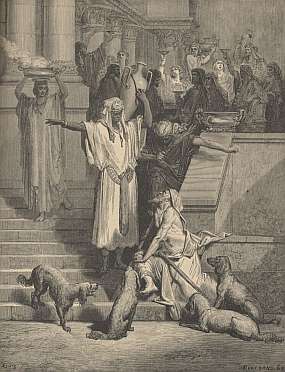
Jefty economics can’t account for chance. It doesn’t allow that people may deviate from the climb to the boardroom by simply being in the wrong place at the wrong time. Lazarus outside the rich man's house - by DoréIt can’t account for the capricious whims of a college admission committee that this year (and this year only) thought that building ashrams in India was a more noble reason for selection than your solution to world hunger, therefore you had to settle for Podunk U. instead of Harvard. It can’t factor in that after you killed yourself for decades to crawl to a middle management position in Kludge Corporation of West Oconomowoc, the CEO’s mistress left him and, in a fit of pique, he sacked your entire department and farmed it out to bean counters in Pakistan. The next thing you know, you’re a greeter at Wal-Mart wondering how the American Dream passed you by.
Who can understand how these things happen? The Jeftys of the world would turn on their radios and give you the answer: “The Shadow knows….”

Welcome to the world of Jefty.

Only problem is, that’s not your reality or mine.

In some ways, I can’t fault Dr. Mohler. Seminary presidents, theologians, and academicians aren’t the best at taking the lifestyle pulse of janitors, taxi cab drivers, and third-shift workers at the old widget factory (who just lost their jobs because the Armani-wearing board of directors moved the work to Shanghai).

See, Jefty economics functions in such a way that the real world, with all its gritty, black ugliness, doesn’t exist. The Jefties of this world can’t see it. The people who are getting killed economically, and have been getting killed for a long time, never happen. They’re simply not there.

Here’s reality: The way we do business, the way we fuel our economy in this country, the way we have been practicing capitalism in the good ol’ U. S. of A. has come home to roost.

I’ve been watching what has been happening to the middle class over the years. It’s not pretty. Hard-working people have been watching their real wealth evaporate. Families I know who were adamant that they were going to maintain the conservative Christian ideal and keep mom at home are not only having to have mom work but are seeing both wage earners’ incomes stagnate to the point that polygamy sounds like the only viable economic option.

And as for the mantra that hard work gets you ahead, it’s time to let that Jefty-ism die. Perhaps at one time it was true, but I know so many people who are killing themselves with hard work and are getting nowhere because they aren’t the right kind of person, didn’t go to the right Ivy League school, didn’t take the Skull & Bones pledge, don’t know the right Masonic handshake, don’t have the right skin color, don’t have the right religious beliefs, and on and on.

I met a person several years ago who shames most of us in hard work. I watched that person get brutalized time and again by the kind of wicked people who populate so much of today’s corporate world. That wonderful person kept a clean nose, gave 210 percent all the time, was the last to turn off the lights at night, and got nowhere. There was always some Maserati driver in a corner office who made sure this person never got out of the cubicle. That constant heel to the neck hurt that person incalculably.

Truth is, I know too many people like that one. They’ve been the canaries in this economy’s coalmine for years. And now the mine’s caved in and gas is seeping into the depths. Is that a striking match I hear?

Here’s the worst part: The kind of people that flame out in the economy aren’t welcome in a lot of conservative Evangelical churches, those gorgeous, multi-million dollar edifices full of Jeftys.

I know because I’ve been in a few Jefty churches. I sat in a men’s Bible study at a prominent Baptist church as a half dozen captains of industry talked about “those people.” Just the other day, a friend told me that the pastor of his old church spotted him in a restaurant and just had to regale him with how wonderfully the new building plan was going and all the millions that he’d raised. Dropped all the monetary figures just to show my friend how stupid he was to leave such a dynamic church. But my friend knew this same church split earlier because a handful of its people had the nerve to evangelize poor Hispanics. You know, dishwashers, gardeners, and garbagemen. Those people. The ones you let into your corner office to dump out your trash can, but God forbid they should aspire to anything higher. Besides, they could never get into the country club—except perhaps as the catering help.

When I hear Dr. Mohler talking the way he does in his piece, I have to wonder if he knows how the sub-economy populated by the least of these lives. If he understands that we really are Two Americas and are becoming more so every day. When he says that people today invest in the same companies that Warren Buffett does, I’ve got ask: “Dr. Mohler, have you priced some of Buffett’s Berkshire Hathaway stock lately? You might be able to buy some at $135,000 a share, but I sure can’t.  And have you noticed that the Gateses and Waltons of the world who can plunk down $100,000 without batting an eye get offered a whole new world of higher-paying investments that Joe Sixpack can only dream about?” Then I’d like to introduce the seminary president to hard workers like Edwin Howard Armstrong. And then I’d introduce him to people who don’t have Wikipedia entries, people who broke their backs working and lost their homes anyway. People who don’t have Ivy League networks. You know, people to whom chance just so happened to happen.

Part of me says I’m being unfair, but part of me says I’m not.

Here’s the saddest part of all. The people who are still operating under the economic pretensions of the “I Like Ike” era are the ones who were looking the other way while the morally-challenged, who laughed all the way to the bank at the expense of the rest of us, engineered  this fine economy we have now.

Yes, I’m angry.

I’ve been saying for years that the global economic game we’ve been playing is not even zero sum but negative sum. When the Church sat back and welcomed the Industrial Revolution like it was the Second Coming of our Lord Himself, we erected an idol that would eventually taint every part of our lives. I find it ironic to the nth degree that so many conservative Evangelicals are fighting the culture war tooth and nail, failing at the same time to see that the war itself is the natural outcome of what they welcomed 150+ years ago.

Christians cannot turn blind eyes to social and economic justice and NOT reap the whirlwind.

We conservative Christians gave up on reforming business practices. Left that to the liberals. No, a few of us tasted the wealth for a while and it intoxicated us. (“Hey, no fair, Dan! We compensated by starting a workplace Bible study to show we still cared about the souls in our companies. That counts, doesn’t it?”)

Despite what Mohler says, too much of how we lived was based on greed and short-term thinking. As long as our companies posted better figures quarter over quarter, who cared what havoc our practices would wreak down the road? Leave that for some other generation!

Well, that generation is here. And, too bad, we’re it.

Thanks, Jefty.

The “Please, Someone Notice Me!” Generation—More Thoughts

Standard

The comments on my previous post were so good that I decided to air a few more thoughts on the phenomenon of social networking Web sites and widgets. If you missed the previous post that featured my take on Facebook, Twitter, MySpace, AIM, and their ilk, plus the more pressing issue they magnify, that of a desperate need for people today to be noticed, then you can read it here.

I found it strange that most people glossed over the greater statement in that post that ours is a voyeuristic/celebrity generation intent on, if not its 15 minutes of fame, avoiding anonymity on a larger scale. The Wall Street Journal ran an article a few months ago that explained the sudden rise in unusual names for children. Parents, not wishing their li’l darlings to suffer the damning fate of being invisible to search engines, are eschewing the common names of the past for ones easily Googled. Pity poor John Joseph Smith! All hail Aloysius Percival Smith!

Hollow on the insideIt’s a strange disconnect with the past and a harbinger of a global future. Our ancestors’ greatest aspirations lay in being a known entity in the local community. Competition for attention typically did not extend more than a dozen miles in any direction. Today, though, Thomas Friedman’s flattening necessitates, in some people’s minds, a sphere of influence no smaller than a continent, and, more optimally, the entirety of planet Earth. It’s not enough to be the town mayor. Unless one shoots for Emperor of the Universe, others might deem one’s aspirations a bit too meager.

So we’re thrust into this bizarre world of everyone scrambling for attention. The oddest part of the odyssey we’ve taken toward essential global recognition through our friend-laden Facebook page or Twitter-a-minute updates is that it began long before the Web took off.

I remember back to the Stone Age of 1992 when I was a senior in college. We had a special assembly that was supposed to promote diversity on campus.  One ethnic group of students after another would come on stage and tell why their group was worthy of attention and celebration. Afterwards, I ran into one of my friends on campus, also an older student, who happened to be of African ancestry. We both expressed the awful feeling we had on leaving the assembly. He said, “It’s as if each group got up there and yelled, ‘Don’t look at them! Look at us instead!.'” And you know, he nailed that observation. It was the first time in my life that I realized that everyone is dying to be center stage, even if it means trampling someone else to get there.

Internet-based social networking takes this to another level. Since there must be winners and losers in the push to be noticed, people have to stay current and hot. It’s now not enough that an actor must keep his or her face out there, even if it means slumming in C-Movie Land, your average Jane is compelled to keep her MySpace page up-to-the-minute or else face obscurity, buried under a hundred million other pages that are hipper and more relevant. To this generation, nothing could be more damning than to find no one cares that you think Timbaland is teh hot because they’ve moved on to someone else’s minty-fresh page.

Some may be laughing about this, but for too many people it’s a serious thing. The hit counter decelerates and depression sets in. The Internet, in many ways, amplifies the feeling that it’s a dog-eat-dog world and you might be a 2-pound Yorkie-poo.

For others, it may be the opposite problem. A little attention and up sprouts the deceptive kingdom of “I Am Somebody!” Suddenly, your Barbie Fashions Designed By Bobby Mackie page has a thousand subscribers who consider you the guru of Barbie fashions designed by Bobby Mackie. (Until they find someone else filled with more Barbie-fashions-designed-by-Bobby-Mackie goodness. See above.)

Whether on the way up to Internet fame or spiraling down into irrelevance, people have to get in on the game. To not play means an anonymous fate worse than death.

But what of the face-to-face encounter?

If my senior year in college was the Stone Age, then my sophomore year must’ve have been the Cambrian Era, when giant trilobites roamed vast continent-spanning oceans in search of some place to drop a quarter on Centipede, Qix, or Dig Dug. (Yeah, I managed to wedge in a decade between my sophomore and senior year.)

For the rehash of my point, I’ll dig into the guts from a past post (“Has the Christian Blogosphere Lost Its Collective Mind“):

When I was at Carnegie Mellon University studying artificial intelligence and robotics in the early 1980s, CMU was on the cutting edge of the pre-Internet world. Every dorm had networked computers, IBM was opening up a networking research center on campus, and there was so much stinking CPU horsepower at the school that they ran their HVAC systems through the mainframe cooling systems to heat the academic buildings. In short, only MIT was even close in computing power.

One of the cool things about the school was that it was on ARPANET. I could e-mail a friend at MIT. Back then that was something. We also had a college online community that existed only in cyberspace. We talked about every subject imaginable. Everyone had cool handles, so it was easy to hide behind our anonymity and be “free.”

I liked to hang out in an area discussing Christianity. Needless to say, it got contentious considering that the (self-identified) “heathen” to Christian ratio was about 500:1. One day a heathen posted something really sick, and the worst flame war I’ve ever seen in my life erupted. I tried with all my might to keep it civil, but things got out of control. I’ve never seen such hateful things said in my life from people with handles like Blasphemer, Bot, Mr. Wizard, and Grue.

Yet behind each of those handles was a person—someone I could be sitting next to in class and not even know it. So I proposed something radical: I asked that the most vocal people—about forty altogether—meet up at a local Italian restaurant for dinner. We could talk face-to-face, drop the anonymity, and be real people. Maybe then we could come to a better understanding. Everyone in the flame war agreed, all forty.

I reserved a room at the Italian place, set up carpools with the forty, arranged a rendezvous on campus so we could drive down in the carpools, and had the whole thing worked out. I was really looking forward to it.

The day comes, and my watch shows 4:30 PM. I’m in the meeting spot for the carpools and no one shows. Around 4:40, my laid-back, barefoot Christian buddy, Tom (aka “Captain Zodiac”), arrives and says, “Hey, where is everybody?” Tom and I sat there until 5:15 before we finally called the restaurant, canceled, and went upstairs to grab a burger in the lounge cafeteria.

Two days later, most everyone was at it again on the BBS system, flaming away. When I asked where everyone had been, there was a vast silence. I never got a response. As for me, I gradually bowed out of the “conversation” having learned a great lesson about human nature.

Nothing we do replaces the face-to-face. God wrapped so much of who we are in these flesh-and-bone bodies. He gave us intonations, facial expressions, and all other manner of communication that is lost through the Internet. Most of all, He gave us a soul. And no matter how eloquent we might be online, we can’t communicate that soul through our high-tech gadgets.

That distance so readily on display in the flame war above only illustrates the ultimate Achilles heel we build into every techno-whizbang toy we consider so vital to our personae. Yet how easily we lose ourselves in the the distant world of iPods, tweets, and Facebook pages.

This is not to say that high-tech social networking tools have no value, only that their value may be far more limited than we understand. The devil in this is that none of us is ubiquitous and neither is our time. Something MUST give. If the sociologists are to be believed, perhaps the give is our surrendering of the face-to-face for the security of a Twitter tweet.

One last illustration culled from a previous post (one that also looks at fractured community, “Radical Thoughts, Real Community“):

I remember many years ago how my old neighborhood experienced a power outage that blackened TVs, silenced video games (Atari 2600s back then), and quieted the bits and bytes of computers (Commodore 64 and Apple IIe). Right after supper, with the electronics stilled, the soft voice of that beautiful summer night called to people. The next thing I knew neighbors were chatting in each other’s yards, kids were playing impromptu games of Kick the Can and softball, and the neighborhood came alive. But when the power kicked on an hour or so later, the neighborhood took on the feel of a tomb. People had trudged back to their electronic distractions, each homeowner shutting the door on his or her personal fortress.

We’re still locked up today. Perhaps more so.

Bowling alone, anyone? On the Wii?

I don’t believe we have to live this way. I don’t believe the disconnected humanity depicted in Pixar’s Wall-E must be our future.

A couple readers asked for my take on solutions. As I’ve written on the subject of community extensively, I suggest selecting that blog category in the sidebar or clicking on this link and this one.

As for the irony of me discussing this through a blog, well, you’re right. Still, this is more about trying to make a difference than it is about getting someone to notice yours truly. And yes, if no one noticed, then nothing in this blog would make a difference. It’s not a perfect medium. God help me if it substitutes for my time in flesh-and-blood, face-to-face connection. May that never be the case.

Thanks for reading. The comments, as always, are open.

The “Please, Someone Notice Me!” Generation

Standard

When I was a teen, I was really into Aerosmith. I had all their albums. Nearly played the grooves off the LPs.

My father was an opera and classical music buff. His assessment of Aerosmith: “The music you kids listen to is complete crap.”

The irony of this is that I eclipsed my father in rank geezerdom by a decade and a half. For by the time I was a mere 30-years old, I was already mouthing his same words whenever I heard the latest rap artist coming out of the boombox of some 16-year old with his pants lurking at the outer limits of his glutes.

What a fogey, eh?

Now despite 25 years in the tech field, I’ve got to say that I simply do not understand some aspects of the popular social/relational technology of our time.

For instance, to this day, I have never once seen the need to send an instant message via AIM or its clones. I see no reason to text anyone by cell phone (phone being the defining usage). Baby goes web surfingThe appeal of MySpace, Facebook, Orkut, Virb, and most of the other social networking sites is lost on me (though I can see some purpose in the business-oriented site LinkedIn). And I am utterly baffled by Twitter. Utterly.

Because I was being screamed at by every blogging guru to get a Twitter account, I did. As of today, I have yet to post anything through Twitter. Frankly, I still don’t get it. Why is anyone interested in knowing that I just took the trash to the curb or that I gave the dog a bath? In fact, if I were a criminal, Twitter and its mimics would be a gold mine. I mean, when some Twit tells the whole world, “Hey, I’m leaving tomorrow to go reef diving in Australia for the next month,” isn’t that akin to “Burglars, please break into my vacant house and rob me blind”?

A bunch of friends have all decided to join Facebook recently. I’m not on Facebook because I hear they sell every last bit of demographic info that you post there—like I need more spam or hopeful authors of books on dealing with incontinence (from a Christian perspective, of course), who beg, “Review my book on your blog and I’ll let you keep it.”

I guess some of you might wonder what the whole point of this blog is then, but the blog was never intended to be about me. It really is supposed to be about us and how we can be a better Church.

One of those new-to-Facebook friends sent me a screen capture of all the accumulated friends who posted on his Facebook page what they were doing or thinking (à la Twitter, sort of negating the point of Twitter, at least as I see it). The more I looked at those comments, the more I thought that we have become a generation of people who are dying for someone to notice that we exist. And we’ve taken that into the most impersonal venue possible, the Internet.

I find that reality soul-crushingly sad.

Several years ago, I read a book by John Locke called Why We Don’t Talk to Each Other Anymore that was prescient in its arguments that we are becoming a relationally-disconnected society through the use of technology. Locke’s arguments were astonishingly accurate for 1999, a date that preceded all the relational techno-ware by which we connect to others today.

Locke notes the loss of nonverbals such as body language, which scientists have found make up the large majority of communication signals we send through social interaction. The result is a generation of people who mangle interpersonal, face-to-face communication because they are too inexperienced in reading other people’s nonverbal communication. Worse, they fail to develop their own nonverbals as a result, which means that even people who are skilled at this type of communication find them to be perpetual blank slates.

In some ways, we are becoming a society of autistics, lacking the basic communications skills that define us as human.

Yet the cry of the human heart to be known and to know others remains. Our problem is that the means by which we choose to do this are fundamentally impoverished. The friend who sent me the screenshot of his Facebook site  was someone I’d seen face-to-face just hours previously. The amount of interpersonal information that we shared in the three hours we were together most likely dwarfed the sum total of emails we have sent each other in the twenty years we’ve been friends. How many people, though, find the majority of their relational cachet bundled up in deficient resources like Twitter, AIM, or even Second Life? I suspect the numbers are larger than we might believe.

I mentioned Joe Myers’ book The Search to Belong a few weeks ago and the startling statement he makes that it is too much to ask of people to come to our homes and visit for an evening. Too many people find this to be a complete nervous freak out, evidently. Is it any wonder? They’ve lived their entire relational life texting to “friends” or Twittering their lives away. How then would you relate face-to-face with flesh-and-blood people in their personal space?

Still, that nagging desire to be noticed by someone, anyone, grips people. When you’re reduced to a jagged avatar on an LCD screen with a couple burned-out pixels, life seems a little less meaningful.

Sadly, most people addicted to this stuff can’t see how they’re losing out. They keep screaming to people digitally to take notice, yet all the while there’s people right next to them they’re ignoring. (For the irony of this, consider the interactions of humans in the movie Wall-E.)

I’ve got to think the Church in the West MUST begin addressing this problem now or we may be too late. We’re inviting people into a relationship with God, but if they cannot relate to other people normally, how will they deal with the God of the universe? He’s never Twittered, as far as I know.

That dire call for attention becomes a roar when billions of people cry out at once. Are we listening? Are we going out to the byways and calling in the ones huddled under their bedcovers trying to get in one last texting from the Blackberry? Or are we, too, trying to type out “NE1 THER?”

***

UPDATE: The friend mentioned in the post sent me a  link to a New York Times article that completely rebuts everything in my post. I didn’t know about the article when I wrote this, but I disagree with many of its points. I find it odd that the fact that face-to-face time is suffering (as I said) is mostly glossed over and explained away. I’ll let you all decide the merits of the article, “I’m So Totally, Digitally Close to You“, and its comments afterward. BTW, the same friend informs me that hyperextroverts like me seem to be the only people who are put off by all these social networking sites. Evidently, introverts are just eating this up because it allows them to hop in and out of the networks so as to keep a toe in the social networking pond without having to dive in and hold one’s breath underwater for hours.