
The people will wander through the land, discouraged and hungry. In their hunger and their anger they will curse their king and their God. They may look up to the sky or stare at the ground, but they will see nothing but trouble and darkness, terrifying darkness into which they are being driven.
—Isaiah 8:21-22
The Lord’s Prayer is one of the most familiar passages of the Bible. As much as each of us has probably prayed it a thousand times over in the course of our lifetimes, one portion stands out in these times:
Give us this day our daily bread.
If you’re like me, you have no idea what it means to live that verse. Most of us have some sort of fallback position that prevents us from ever being in a condition to truly need “our daily bread.” We open our pantry and the food practically bulges out. The refrigerator can’t hold any more than what we’ve already packed in. Daily bread? What the heck does that mean?
And does it extend beyond food?
A few years ago, my wife and I were carrying a private insurance policy not paid for by an employer. It had a high deductible and was intended to get us through a period of unemployment. 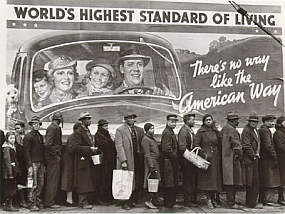 During that time, I got a sinus infection and the doctor strongly recommended I get a series of X-rays taken to judge the severity of the infection. When I found out how much the X-rays would cost, I passed on them.
That was the first time in my life I wondered what it would be like to be poor and have to forgo medical care. In the years since that time, the reality of being unable to afford basic medical care hits home harder and harder. Less and less is covered by increasingly costly insurance. Now the majority of employers offer no group plans at all. What’s amazing is that even with insurance, many people can’t afford to pay what their insurance will not. (Ask me about my family’s out-of-pocket dental outlays in the last few years.)
The Wall Street Journal today said that hospitals are now checking people’s credit histories before treatment. The way things are going (especially if RealID comes to pass, as it looks it will), you may one day be turned down for necessary medical treatment because your credit score is too low. That the hospitals are being granted access to your credit history is bad enough, but if things go as they are, it might get worse than that.
What does it mean for us to pray Give us this day our daily bread ?
I once went on a five-day, water-only fast. Most people don’t handle a single day of fasting well. Try five. The strange thing about fasting is the euphoria you begin to feel around day four. It’s a bizarre sensation. Oddly enough, by the time you reach day four, driven by that fasting “high,” you could probably hold out for another week or so before physical damage sets in. The hunger that gnaws at you those first few days passes. A giddiness replaces it.
I don’t want to think we’re at a point where more and more people will acquaint themselves with the strange rush of starving to death. But I’m nevertheless convinced that any time we had to buttress our positions against such an inevitability may have come and gone.
Give us this day our daily bread.
Here’s the questions an unprepared church must face:
- Companies lay off workers and giving goes down. Now how do you pay for your building and staff when the collection plate is half-filled and you budgeted for a full one?
- The bastions of the church start discovering that they need an extra job or must take service industry jobs that work strange hours, hours that overlap most church activity times. Suddenly, your lay leaders aren’t available to lay lead because they are busy making ends meet any way they can. Who is left to run all your discipleship programs?
- Churches that bet the farm on small groups, hoping they will sustain the flock during the week, now find that most people are busy trying to make a living and have no time for small groups. Now what?
- The most vulnerable people in the church start suffering. Who will care for and comfort them when you’ve been forced to reduce paid staff numbers and lost to job-related issues the 20 percent of non-clergy who do 80 percent of the ministry?
- When people lose jobs, they lose employer healthcare benefits. When they take part-time jobs (if available), they don’t get health insurance. What do you do when one of the cornerstones in your church tells everyone he has cancer and will need at least half a million dollars for a course of therapy?
- Scared people start making runs on banks and grocery stores. The ones who still do have some money clean things out. How will the people in your church eat?
- People in misery do stupid, desperate things. How do you react when an important person in your church goes down in flames and possibly goes to jail for it?
- What network connections has your church forged with churches who may have anticipated this trouble and planned better than yours did? Were you castigating their theology all these years, only to have to go to them for help now?
- People start losing homes. How will you shelter them?
- People start moving out of the worst areas to find work in better areas. Your church isn’t in one of the better areas. What do you do when you start losing people to nomadic lifestyles, or worse, to a falling away because of hard times and persecution?
Give us this day our daily bread.
We need two things: the faith to pray Give us this day our daily bread and the clear thinking to address terrible issues with radical answers rooted in the Gospel.
In the next installment of this series, I’ll offer some ideas of what we can do to better weather bad times and be a Church that is not only prepped for battle, but knows how to live by Give us this day our daily bread.
Stay tuned.
***
 I also think that most of us Evangelicals find money to be a stronghold issue in our lives. Living in America, the wealthiest nation ever, money is a big deal for us. Most of us have staked our lives to money. Thus, the stronghold.
 The kind of man who prays big prayers and knows God intimately for those prayers. The kind of man who readily leads many others to his Savior and disciples those same people to maturity. I want to believe, but I don’t know any men like that.