
When Parents Fumble for Answers

Standard

I had a second cousin on my dad’s side who was older than me; her name was Lois. She was a big, warm-hearted person with a nice laugh who was always nice to me. My dad, who was never the social sort, really liked Lois, too. And like many children, I wasn’t sophisticated enough to understand the whole relational thing, so Lois was always “Aunt Lois” to me.

When I was about twelve, Lois developed leukemia. I remember many nights I spent praying for Lois. In fact, I think I prayed for Lois more than anyone or anything I can remember from that time. I remember reading verse after verse about how God heals. I prayed my heart out for Lois.

She died a little more than a year later in her young thirties. I was so broken up by this that I did not want to go to the funeral because I thought it was my fault that she died. Part of my childhood died with her.

Friday, I had to take my four-year-old son to the emergency room at the local children’s hospital. Despite my constant care and attention (and only three hours of sleep each on Thursday and Friday AM), I could not keep enough fluids in him to prevent his getting dehydrated. Father & son, hand in handHe entered that vicious vomit cycle of losing so much water from his system that adding it only made him more nauseous. In the end, nothing could stay down. He awoke Friday morning looking like one of those hollow-eyed waifs you see in ads for Third World children’s charities.

Now he’s a resilient kid, and despite some bad allergies to furry animals, he’s relatively healthy. Never once have I heard him say, “Daddy, I feel really terrible,” but he did so today. He looked really terrible, too. So at 8:30 AM, I sat half-conscious beside him and said, “Let’s pray for God to heal you.” After I prayed, he looked up at me and said, “I still feel terrible. Why didn’t God heal me? Why will I have to go to the doctor?”

It was the look on his face that broke something inside of me. That look reminded me of how I felt when my dad came into my room late one night to tell me that Lois had died. The expression I must’ve given my dad then was the same one I now saw in my own son’s eyes.

In that teachable moment, I tried to distill the ideas of special grace versus common grace to him, to tell him that God heals alone and sometimes He uses doctors, but that hurt look remained. There was the chink in the armor of childlike faith in a little boy whom I wished would never lose that simple faith that children seem to be born with, the faith Jesus commends for all of us.

He didn’t say much to me the rest of the afternoon. They turned the TV on in the room they gave him at the hospital, and through much of the four hours we were there watching the electrolyte solution plump him up like air in a deflated balloon, he was glued to Nickelodeon’s snarky cartoons for adults packaged for kids. When I’d had enough of the veiled references, we switched to Nick, Jr. Me, the one with all the answers, didn’t seem too filled with them in that moment and I couldn’t compete with the TV. And though he didn’t once cry at the hospital, despite the IV dripline jabbed in his hand, he cried when he got home over a waxed paper pill cup he’d clung to during the whole ordeal; I’d thrown it away as we were leaving the emergency room.

He’s physically fine now. And though he’d already seen a brain full of TV, his mom and I had rented Singing in the Rain and wanted to watch it before we had to take it back to the library. My son laughed his head off during Donald O’Connor’s “Make ‘Em Laugh” scene, and for a while everything seemed like it had always been.

I was a sheltered child. Even at in my 20s, I was pretty naïve. I regret none of that. Yet trying to preserve childhood today is an effort I think all of us underestimated when we started having babies. I thought I knew how to handle every possible outcome, but I didn’t know what to do about the look of abject disappointment I saw in the eyes of my own child when he realized that God was not going to make him better there and then, and that a trip to the doctor, and then to the hospital, was the only outcome. In that moment was a slow leaching away of the reservoir of childlike faith that Jesus loved in the children He blessed.

Millstones. I started thinking about millstones we tie around the necks of people less spiritually mature than we are. Had I said something in the past to my son that setup the expectation that was not fulfilled? Not as far as I knew. Though I’m relentless in turning what he hears of naturalistic explanations for life back to explanations of the workings of God in Creation, I must’ve left open a chink.

Adults put on the full armor of God through the spiritual disciplines and intense discipleship. But children must don that armor through the grace of God working in their parents’ personal instruction. With so many forces of darkness attacking from untold directions, I often feel unprepared for that task. The last thing I want to see happen with my son is for me to fumble the answers, to fail to provide his cover as he moves into adulthood.

It’s that look of innocence lost in a child’s eyes that should chill every parent to the bone.
Arrogance, Ignorance, and “I Don’t Know.”

Standard

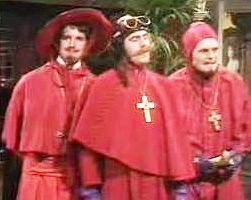
Nobody expects the Spanish Inquisition!Slice of Laodicea notes an Al Mohler article that brings up good talking points about the state of today’s Church in light of the proliferation of cults. Mohler’s basic comment is that poor doctrinal defense and an inability to nip error in the bud have resulted in Christianity being dogged by a plethora of pseudo-Christian cults all clamoring for legitimacy. Given that Eerdmans, long a stalwart in Evangelical publishing, just published a defense of Mormonism, fueling the growing desire of Mormons to be considered mainstream Christians (rather than gladhanders in bleached white Oxfords trying to dig up the remnants of a civilization as non-existent as Plato’s Atlanteans), Mohler may have a point.

But then again, nah.

Mohler’s piece is written as if no Church existed before 1800. Witness this assertion:

Writing early in the last century, J. K. Van Baalen argued that “the cults are the unpaid bills of the church.” Van Baalen’s influential work, The Chaos of the Cults, represented one of the very first comprehensive efforts to evaluate the various cults of the day from the vantage point of orthodox Christianity. Van Baalen’s survey considered movements and groups such as Spiritism, Theosophy, Christian Science, Rosicrucianism, Swedenborgianism, Mormonism, and the Jehovah’s Witnesses, among others.In Van Baalen’s analysis, orthodox Christianity had opened the door for the cults to emerge and to proliferate throughout the culture. Sidelined by pragmatism, distracted by divisions, and committed to a “smallest common-denominator faith,” the orthodox churches had left the larger culture, and even some of their own members, unprepared to meet the challenge of the cults.

If anything, the problem is more acute in our own day. The seductions of postmodernism and the complexities of a pluralistic culture compound the difficulty involved in engaging, understanding, and confronting the cults.

Is the problem more acute in our day? Well, if the Scriptures are to be believed, the first NT writings were not even dry on the page before the Church was confronting cults. We know that the Apostle John wrote to counter the nascent Gnostic heresies and that the Lord Himself called out the Nicolaitans in Revelation. In fact, as long as there has been Christianity there have been cults of Christianity. Paul was constantly squashing one heretical belief after another and even came into conflict with Peter over the Judaizers, a group that Mohler would be forced to tag as a cult if it existed today.

The list of heretical leaders and the groups that formed around them in the early days of Christianity’s spread could take up a leather-bound tome in itself. Mohler’s amnesia here is startling: Marcion, Pelagius, Apollinarius, Montanus, Arius, Nestorianus and on and on. Yes, the Church did put them down, but even today groups of pseudo-Christians cling to the remnant teachings of these heretics. Still, their ideas did not die; even a casual glance around proves Pelagianism is alive and well in the 21st century.

The issue of what constitutes a cult in the history of the Church is also difficult to ignore. To the orthodox Church (and Mohler makes much of what is “orthodox”), Martin Luther and his band of German ne’er-do-wells were a cult. Same goes for that Calvin guy and that fellow Knox. To those early Lutherans and Presbyterians, the Roman Catholic Church was a cult and plenty of Christians today still maintain that view.

In fact, you can trace every modern denomination in Christianity to a blistering reaction by that denomination’s adherents to an “apostate orthodox church.” Methodism, the Restoration Movement, the Quakers, the Puritans, all had a start as folks who came out of a church that was backslidden and given to cultic practices—at least as they saw it. How Mohler fails to consider this is beyond me.

Worse still, Mohler attributes the problem of cult proliferation in the last one hundred-fifty years solely to the Church’s inability to promote correct doctrine. To be honest, I don’t believe that this is the whole story, especially since Mohler lumps seeker-sensitive and Emerging churches in here. Again, an honest assessment shows that these two came not out of bad doctrine, but a reaction against an orthodox Church in America that simply wasn’t doing its job. A lot of denominations started out that way, but when they left their parent churches, the angry ones left behind were bellowing, “Heretics!” even as they smarted over the possible truth behind the breakaway group’s leaving. It was easier to blame them for bad doctrine than it was for being right about the status quo’s calcification and deadness.

Every doctrine of the Church is not nailed down. If we were honest with ourselves we would have to admit this. Get one hundred Christians of all “orthodox” persuasions in a room, and you’ll have at least twenty distinct eschatologies. And while some may say that eschatology makes no difference, many of the cults that arose in the mid-Nineteenth century did so because of eschatological beliefs. Nor does one’s eschatological view exist in a vacuum. The very way we live our lives every day is a reflection of how we think the world will end. If you don’t think that’s true, then compare and contrast Booth’s Salvation Army with today’s Christian survivalists.

I’m going out on a limb here and will certainly get angry comments, but even Paul didn’t have his theology crystal clear on all points—at least as many orthodox Christians might see it today. We know that Paul publicly confronted Peter over his falling in with the Judaizers, but Paul was not so sure of the issue of circumcision early on in his ministry (Acts 15), but then after it was decided that circumcision was not necessary, Paul went ahead in the very next chapter and circumcised Timothy in order to get a better opportunity to preach to the Jews who would have disqualified his testimony because of his uncircumcised co-worker in the Faith. Later on, we have Paul abiding Nazarite vows and ritual cleansings in Acts 21, acts that would drive batty those orthodox believers who eschew anything that looks like a ritual or smacks of legalism.

So just who is wrong here? And better yet, who’s willing to admit it?

It’s that latter sentence that may explain some of the reason why we have cults: dogmatism. Cults— and Christian denominations—exist in large part due to inflexibility of beliefs. They are all backlashes against a rock-solid dogma that chafed. Sometimes (and yes, I know, not always) we Christians must acknowledge some negotiables. Paul did so when he circumcised Timothy. Who here is willing to toss him out for that act? Was it a sin? Was he violating doctrine? Or was the Holy Spirit leading him outside the newly established boundaries just this once in order that some might be saved? That Paul also consented to a similar act (the vows) later on in order to win some to the Lord should give us pause.

Frankly, if Mohler were honest, he’d just skip to the punchline and say, “I’m a Baptist. From my perspective, anyone who baptizes infants is a heretic and their church is a cult.” The problem is, he can’t bring himself to say that because he mentally assents to some doctrinal “wiggle room” himself.

I’m not positive on a lot of points of established “orthodox” doctrine. I believe that because Man is made in the image of God, he’s a tripartite being, just as God is. Wayne Grudem, whose Systematic Theology is a work I deeply respect, does not share that belief. That makes one of us wrong. Applying the standard that Mohler asks, one of us is therefore a heretic.

The Holy Spirit will guide us into all Truth, as the Scriptures say, and yet we see through a glass darkly. I believe both those statements. I believe that the Holy Spirit will progressively make me more like the Lord and I will take on more of His Truth in doing so, but I also believe that I will not have all the answers in my lifetime. As Paul’s “man caught up into the third heaven” can attest, there are answers to questions we may never ask this side of eternity. And if we’ve never asked them, how then can we be perfect in our doctrine?

Arrogance led to erecting a gospel of stone, a weight that not only were the cultists not ready to accept, neither were the leaders of Christian denominations who broke off from the accepted teaching of the day and went down another path. On the other hand, there is no purity in ignorance. Certainly ignorance accounts for the cults and some of those same Christian denominations—ignorance of the Word and of sound doctrine.

Perhaps the reality we face this side of heaven is that on some issues the believer must be more humble, even to the point of saying, “I don’t know.” While I don’t ascribe to the belief that everything is a mystery, neither do I believe that everything is set in granite. I don’t believe that Jesus came to establish a set of dogmas used to crush ordinary people with, and yet He never tolerated erroneous teaching, either.

No matter what the case, we all need a bigger dose of humility when it comes to this issue of who is right and who is wrong. We use the word “heretic” far too often today. The Christian blogosphere is choking on the brutal arguing going on over who’s perfect and who isn’t. I don’t want any part of that anymore. It’s possible to call others to holiness without strangling them to death with a noose of righteousness. That’s the way I’m going to try to take, because in the end, I’m not perfect.

Now where’s my comfy chair?

Lord of the Bored?

Standard

No one is saying it, but someone has to: There are a lot of bored Christians out there.

What is American Evangelicalism's fascination with materialism and consumption? It's a cure for boredom. Why are the charismatics traveling like nomads in search of the next "spiritual" high? They're bored. Why are so many leaving their traditional churches in favor of postmodern or Emergent ones? They are looking for an escape from the boring.

The monster bestseller Wild at Heart by John Eldredge has at its very core the premise that Christian men are bored. Boredom leads to dissatisfaction and, eventually, the fruit of boredom, sin. On this he won't get any arguments from me, but is the solution to go hunt grizzlies with nothing more than a pointy stick? Is life simply about rescuing damsels in distress?

No, there is something more.

I think the "problem that dare not speak its name," the issue that so many Christians are struggling with, is a lack of connection to the Lord. Our churches are filled with people that simply are not experiencing the fullness of the Lord Jesus.

But why is this? What have we done to create a generation of disconnected and bored Christians?

The reasons are many, but five stand out:

1. Leadership. We like to think that everyone in America is an individual, but Jesus' assessment that we are like sheep has not skipped over this country. People still need good role models and leaders. But much of the leadership of churches today can't help people get to that next level of discipleship simply because they have never been there themselves. There has not been a true revival in America in almost a hundred years, and despite a few local revivals (that sadly stayed local), virtually no one pastoring a church today has seen a real revival. Subsequently, we don't know what one looks like, nor have we experienced the deep, abiding presence of Christ that falls on those who have been set aflame by revival. The people can't get there unless the leaders out there show us the map. Leaders, guide us!

2. Anti-supernaturalism. Some say that we are in a postmodern age, while others contend that modernism still reigns in the churches in America. Regardless, we still live in a largely secular world that has driven supernaturalism out of Western churches. If we do not believe that prayer can drive mountains into the sea, then we will absolutely never see that occur. What happened to our faith? Does anyone still believe that if we abide in Him and He in us, we can ask anything in His name and it will be done? I'm not talking Word of Faith craziness here, but simply taking the Lord at His word. What will the Lord do through us if we believe Him for the miraculous not just when miracles are needed, but at the core of our beliefs?

3. Love for the world. 1 John 2:15 has never changed:

Do not love the world or the things in the world. If anyone loves the world, the love of the Father is not in him.

We can't get blood from a stone. If the world has calcified our hearts, then we need that heart of flesh restored in us, a heart that burns with love for Jesus—and Him as Lord over all we are. Yet why are so many Christians absolutely no different than the worldly? Sadly, this appeasement of culture by Christians and the culture's inevitable penetration of the churches in this country is being preached with greater intensity as a GOOD thing. How foolish! That Christians look and act no different from unbelievers is shameful. We are the aroma of Christ, not the foul stench of death! Instead, we have become like rats with electrodes wired to their brains, gratified by every push of the entertainment lever, a new wave of stimulation washing over our addled minds. How sad!

4. Higher criticism of the Bible. It's been more than a hundred years since German higher criticism washed up on the shores of America and crawled into our churches unannounced. The damage this has done to the authority of the Bible in the minds of the average person, Christian or not, is incalculable. When Christians don't believe the Bible speaks to every part of a man, nor that it is authoritative for learning and correction, what basis do we have for anything we say or do? How can the revealed truth of Scripture capture anyone's heart if even our church leaders don't truly believe it?

5. Time. We live in an age in which everything presses us for time. People are harried in an era labeled as The Age of Leisure. How then can we expect to reach that sacred place of standing before God on five minutes of prayer dashed off as we rush to work? In other times, people would be travailing on their knees for hours before the Throne of Grace, but does anyone reading this know anyone like that anymore? (Not only do I not know anyone like that, but far worse, I can't count myself as one of those people even though I once was.) But there is no instant discipleship. Those of us who seek it only find boredom when we fail to break through to God. Our lack of time committed to Christ can only lead us to lament our sorry states, questioning if God is even there.

And so we are bored. Bored with the Bible. Bored with our church meetings. Bored with the Lord. How that must break His heart! All eternity, the entirety of His own Self, ready to be revealed to those who press on, and yet so precious few do.

One thing I do know—those who press on to know the Lord are never bored. I pray that for all of us. Let us press on to know the Lord and put boredom behind us.