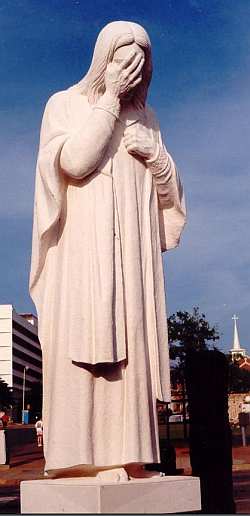
The Finger in the Mirror

Standard

We hear the word repentance bandied about in Christians circles, and in some of those circles, it’s practically a mantra. The list of things we Christians need to repent from is an arm long, filled with things like lust, jealousy, faithlessness, failure to tithe, lack of a decent quiet time, etc.

We also hear pastors and parachurch leaders going on and on about the culture wars. Each day seems to bring a new call to arms from some ministry or self-appointed Christian leader to pray and/or write our political reps over homosexual marriage, abortion, Obama’s health care package, illegal immigration, the rise of Islam and jihad, and so on. The list is nearly endless.

But what I NEVER hear is a combination of the two messages that asks Christians to repent for our complicity in helping to empower the very culture war problems we fight. Never.

A friend sent me a call to prayer for the gathering of Muslims due to take place Friday, Sept. 26, 2009,  in Washington, D.C. Evidently, Islam is trying yet again to market itself as the religion of peace, even as it promotes Sharia law, says little about terrorism,  and advocates a host of legalistic follies that oppose the Gospel of Grace and send millions into a Christless eternity.

When I read that call to prayer arms, I had to ask the question that Christians in America avoid at all cost: In what ways am I at fault for this?

A few thoughts to consider:

  • If American Christians had continued to follow the way of Jesus in ministering to the sick, would we have the health care debate now tearing our country apart?
  • If American Christians had continued to follow the way of Jesus in caring for the orphan, the widow, and the elderly, would we have abortion on demand and a nearly bankrupt Social Security system?
  • If American Christians had continued to follow the way of Jesus in visiting the prisoner, would we have a sky-high recidivism rate?
  • If American Christians had continued to follow the way of Jesus in caring for the poor, Do we truly believe He is the answer?would we have government welfare and the burden of having fostered a society-wide victim mentality?
  • If American Christians had continued to follow the way of Jesus in loving the outcast, would we still be fighting the homosexual agenda on its proponents’ terms or battling race and illegal immigration  issues?
  • If American Christians had continued to follow the way of Jesus by actually obeying His  Great Commission, would we be fighting Islam in this country or dealing with any of the culture wars we seemingly can’t wait to engage with calls to prayers and letters to our congressman?

I would offer that the answer to these and other questions like them is a simple NO.

I would offer that we Christians are as much to blame for the condition we find ourselves in as any of our supposed foes are, but you won’t hear that from the pulpits or from parachurch ministry leaders.

When the Church of Jesus fails to do what the Gospel asks of us, something will fill the vacuum created by our absence. And I can guarantee this: We will not like what fills the vacuum.

Honestly, the denial on our parts sucks the life out of me. And yet we will go on and on about our foes, the way the government does things we don’t like, or the next moral truth to come under assault.

We talk about our nation being a Christian one, but in truth, we’re Christian in name only. If we’re not living the Gospel, then of course everything will go to hell. Why would we be surprised at that?

Do we still believe that Jesus changes lives? Do we believe that Jesus is the answer to all of life’s issues? Then we better stop living as if we don’t.

Equipping the Saints: Leaders, Doers, and Community

Standard

This will be my final post in the Equipping the Saints series. I could probably write on Christian Education issues forever, but I have other things to say, so I’m going to wrap this up for now.

Strangely, one of the things I’ve been accused of during this series is failing to talk about educating Christians outside of mere Bible knowledge. Obviously, that accusation must come from people who don’t regularly read this blog. As I see it, I mostly write about Church issues that have little to do with teaching the Bible and everything to do with the practice of the faith. Cerulean Sanctum exists to talk about how we Christians can more effectively live out the faith in a practical way.

And that’s what today’s post is about.

I find this to be one of the most telling verses in the Bible:

In those days there was no king in Israel. Everyone did what was right in his own eyes.
—Judges 17:6

What makes this verse even more intriguing is that it is duplicated later in Judges 21:25. You don’t see that too often in the Scriptures. The writer of Judges certainly has a point to make!

I’ve heard the latter portion of that verse quoted slightly out of context by teachers attempting to make a point about sin. Well, I can see that a little, but the modifier for that second sentence comes from the one that precedes it.

Israel, in the era of the judges, lacked consistent leadership. The nation had no direction. We see why here:

Now the young man Samuel was ministering to the LORD under Eli. And the word of the LORD was rare in those days; there was no frequent vision.
—1 Samuel 3:1

And we see the outcome of that lack here:

Where there is no prophetic vision the people cast off restraint, but blessed is he who keeps the law.
—Proverbs 29:18

Without visionary leadership plugged into what God is doing, a church simply cannot grow its people deeper in Christ. The success or failure of most churches rests on their leadership.

This is not to say that an anointed leader can’t be done in by external forces, such as church squabbles and other leaders seeking glory for themselves. But whether or not a church makes genuinely deep disciples who know Christ and minister Him through the power of the Gospel and the gifts of the Spirit rests largely on the leadership and its vision.

It worked for Jesus:

So Jesus said to them, “Truly, truly, I say to you, the Son can do nothing of his own accord, but only what he sees the Father doing. For whatever the Father does, that the Son does likewise.
—John 5:19

Jesus connected with the Father and grabbed the vision. So if Jesus is our model, how then can we excuse ourselves from imitating His lead of only doing what He sees the Father doing??

Yet how many leaders know the doings of God? They might know what they are doing, but if that doesn’t align with God’s direction, forget it; the whole enterprise will fail. (Or it might succeed ever so slightly in the flesh so that it becomes a norm that people equate with success, which results in a lowest common denominator measure of future successes that bears no resemblance to what God can make happen.)

This lack of leadership clued into God’s intent defines the state of Evangelicalism in the 21st century. But without God-directed leadership, making disciples will forever be a hit or miss proposition.

It simply doesn’t have to be that way.

As for the people in the seats, their role is doing. We assume leaders are doers, but are their charges?

But be doers of the word, and not hearers only, deceiving yourselves.
—James 1:22

We can teach the Bible until we drop dead of exhaustion, but it will be for naught if the people who receive it do nothing with it. The Bible isn’t meant to exist in a vacuum, but some people make it so. I know in some parts of Evangelicalism, people treat the Bible like a Bible Bowl contest and even award kids for how much they know. Honestly, that’s worthless unless it’s paired with actually living what the Bible says.

One of the most abused verses in the Bible:

All Scripture is breathed out by God and profitable for teaching, for reproof, for correction, and for training in righteousness, that the man of God may be competent, equipped for every good work.
—2 Timothy 3:16-17

I think it’s abused because many Christians will go on and on about how Scripture is God’s word and we should know it, but they then neglect the purpose of God for knowing it: good works.

Folks, that’s the end goal of knowledge of the Bible. Everything you and I read in the Bible is intended to equip us to be doers. That’s why James’ admonition is so powerful. Absorbing Bible teaching after Bible teaching yet doing nothing with that teaching is wicked! It’s a lie we tell ourselves about our maturity, because we base that maturity solely on what we know, not on what we do because of what we know.

I am perpetually amazed by the martyr Stephen. Here he was whip smart in the Scriptures and filled with the Holy Spirit, yet his job ensured the people forgotten by the rest of his culture were waited on at table. And he didn’t discharge that waiting to some lesser; he did it himself.

In our day, we would call that a waste. But Stephen didn’t think so. Nor did the apostles who chose him for that role. All had caught the greater vision of knowing the Scriptures. And when time came for Stephen to die by the hands of those who hated him for what he practiced, what he knew came out in full force. So that even as he was dying, he was doing the work of an apologist and evangelist.

Doing ensures learning. Tell me something and I might retain some general knowledge. But let me do based on what I have learned, and I will grow deeper. That’s how it works. God intends for us to do what we know so that we put down spiritual roots and can take on even more responsibility in learning and doing.

Do we want revelation by the Holy Spirit in our lives? Rather than trying to snatch mystical revelations out of thin air, why not just do what the revelation of the Scriptures has already told us to do? How can anyone expect to hear the Holy Spirit speaks some charismatic revelation if that person fails to do what the in-hand revelation of the Holy Bible has already said to do?

Feed the poor. Visit the sick and dying. Minister grace to the prisoner. Share Christ with others. I can guarantee that if we do those things the Lord commanded in the Scriptures we will understand what the Bible means in a greater way. Doing is its own learning. It’s the on-the-job training that takes everything we know already from the Bible and sets the Spirit’s fire to it, making it real in the life of the believer. You and I simply cannot grow to understand the Bible, grow in grace, grow in knowledge of the voice of the Lord, and grow in spiritual giftings unless we do the things God has already taught us to do.

Leaders must lead based on the vision they have received from God. The congregation must know the Bible and do what it says to do.

The last piece of this is to blend it together in community. The more mature folks work alongside the less mature, helping them to see through service what it means to put the word of God into practice. Mentoring isn’t then reduced to a 1:1 relationship that only comes about through much wrangling, but it defines how the community lifeblood of the church flows, as it should always occur on a community scale. When the community of the local church then catches the vision of God given through the leadership, Christian Education finds its fulfillment. Great things happen. People grow deep in Christ. The local church blooms and prospers, as does the greater Church Universal.

So many times this ideal fails because we fail to understand that it must and always be a process that depends on everyone doing his or her part. Leaders must draw close to God enough to see what He is doing. The congregants must be willing to put what they learn in the Bible into practice. And the greater community, both leaders and nonleaders, must be working together toward a common goal.

We can have such a practice in our churches if we wished to. But I believe that too few of us do. Satisfied with a snack, we miss the feast. And worse, we come to believe that the snack is all there is.

Equipping the Saints: How to Have a Sweet Hermeneutic

Standard

The Bible, old school style...Apologies for being away for more than a week. Thanks for being a reader and for hanging in there through blog hacks and workloads.

As we start winding down this look at equipping the saints, let’s talk about hermeneutics.

Hermeneutics is NOT the fan club of the father on The Munsters. It’s the theory behind how to properly interpret. While the word hermeneutic may be associated with other fields of study, it gets its workout in the field of interpreting the Bible. And that’s what we’ll be talking about today, biblical hermeneutics.

If you’ve been a Christian long enough, you’ve encountered both good and bad biblical hermeneutics. The classic example of bad hermeneutics is the fellow who decides he wishes to hear from God and chooses as his oracle to let his Bible flop open, followed by him blindly dropping a finger on the open page. The first verse that comes up is Matthew 27:5, wherein Judas hanged himself. Unnerved, the guy lets his Bible flop and ends up on Luke 10:37, where Jesus said, “Go and do likewise.” In a near panic, the guy tries one last time and comes up with John 13:27, which admonished, “Whatever you are going to do, do quickly.”

We laugh, but I’m certain each of us has encountered this kind of application and  interpretation of the Bible, not just by those new to the Faith but also by teachers, pastors, preachers, and leaders who should know better.

If we are going to truly equip a generation to be strong in the knowledge of the Bible, we have to have a solid biblical hermeneutic.

Here are my top ten suggestions on how to interpret the Bible properly:

1. Always ask the Holy Spirit to be your guide. One of the reasons the Holy Spirit was given by God is to help us understand God’s words to us. If we ask God for His Spirit’s guidance in understanding the Bible, He will be faithful to provide it. Not enough of us make this plea, and it is one reason why we have so many weird Bible interpretations out there.

2. Let the Bible interpret the Bible. The Bible is a coherent whole. God is wise enough to know how it comes together, so He can help us see that unity. If we come to the Bible with an agenda or with the latest nonfiction title from Oprah’s book club in our other hand, we’re going to let those doing the interpreting for us. So many people fall down at this stage that I would advise “Let the Bible interpret the Bible” be stamped in large letters on every Bible printed.

3. The Bible has two distinct testaments, Old and New—and that’s for a very good reason! Whenever New Testament Christians begin to read the Bible through Old Testament lenses rather than New, error crouches at the door. It boggles my mind how many Christians attempt to resurrect Old Testament practices and make them “new,” even though those old practices were fulfilled in Christ. More often than not, the Church suffers for this, as people attempt to live by the Law and not by the Gospel of Grace. If I had my way, every new Christian would spend a full year in study of the New Testament book of Galatians before ever being allowed to read one page out of the Old Testament. Whenever I hear a teaching meant for the Church today and it spends the vast majority of its time in the Old Testament, the flags go up. Be very careful on this, as confusing the Testaments makes for deadly cases of damnable legalism. This is not to say that the Old Testament does not speak to modern Christians, only that what it says must be interpreted through the reality of the Gospel and the Kingdom of God as revealed through Jesus.

4. Thou shalt not build entire systematic theologies on a single verse. If God really wants to command us to do something or show us how to live, He’s going to do so more than once. Some of the wackiest things Christians do comes from some leader’s weird interpretation of a single verse, usually taken out of…

5. Context, context, context! When verses are taken out of their full context, they can be made to say anything. Witness again the poor fool with the floppy Bible and errant finger. Context is king! I recent had the displeasure to hear someone talking about Jesus’ sole “command to tithe” in Matthew 23:23, as it seems that Jesus is praising the Pharisees for tithing their spices. That this passage occurs within a litany of condemnations Jesus calls down on the heads of those same Pharisees, the poster children for doing it wrong and missing the real heart of the Lord, should give us pause. Context begins with the whole of Scripture and trickles down through the testaments, the books, the chapters, and the scenes (but never to the verses alone). I would even offer that for some books of the Bible context should never go lower than the whole book. The epistles (letters of Paul and other writers) of the New Testament are meant to be read in their entirety and should be understood in that larger context.

6. Beware of numbers. I don’t mean the book of Numbers in the Old Testament, but any teaching that makes enormous use of the numbers of the Bible. Some of the worst theology, especially related to end times predictions, has been concocted by people attempting to string together numbers in the Bible. For instance, I have heard numerous teachings over the years on the “number of completion in the Bible,” with the only problem being that each teacher chose a different number: 3, 7, 10, 12, 40, 100, 1,000, and 144,000.  Such exercises are more likely manmade than God-inspired, as tossing around numbers is a sure way for a “Bible expert” to appear “deep.” Numbers are what they are, and attempts to read too much into them can lead to some seriously goofy teachings, especially when trying to make them say something within a teaching agenda. (A glaring exception to this is the Trinity, but even then, I would be wary of always associating anything with the number 3 back to God. I mean, Paul asked God three times to take away his thorn, but I don’t think I’d carve in stone that he was addressing a different person in the Trinity each time!)

7. While the Bible is timeless, culture is not. This can be a fine line for people and creates the most arguments as to WHAT GOD REALLY INTENDS™. For the serious Bible student (which, honestly, should be every Christian!), it pays to understand the cultural context of the times in which the Bible was written. When God says he doesn’t want trees near His altars (Deut. 16:21-22, and elsewhere), it pays to understand why, especially if we wish to see if that reasoning is based in culture. When Paul tells the Corinthians that women should always wear a head covering when praying and prophesying, is His admonition culturally mandated or not? Why? (Evidently, we think it is a product of the times, since rarely do I see today’s women covering their hair in church as commanded by Paul.)  Be very careful, though, to avoid confusing timeless truths with cultural ones, as that confusion is often used by moral relativists to justify all manner of sin. Such sins as lying, pride, and sexual perversion are always wrong, no matter the cultural context, and the Bible will always bear this out.

8. No matter who a Bible teacher might be, always be discerning. Paul praised the Bereans for not taking him strictly on his word, factchecking him against the Scriptures (Acts 17:10-11). That kind of healthy skepticism is missing in the lives of too many Christians, as millions readily fail to check if what they are hearing is really true. Honestly, in my own life, I start with the assumption that what I am hearing is suspect until proven otherwise by the dual testimony of the Holy Spirit and the fullness of the Scruptures, and that reasoning has not failed me in nearly 35 years of walking with the Lord.

9. Use multiple translations of the Bible when examining passages, especially ones that are not immediately clear. Some Bible companies offer parallel Bibles that include multiple versions/translations side by side for comparison. Chronological bibles are fascinating tools to help readers see how books like the Psalms or Jeremiah fall into the context of books like Kings or Chronicles. The Amplified Bible is an interesting attempt to expand the meaning of certain Hebrew and Greek words and phrases (though I would NOT recommend it as an everyday reading Bible), which can help illuminate the text. I believe that English-speakers will be well off with a literal translation (such as King James, New American Standard, or English Standard versions), a dynamic equivalency (which tries for literal phrasing, if not word for word—the New International Version is fine), and a paraphrase (such as the New Living Translation or the NT-only New Testament in Modern English by J.B. Phillips).

10. Don’t just read the Bible, study it! And use good reference books, too. A devotional reading of the Bible will not help us understand it fully. Such a technique may help us find comfort in its words, but there is much that lies below the surface, and it pays to root out the deeper truths. Many good reference books exist (I use a bunch of old, dusty ones that are no longer in print, but excellent contemporary helps are available), so do a little comparative shopping and talk with people whose spiritual lives you wish to emulate. I’m sure they can recommend books that can help them. (One newer book I recommend on this topic of proper hermeneutics is How to Read the Bible for All It’s Worth by Gordon Fee and Douglas Stuart.) Every student of the Bible should have a good concordance (for looking up words in verses), Bible dictionary, and Bible commentary (or three) as a means for study.

These ten suggestions do not comprise the whole of good hermeneutical technique, so I would encourage you to delve deeper into the topic of how to properly read and interpret the Bible. With so many bad teachers and preachers out there today, wisdom dictates that being properly equipped demands more of us than simply nodding our heads in unison to whatever some guy with moussed hair, brilliant dentition, and a Brooks Brothers suit tells us to believe.

Finally, why did I choose to label this post “How to Have a Sweet Hermeneutic”? Because when we truly know how to handle God’s word correctly, we’ll enjoy this:

How sweet are your words to my taste, sweeter than honey to my mouth!
—Psalms 119:103

And in the end, isn’t that what every believers truly desires?