

Banking on God: Crisis, Part 1

Standard

Woe unto the grasshopper!That I’m still under the weather makes today’s post all the more apt. Feeling lousy may be a state many of us will better understand in the days ahead.

The fifth largest investment bank in the United States collapsed Monday. Please read that again.

Now read this: 60,000 homes in my state of Ohio are in the process of foreclosure as of last quarter. That’s the worst in the nation.

When I first read a nondescript, well-hidden article in The Wall Street Journal last May concerning problems in the sub-prime mortgage industry, I told my wife, “This is it. The ripples are going to be devastating.”

Long-time readers of Cerulean Sanctum know that this is one of the few Christian blogs out of thousands that talks about economic issues facing the Church in America. I’m no prophet, but it didn’t take a seer to read the handwriting on the last recession’s wall. My church’s number one prayer request was for meaningful work. Number one. Sadly, many of those who lost jobs in the last recession could not find jobs that paid as well as the ones they lost. This is a serious concern that many people, including economists, ignored.

The chance that we would suffer another economic meltdown worse than the one that hurt us for nearly five years seemed lost on all the stampeding bulls when the US economy supposedly turned the corner sometime in 2004-2005. Sadly, though, that corner turn didn’t trickle down to many people. Every economic survey known to man showed that real wages only improved during the last “rebound” for those in the top one or two percent of wage-earners. The rest of us could not keep pace with inflation. But those dour, yet real, numbers got lost in the giddiness over the fact that the ultra-rich got ultra-richer, and their continued ultra-richness drove up all the positive economic figures disproportionately.

Now the greed of many of those ultra-rich, particularly those who drove ludicrous speculation in investment sectors, is threatening the entire world economy.

Once again, the question must be asked: How has the Church prepared for any of this?

Perhaps this poll figure will show us:

[poll=35]

Answer? Not at all, it seems. Once again, we’ve been caught napping.

And this is patently sad, as I see it. One can’t read the Bible and not note that God blesses people who are prepared. Imagine a world where Noah failed to build the ark. Think on Joseph ignoring God’s counsel, leading to an Egypt ill-equipped to handle seven years of famine. Scratch those and there is no story of salvation, folks. The world grinds to a wet, watery end. Or it starves to death.

So which of our churches stored up for seven years of famine during the few years of “plenty” we supposedly just experienced? Just two percent by the poll responses. As far as I see it, every “unknown” response might as well be a “false,” because if it’s not obvious we’re preparing (and our preachers aren’t talking about it), then we haven’t been.

[poll=39]

Half of us said we could help a family in need up to a month’s worth of groceries. I figure that’s good for a one-time gift of $200-$300.

My concern here, though, is whether this will be enough when the need moves from being a lone family in your church and mine to dozens. Or in the case of some megachurches, hundreds.

[poll=38]

While it looks as if this poll shows a drop in what respondents thought would be the largess of their church versus what they would give themselves, it balances out because some believed their churches would handle more expensive needs. That’s a positive answer. Let’s all pray that it reflects reality.

[poll=37]

The last recession lasted three to five years, depending on which economists you read. The news for this poll question, though, deals with the increasing length of time it takes job searchers to find decent jobs lost during an economic downturn.

On average, the last recession saw the unemployed enduring ten months of nada before finding replacement work. Considering that most unemployment payments end after six months, it’s a four month shortfall on income. That’s all that half the respondents had set aside. God help us if things should be worse this recession.

About five years ago, I sat in a church amid 2,500 or so people and raised my hand when the pastor asked how many had at least six months income set aside. I looked around that massive auditorium filled with people and a grand total of six hands were raised. My wife and I counted for two of those hands.

This was not a throwaway poll by that pastor, either. He beseeched people to be honest. What was most scary was I would deem the majority of people sitting in that church that night to be middle to upper-middle class. These weren’t poor people already scraping by, but the ones who should know better.

How is it that we are not better savers? Why is the savings rate in this country in the negative numbers? I was playing a trivia game a couple weeks ago and a question asked, “What percentage of Americans spend more in a year than they earn in wages?” I guessed around 30 percent. The answer? Closer to 75.

Yeah, you read that right.

Folks, we Christians need to be better prepared than that and far more serious about money than we appear to be.

[poll=41]

If this answer were truly the case, then why are our churches unprepared to take care of people, both members and outsiders, if and when the economy tanks?

[poll=42]

A CNN poll today said that three out of four people believe we’re in a recession. I wonder what the poll above would show today versus three weeks ago if I re-ran it.

[poll=40]

In the church finances poll, most respondents said that staff salaries comprised the largest chunk of financial outlay for their churches. Fortunately, clergy positions are exempt from payroll taxes. Same for property taxes for churches.

Now imagine if those were removed on a church on thirty acres of land that had a dozen exempt-clergy positions. That’s a mighty big resulting ouch.

I would not be surprised if in my lifetime churches lost their tax exemption. Increasingly, city governments are fighting harder to keep churches out of any area deemed business-worthy. Why? Because the locality can’t draw taxes from that church, and the church keeps one more business from locating on prime, taxable turf. You can bet that sooner or later someone, somewhere, is going to run the numbers on all that uncollected tax money and somebody’s not going to be happy with failing to get a cut.

This issue becomes even scarier when we realize that the Fed position on church tax exemption considers it a privilege rather than a right. A series of court rulings in the 1970s formalized that “privilege, not right” position legally. And what is labeled a privilege is typically taken away when it seems most expedient to do so. Like in a deep, protracted recession. Just the kind that economic experts at the University of Michigan claim we now face.

Wouldn’t it be dispiritingly ironic if the American Church lost its tax exemption in order for the government to fund social services the Church should’ve been handling anyway?

[poll=43]

Pascal’s Wager is a famous apologetic that states it is far wiser to believe that God exists than to bet that He does not and be forced to pay the consequences of His existing. In other words, if God doesn’t exist, then it doesn’t matter who believes in Him or not, the end of all humans is the same. But if He does exist (and particularly if the Bible establishes His rules for living), then those who don’t believe in Him are in one world of hurt when they die. Better then to believe in Him.

Describing the Church’s position on the End of All Things poses the same problem, except for Christians. It’s nearly impossible to gather a room of noted theologians and get them to agree on issues like the Rapture, the millennial reign of Christ, and the meaning of the symbols and events of Revelation. Eschatology divides more Christians than just about any other issue.

In that case, would it not behoove Christians to prepare for the worst possible end times scenario rather than the least? If so, the worst would be that the Church goes through the entire Great Tribulation. If the Church gets raptured out of here at the first sign of trouble, then great! We avoid the Great Tribulation altogether. But what if that’s not the way it works? (And no one thought it worked that way until the late 19th century, so what does that tell us?)

Where then is our preparation? How will our churches handle persecution? What alternative economic systems are church leaders developing so Christians can exist outside the corrupted world economic system? Have we identified people in our churches with specialized skills? Are we doing anything at all to weather even a few months of the storm? Anything?

We simply are not ready and have no excuse for our lack of preparedness.

[poll=44]

Almost a third of poll respondents said they believed that Jesus would return in the next 5 to 25 years. That’s a pretty astounding number, though not unusual. I believe that most Christians throughout history have believed that the Lord’s Second Advent would come in their lifetimes.

Still, if one person out of three believes this, where is the evidence of our preparation for His return? One out of ten of you believe Christ will not only return soon, but that the Church will persist through the Great Tribulation. Where then is the evidence that one church in ten is prepping for that reality?

What we say we believe and how we live that belief MUST align or else we deceive ourselves.

I don’t want to sound like a broken record here, but it’s hard not to see today’s Church in America as the grasshopper in Aesop’s tale. We need to be more like the ant—or should I say that we needed to be more like the ant. Because if winter is indeed already upon us, it’s going to be a brutal and savage cold like we’ve never experienced before.

***

Banking On God: Series Compendium

Banking on God: Theology, Part 3

Standard

I’d not intended on writing a third post on theology in my “Banking on God” series, but a combination of events convinced me I need to say more.

Today in church, we had a visiting evangelist from Ghana in Africa. He regularly comes to our church because we help his missions organization minister in the countries of Liberia, Ghana, and Togo. He’s a gentle, self-effacing, native-born African who always has a powerful word to speak to us Americans, especially how we must bring Jesus to Africans and also address their extreme poverty.

As I listened to him speak, he drove home a truth that can’t be ignored. And while I already knew of the situation he detailed, I never saw how critical it was until yesterday morning.

Islam continues to swallow the northern half of Africa, with more and more countries becoming majority/exclusively Muslim each year. Poverty, Christianity, and Islam in AfricaPart of the reason for Islam’s growth in Africa is that “evangelists” for Islam have learned what Christian missionaries knew for years: people are more willing to embrace your message if you help meet their physical needs.
To this end, Muslims are building schools, hospitals, wells, orphanages, electrical generators, and mosques at record pace. And they’re doing so backed by the money we pay for oil. With a barrel of oil over $100, it doesn’t take a genius to see where this is heading. The Saudis funnel massive amounts of money to Islamic “missions” programs, and the leaders of those programs go into villages loaded full of cash they lavishly spend to help poor people out of crippling poverty.

This evangelist told us that this is a very difficult issue to overcome, especially when Christians cannot muster the same outpouring of largess. Worse, he told us that many projects by a number of Christian ministries in his area have stalled due to a lack of funds.

Part of his work is to help new converts find work because so many people are stuck in grinding poverty. His organization equips people to start businesses and find careers because the need is so great and so practical. His hope is that the Christians in the countries he ministers to will leverage their new businesses to make local churches self-supporting. But they are not there yet.

Sadly, as Christian efforts break even or stall, the continued flood of cash by Muslim organizations is perpetuating Islam’s tsunami through Northern and Central Africa.

I heard this and, I’ll tell you, it just made me sick to my stomach. Truly.

I don’t want to think that the reins we keep on our wealth here in the American Church are so tight that millions will go to a Christless eternity for our stinginess. And while some may argue that money is not the reason for people going to hell, surely a lack of benevolence on our part contributes to that outcome. The starving African should not come to the Christian and be turned away for lack of funds—only to find comfort in the arms of wealthy Islam.

Are we ready for that kind of apologetic? Isn’t it sad to think that Christians, who once built the vast majority of hospitals, schools, and orphanages around the world are being rapidly outspent in those same areas by Muslims?

In an age when rational Western Christians have largely dismissed signs and wonders evangelistic techniques, we either need to re-evaluate our anti-supernatural position in light of Islam’s outpouring of cash or exceed that benevolence with our greater giving. If we can’t compete monetarily, we better have something a whole lot better to offer people, something that meets their physical need right where they are.

As the Bible notes,

But Peter said, “I have no silver and gold, but what I do have I give to you. In the name of Jesus Christ of Nazareth, rise up and walk!”
—Acts 3:6

That’s something Islam can’t possibly hope to match.

***

Banking On God: Series Compendium

Banking on God: Theology, Part 2

Standard

The prosperity gospel. You know it. You probably despise it.

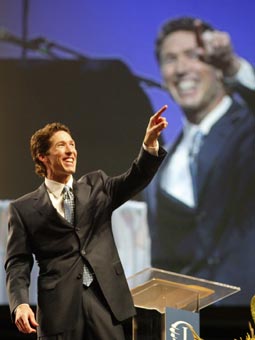
Just the thought of some loud, sweaty, Armani-wearing “preacher” telling you that sending him $100 as “seed faith” money guarantees an increase of three, ten, or even a hundredfold…No, not this guy...the OTHER prophet Joel...well, the veins start pounding in your forehead and you’re wishing you could reach into your TV and slap the guy a good one.

“God wants you rich!”

“If you can envision it, you can have it by faith!”

“If words of death come out of your mouth, you’re going to reap death. Speak words of life!”

“Why ask God for a Ford when you should be asking for a Lexus?”

“You don’t have to live with disease if you have faith in God.”

“The power of wealth creation is in your tongue, so speak out that wealth!”

“You’re a child of the King, and you’ll never see a prince or princess enjoying anything less than the best the world has to offer.”

Now I made all those up. I’ll bet, though, that at some time or other a prosperity gospel preacher said something pretty darned similar. In fact, we could almost make a game of it by coming up with outrageous claims by prosperity teachers who teach a gospel without a cross, without sin, without holiness, and without—unbelieveably enough—Jesus.

These “preachers” of prosperity sucker millions of dollars from millions of people. Naifs who fall under the spell of these slick-talking, Bible-waving, perfectly coiffed “evangelists” often come to a sad—and savings-less— conclusion. Those prosperity preachers like to call everyone “Brother ” or “Sister,” and they often go by titles like “Apostle” and “Bishop.” And sadly for the rest of us charismatics, they claim Pentecostal and Assemblies of God backgrounds.

I feel for the people taken by these manipulators. For the most part, many of the fleeced are poor to begin with. Or perhaps it’s better to think of them as the working poor, especially in America. They have jobs; they’re just not good jobs.

Consider a mom and dad who collectively bring home about $16 an hour with no decent benefits. They have a car, but it costs more to keep it running than it’s worth. Things break in their home and they can’t afford to repair them. Doctor? Who can afford one when there’s no insurance and a simple office visit costs a day’s wages (and there’s always more days at the end of the month than there are wages). Taxes keep going up. Energy keeps going up. Prices for everything are up, up, up. Yet for these folks, wages stay the same. They’re the ones getting destroyed in this recession.

And every day they see themselves sinking further and further down with no hope of recovery. Think they’re going to latch onto anyone who can give them hope of getting out of their predicament?

The two question I ask amid all this is Where are we and what hope do we give them?

And that’s a problem for us Evangelicals who gag every time we think about the prosperity gospel.

Here’s a clue for us suburban McMansion-dwellers in our newly-erected, mega-community-churches: Poor people don’t like being poor.

It stinks to be poor. When your kid needs glasses and you can’t secure a pair because you’re too “rich” for government aid yet you’re not rich enough to afford them outright…well, it stinks even more.

I live in a not-so-rich area. Many of the houses on my road aren’t houses; they’re trailers. The state of the economy is putting a terrible squeeze on these already-squeezed people. So when they start putting faith in the prosperity gospel, I’m not surprised. The real Church hasn’t given them much other hope. Billy Joe Jim Bob Preacher Boy with a Gilt-fendered Escalade was there when the real Church wasn’t.

Do we remember Acts 2 & 4?

And all who believed were together and had all things in common. And they were selling their possessions and belongings and distributing the proceeds to all, as any had need.
—Acts 2:44-45

There was not a needy person among them, for as many as were owners of lands or houses sold them and brought the proceeds of what was sold and laid it at the apostles’ feet, and it was distributed to each as any had need.
—Acts 4:34-35

I would contend that if we in the Church actually lived as those four verses describe, there wouldn’t be any need for anyone to rush to prosperity teachings for hope. But when we simply ignore those passages, especially in light of those parents who don’t know how they’re going to pay the hospital bill for their kid’s broken arm, then we’re assisting the prosperity message through our inability to live by the Bible so many of us call inerrant.

But you want to know the craziest part of all this? As bad as these prosperity preachers are, as little as they care about the cross and bearing it, they’re not wrong on everything.

Psalm 112 says this:

Praise the LORD! Blessed is the man who fears the LORD, who greatly delights in his commandments! His offspring will be mighty in the land; the generation of the upright will be blessed. Wealth and riches are in his house, and his righteousness endures forever. Light dawns in the darkness for the upright; he is gracious, merciful, and righteous. It is well with the man who deals generously and lends; who conducts his affairs with justice. For the righteous will never be moved; he will be remembered forever. He is not afraid of bad news; his heart is firm, trusting in the LORD. His heart is steady; he will not be afraid, until he looks in triumph on his adversaries. He has distributed freely; he has given to the poor; his righteousness endures forever; his horn is exalted in honor. The wicked man sees it and is angry; he gnashes his teeth and melts away; the desire of the wicked will perish!
—Psalms 112:1-10

Well, is that true or not?

That passage embodies many of the teachings found in the prosperity gospel.

And what of this?

Is anyone among you suffering? Let him pray. Is anyone cheerful? Let him sing praise. Is anyone among you sick? Let him call for the elders of the church, and let them pray over him, anointing him with oil in the name of the Lord. And the prayer of faith will save the one who is sick, and the Lord will raise him up. And if he has committed sins, he will be forgiven. Therefore, confess your sins to one another and pray for one another, that you may be healed. The prayer of a righteous person has great power as it is working. Elijah was a man with a nature like ours, and he prayed fervently that it might not rain, and for three years and six months it did not rain on the earth. Then he prayed again, and heaven gave rain, and the earth bore its fruit.
—James 5:13-18

Do we believe that or not? The scary thing is that the prosperity preachers do.

And that’s a problem for us. Because there’s little difference in the eyes of the Lord between someone who preaches the wrong kind of faith and someone who has no faith at all.

Recently, I visited a few sites where people who believed God for healing terminal diseases came under fire from commenters. That made me livid. While it may be true that the commenters were wise enough to see through the phony promises of prosperity preachers who took money from the sick in exchange for a promised healing, is that any worse than not believing for healing at all? When I read those commenters, this quote struck me:

“Your daughter is dead. Why trouble the Teacher any further?”
—Mark 5:35b

Isn’t that the voice of resignation? Isn’t that the voice that says to give up? Isn’t that the voice that says to just make peace with the suffering?

Isn’t that the voice of the Enemy?

To which Jesus replies:

“Do not fear, only believe.”
—Mark 5:36b

I’m convinced that when we get right down to it, for many of us, our so-called faith is a sham. We may pray, “Give us this day our daily bread,” but which of us actually lives from one day to the next dependent on God to provide that day’s food? Can’t we buy our way out of almost any trouble we encounter? Why do we need God for anything?

Sure, Christ died and with His blood secured eternity for us who believe. No, we couldn’t do that ourselves. But beyond having faith that He will take us to heaven at some future date, how well do we live in the dark moments before then?

What happens should we find ourselves on the tight loop of the downward spiral? That time when we can no longer afford medical care, even if we have insurance? What happens when we confront some expensive-to-deal-with disease. Will we have faith then that God will come to help when before we counted on our money to make it all better?

Or will it all be suffering?

Prosperity preachers don’t like suffering much. In fact they pretty much hate suffering in every form. Boo on them, because we should expect suffering in life, right?

Funny thing is, the Scriptures tell us that one of the reasons Christ came was to relieve suffering:

“The Spirit of the Lord is upon me, because he has anointed me to proclaim good news to the poor. He has sent me to proclaim liberty to the captives and recovering of sight to the blind, to set at liberty those who are oppressed, to proclaim the year of the Lord’s favor.”
—Luke 4:18-19

Isn’t our Gospel supposed to be Good News to suffering people? How then did we turn it back into being about suffering? Isn’t the Kingdom of God a Kingdom that drives out that wicked kingdom filled with suffering? I mean, if we should be content in our suffering, I guess all those sick folks and families of demon-possessed people had it all wrong when they cried out to Jesus to come and take away their suffering.

And while we’re at it, what is so wrong with speaking positive things by faith? The prosperity gospel people always talk about making a positive confession:

From the fruit of a man’s mouth his stomach is satisfied; he is satisfied by the yield of his lips. Death and life are in the power of the tongue, and those who love it will eat its fruits.
—Proverbs 18:20-21

True or not true? Obviously, I believe it’s true. Why then do so many act as if it’s not? I’ve got to believe the world would be a better place if Christians, especially here in the States, showed their faith more effectively to the world by speaking words of life rather than so many deadly words that only drive the lost further from Christ. And even in our own lives, how many times do we condemn ourselves by the negative words we speak with regard to our own lives? If a man truly reaps what he sows, what is reaped by the negative things we say about ourselves or our neighbors?

So as much we say we despise these prosperity preachers for filling desperate people with naive hope while draining their wallets, I look at my own life and the lives of a lot of other Christians who oppose those charlatans and wonder if our faith is even visible at all.

Now which problem should concern me most?

***

Banking On God: Series Compendium