In it, people discovered the fullness of Jesus Christ.
People gathered together daily, ate their meals together, and shared the Lord’s Supper in an atmosphere of joy and celebration.
People gave, and without man-made limitations. They gave everything they owned, everything they were, and every spiritual gift they had received from the Lord, because they loved each other, so no one among them lacked for anything.
People saw themselves as equal partners in the Faith, but each with unique gifts, so that no one would contemplate surviving completely in Jesus without the others. And no one among them lorded anything over any other, but each was was seen as an essential part of the whole.
People acknowledged that the only hierarchy among them was that some had been in Jesus longer than others, so those had grown deeper and had more to contribute, with those more mature ones afforded the honor they deserved. Jesus alone was the head, and all others were fellow members of the Body, each one a saint, priest, and fellow sojourner.
People brought their spiritual gifts to each assembling together, with each person encouraged to share what the Spirit was doing in and through him or her, as the Spirit of God Himself directed.
People were in Jesus, who was in the Father and the Holy Spirit as well, all experiencing the fullness of true fellowship and intimacy.
And among the people love ruled, with each person lifted up by the other, joined in unity in the Lord. And that love was so compelling that nothing in the world could compare, not even a little.
I had a dream, and it seemed so strange, like nothing I had experienced before.
And I wanted it to be true, and real, and present right now.
Here’s to the crazy ones. The misfits. The rebels. The troublemakers. The round pegs in the square holes. The ones who see things differently. They’re not fond of rules, and they have no respect for the status quo. —Apple Inc., “Think Different” ad, 1997
And as they were speaking to the people, the priests and the captain of the temple and the Sadducees came upon them, greatly annoyed because they were teaching the people and proclaiming in Jesus the resurrection from the dead. And they arrested them and put them in custody until the next day, for it was already evening. But many of those who had heard the word believed, and the number of the men came to about five thousand. On the next day their rulers and elders and scribes gathered together in Jerusalem, with Annas the high priest and Caiaphas and John and Alexander, and all who were of the high-priestly family. And when they had set them in the midst, they inquired, “By what power or by what name did you do this?” Then Peter, filled with the Holy Spirit, said to them, “Rulers of the people and elders, if we are being examined today concerning a good deed done to a crippled man, by what means this man has been healed, let it be known to all of you and to all the people of Israel that by the name of Jesus Christ of Nazareth, whom you crucified, whom God raised from the dead–by him this man is standing before you well. This Jesus is the stone that was rejected by you, the builders, which has become the cornerstone. And there is salvation in no one else, for there is no other name under heaven given among men by which we must be saved.” Now when they saw the boldness of Peter and John, and perceived that they were uneducated, common men, they were astonished. And they recognized that they had been with Jesus. But seeing the man who was healed standing beside them, they had nothing to say in opposition. But when they had commanded them to leave the council, they conferred with one another, saying, “What shall we do with these men? For that a notable sign has been performed through them is evident to all the inhabitants of Jerusalem, and we cannot deny it. But in order that it may spread no further among the people, let us warn them to speak no more to anyone in this name.” So they called them and charged them not to speak or teach at all in the name of Jesus. But Peter and John answered them, “Whether it is right in the sight of God to listen to you rather than to God, you must judge, for we cannot but speak of what we have seen and heard.” And when they had further threatened them, they let them go, finding no way to punish them, because of the people, for all were praising God for what had happened. —Acts 4:1-21
In the wake of the death of Steve Jobs, people all over the world have lamented the passing of Apple’s charismatic leader. Gene Veith, provost and professor of Patrick Henry College and a member of the Alliance of Confessing Evangelicals, attempted to understand this outpouring in his article “The Apotheosis of Steve Jobs.” In it, he writes:
I would say that it isn’t just that Jobs has been turned into a saint. In our newly-minted paganism, he and other celebrities have undergone apotheosis. That is, they have been turned into gods. The parallel is what would happen in the Roman Empire. An accomplished emperor dies. So the Senate votes to proclaim him a god. Whereupon he enters the pantheon and citizens are enjoined to perform sacrifices to him.
Hardly.
Unfortunately, Veith is blind to the real feelings of people who seem unusually grief-stricken by the death of a business leader they didn’t know. He represents the typical Evanglical Christian position that interprets the world through personal perspective only, not from any view larger than the individual. “Personal Jesus” indeed.
Everything we need to know about the lament over Jobs and what it means for Western Christianity can be found in two Apple commercials, “1984” (hailed by advertising experts as the greatest commercial of all time) and “Think Different,” which followed 13 years later with the identical message:
The average American slogs through the wreckage of the industrial revolution, commuting through endless traffic to a job he tolerates simply for the (diminishing) money, rushing through some “quality time” with the fam, and then collapsing into bed—only to start the relentless process anew the next day. His life consists of buying things he doesn’t need so that people will think better of him. He buries himself in his work, his family, and his home, walled off from the greater world—and from any hope of transcendence. He consumes for 70 years, retires, takes a job as a greeter at Walmart to make his insufficient pension last, and then he dies, having made no mark on the planet at all save for a pile of garbage.
The epidemic of prescription psychoactive drug use, the Occupy movement, the Tea Party, the overwhelming worry and angst people everywhere are feeling—much of it is due to the collapse of ideologies we once held dear. Industrialism made us little more than cogs in a broken machine, and the American Dream imploded.
What Steve Jobs and Apple sold better than any individual or company in the last 100 years is a break from that oppressive conformity. The kingdom Jobs promoted told people crushed by it all that their thoughts can make a difference. That they could be more than just a cog in an impersonal machine. They could think different. They could toss the hammer into the face of the oppressor. Each of us was creative and could make a difference, a better world for ourselves, our families, and the rest of the world.
Now whether Jobs was a true visionary or just a marketing genius is debatable. So is his kingdom’s ability to pull off what it sold.
But the only thing that mattered in Jobs’ message was that other people bought it. They hated being crushed down by the world and they thought Apple products might be able to unleash their inner world-changer.
The outpouring of grief over the death of Jobs reflects two similar trains of thought.
Those who had a teacher or coach who stood by them when no one else did, who challenged them to reach further, who believed in their potential when others scoffed, understand the loss of that mentor.
Those who look around the world today and believe even more strongly that we must break out of conformity and conventional thinking to solve the problems of the world feel the loss of someone who urged them to do just that.
This explains the continuing lament over the loss of Steve Jobs.
It also starkly frames what is wrong with the Church in the Western World.
Jesus Christ came to establish a Kingdom that turned every status quo belief and practice on its head. Everything we thought was right about God and what He desires of us was out of kilter with reality. The Kingdom of Heaven comes and upsets the conventional, bland, and mundane.
Read the Book of Acts and tell me if today’s Western Church resembles that dynamic, supernatural, communal, loving entity that was the Early Church.
How is it that we Western Christians have become so bland? Why are our services so dead? Our people so disempowered? Why do we settle for living like dogs who eat crumbs from the Master’s table when we are supposed to be seated beside the Master Himself?
Steve Jobs was a man. He’s dead and gone. Jesus Christ was not only a man, but He was God Himself too. He lives and reigns forever. His Kingdom is infinitely better than anything Steve Jobs could whip up, and it’s not based on clever marketing or tapping into some cultural angst, but on everlasting truth.
The reason for the almost religious fervor over Apple products and over Steve Jobs’ death comes because people today are starved for transcendence. They need not only to know that there is more to this life, but they want to feel empowered to reach out and make a difference. They want to live and think differently from the status quo. They want to be extraordinary.
We Christians can pooh-pooh that desire, but the fact is that God lit that flame in us. He made Adam to be remarkable, creative, strong, and intrepid. Those qualities reflect the fulfilled man of God.
So how is it that the Church has driven out the creative class? Why do we love conformity and the status quo? Why do we endorse the conventional rather than the unconventional? How is it that we are so reactionary rather than revolutionary?
We are the square pegs in the round holes, the fools for Christ. We have a better Kingdom! How then can we let our churches continue to be so conventional and bland?
Steve Jobs tapped into mankind’s discontent with bland conformity. How the Church continues to ignore that discontent and go on doing the same old same old is one of the tragedies of our times.
If you’ve noticed the lack of posts here recently, kudos for being a consistent reader! I must admit to some burnout. It’s not that I don’t have many topics I’d like to write about, it’s just that the Internet is such a poor place from which to minister to others that I’m having something of a crisis of conscience adding my voice to the cacophony and lack of action.
One of the things that has set me off lately concerns several posts and comments I’ve read from folks under the age of 40. I have no axe to grind against younger Christians, but when such folks start talking about how someone else isn’t carrying his or her cross correctly, I get furious.
The problem of judging someone else’s ability to carry the cross is a huge one on the Internet. The amount of presumption on the part of these judges is staggering, particularly when that judger has lived a golden, carefree life in which “my cross” consists of mistakenly receiving a mocha latte instead of the ordered cappuccino from the barrista at Starbucks (or whichever coffee dispensary is trendiest among the self-righteous).
The wisdom to discern anything about another person’s life can only be gained through time and the Holy Spirit. Bury a parent or two. Have a child wind upon the wrong side of the law. Suffer a divorce. Care for a chronically ill or terminally sick family member. Adopt a special needs child. Suffer repeated job losses.
There’s a reason why the eldest were the first to drop their stones in John’s chapter 8 telling of the woman caught in the midst of adultery. The eldest were the first to understand what Jesus was saying. Age buys people rights, but that’s largely because they’ve experienced enough vicissitudes of life to know that sometimes they need to withdraw their dog from the hunt.
A prime example of how the young often get it wrong is the pile-on concerning stupid things Pat Robertson said to a man wondering if his pursuit of personal happiness trumped taking care of his wife, who had Alzheimer’s. Was it okay to divorce her and marry someone else?
No, it’s not okay. And the youngsters quoted Scriptures and got riled up and foamed at the mouth and all the other things they tend to do to make sure EVERYONE knew it was not okay. To let everyone know how right and just and perfect they were by letting their righteousness shine before all on the Internet.
But the funny thing about holding onto the rock when the elders have already dropped theirs is that the rock cries out against the holder. And it does so because the holder lacks the wisdom of empathy and basic compassion. To the fool, the path is always clear and obvious. Needless to say, the fool often winds up on the wide path that leads to destruction.
The ugliness that is self-righteousness starts from frame of reference. In the case of judgmental people, they rarely wander outside themselves to ask what it is like to be the person on trial. They don’t have enough rotten experiences in life to have any kind of empathy. They lack that perspective of Jesus, who saw lost people as more than just another face in the “bound for hell” crowd. He saw people as being more than their disease. More than anything else, He saw how He could be there for others.
The great unanswered question in the Robertson fiasco was not about the rightness or wrongness of the reply to the man asking the question about his wife, but why that man asked it in the first place. People who lack widsom and empathy never ask those kinds of deeper questions when confronted with a problem situation. They instead rush to the obvious question with the most broad, simplistic answer. The problem with that mentality is that life is found in the narrow, more difficult way.
While self-righteousness and judgmentalism rush to the approved mob answer, empathy and wisdom draw people to ask how difficult it must be for others to carry the cross.
Anyone who has spent a couple decades watching a spouse slowly lose his/her mind endures a cross unimaginable by most. Not everyone can afford the kind of professional, third-party care that allows the remaining spouse to put some distance between the horror of that cross and the rest of life. We know the simplistic answers, but it’s the daily living in the shadow of that cross that should have us clapping a hand over our mouths before we presume to speak and to reveal our ignorance.
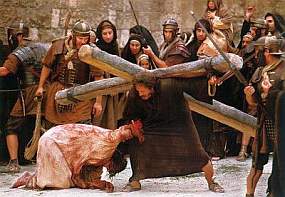
No one wanted to help Jesus carry His cross. Someone had to be compelled to do it.
We can talk all we want about right and wrong. We can point fingers at weasels, liars, and cheats. We can let the world know just how right the Law might be. But for most of us, we are far, far away from anyone bearing a difficult cross.
All the Scripture study in the world cannot trump helping another bear the cross. I don’t care how right you are or how well you divide the Scriptures. It all comes to naught if you are too preoccupied to shoulder for a time someone else’s crushing cross.
Young people, here’s my word for you: One day it will be you. No one gets out unscathed. Be careful what you speak to others bearing up under the weight of the cross. Because you might very well have a massive one dropped on you, and when you cry out for help, you better pray that some kind soul shows you more compassion and aid than what you offered to others.

 They gave everything they owned, everything they were, and every spiritual gift they had received from the Lord, because they loved each other, so no one among them lacked for anything.