

Big Box Altars

Standard

All hail the might dollar!This last weekend, my wife and I did something we haven’t done in almost three years…

We spent a day shopping.

Unlike some Americans, we shop only if forced. As we try to simplify our lives by purchasing fewer and fewer things, shopping dwindles into the background along with other things we’ve relegated to the backburner of life (like TV viewing, going to the movies, and taking vacations every year).

One of the truths the Lord’s been teaching me concerns the embarrassment of riches we have in the United States. I got a larger lesson in this when I walked into a store I haven’t visited in more than two years: Best Buy.

My wife practices her singing on the way to work, but her car’s stereo burned out so she can’t practice along with her CDs. I came to see what I could find in a new stereo under $150. I also noted here a few weeks ago that our TV burned out. While we may watch next to no broadcast television, we do, on rare occasions, get a DVD out of our local library and take an evening off. So I wandered into Best Buy to get a feel for what’s out there in both offerings.

Whoa. The price tags! Am I reading it right that a TV capable of rendering a fully digital signal—as mandated by the FCC as of this month—costs a minimum of $1,500?

Sometime in the distant past of my shoddy memory, $1500 used to be what a car cost. In other words, one heck of a lot of money. Yet on this eighty degree, sunny day, Best Buy filled with people waving cash, their eyes wider than the width of the TVs that grabbed their attention.

What grabbed my attention was those folks’ shoes. You can tell everything you want to know about someone’s income by their shoes. Well-off people may wear grubby clothes, but rarely do they wear grubby, no-name-brand shoes. (When I worked in sales years ago, I picked my customers based on their shoes and routinely chalked up monster sales figures as a result) .

The shoes on the humungo TV-buyers said this: “We can’t afford this TV.” The kids wore knock-offs, swooshes that mimicked Nike, stripes not exactly Adidas. And so did their parents.

Thrifty, perhaps. But a quick scan of the newspapers tells a different story. We’ve got record personal bankruptcies, record mortgage defaulting, a huge spike in credit card debt (after years of downward numbers), negative savings rates, too much leverage on our houses through home equity loans, and a rise in every negative economic indicator known to Man.

Yet we keep on buying. We have to.

Hear David’s heart cry:

Look to the right and see: there is none who takes notice of me; no refuge remains to me; no one cares for my soul. I cry to you, O LORD; I say, “You are my refuge, my portion in the land of the living.”
—Psalm 142:4-5

Standing there in Best Buy, watching people cart out thousands of dollars worth of items that a house fire would reduce in heartbeats to so much melted glass and oozing plastic, I understood.

Best Buy takes notice of them. Samsung cares for their souls. Sony is their portion, Panasonic their refuge. Be it Best Buy, Home Depot, DSW, Bass Pro Shops, or whatever— that big box store’s got an altar to perfectly fit that hole where God should be enthroned.

At some point in the history of the United States, Jesus Christ failed to satisfy. You and I know this had nothing to do with the splendor of the Lord. He’s the same yesterday, today, and forever. But something changed in us.

I’ve been writing about the Holy Spirit quite a bit lately, and I think the American Church’s understanding of Him may explain our Big Box Altars.
I believe that we made the Lord a mental exercise. The Enlightenment inflicted a dire wound on our grasp of the Faith. We turned the Faith that enlivens us into something we cognitively assent to. Yet in doing so, we stripped the passion, the intense feelings of intimacy, that accompany faith in Christ. Our churches transformed into dim depositories of hazy reflections of what it means to be aflame with love for Jesus.

As a result, verses like the following don’t register with us:

I was glad when they said to me, “Let us go to the house of the LORD!”
—Psalms 122:1

I am a rose of Sharon, a lily of the valleys. As a lily among brambles, so is my love among the young women. As an apple tree among the trees of the forest, so is my beloved among the young men. With great delight I sat in his shadow, and his fruit was sweet to my taste. He brought me to the banqueting house, and his banner over me was love. Sustain me with raisins; refresh me with apples, for I am sick with love.
—Song of Solomon 2:1-5

Instead of being sick with love for Jesus, instead of longing with all our hearts to dwell with our brothers and sisters in Christ before Him, we pump ourselves up to watch March Madness on our new 60″ plasma TV. You should have seen the eyes of the men in that store as they watched (oh so fortuitously) NCAA basketball games on those monster TVs. You could almost hear their souls saying, “This is what I truly need. I’m sick with love.”

Idolatry isn’t pretty.

But then again, neither is sterile intellectual debate. Yet how easily the American Church concedes passion and emotion! Dry, dusty churches fill with people looking to be sick in love with something, someone, anything, yet we give them intellectual discourses on the fiery faith of our fathers. We hold Jesus Christ out as a systematic theology. Or we make Him into a trifle that exists only to wave a magic wand and Poof!, a more real object of our affection shows up in our living room—all sixty plasma-filled inches of it.

A reader asked me the other day what kind of church I go to that it has drums and dancing. The fact that someone asked that question saddened me, because it made me wonder what kind of church he/she attends. What kinds of sermons? What kind of fellowship? What kind of worship?

Any life at all?

I’ve got to believe there’s something wrong with a Church where week in and week out there’s no weeping before the altar of the Lord. If a man can go through an entire church year without once falling on his face weeping, without soaking the church carpeting with his tears, something’s desperately wrong with his church.

I’ve got to believe that a church will never amount to much for the Kingdom if it never once sees someone get up and dance during worship. I’ve got to believe that a church filled with people who just sit and nod their heads will be asleep when the Bridegroom comes. The Holy Spirit’s missing in a church that goes through the emotionless motions.

How can an unstirred church reflect anything resembling the abundant life?

In C.S. Lewis’s masterful book, The Great Divorce, he posits a heaven so substantial that all of life this side of it resembles a vapor. Massive, unearthly Christians fill that dense heaven, giants, heroes that shake the foundation of the world with their conquests. How then can it be that so little life fills believers today? Why is it that we cannot find succor for our souls on Sunday, but instead find our hearts strangely warmed—if only for a passing moment—by a 60″ plasma display rocking with the Final Four?

Have we Christians rendered Christ so inconsequential? Have we denied the power of YHWH for the power of LG?

What happened to passion and fire?
Mysticism, Part 2

Standard

And this is eternal life, that they know you the only true God, and Jesus Christ whom you have sent.
—John 17:3

We don’t emphasize that verse enough. Eternal life is knowing the Lord. The great Christian mystics of the past had one goal: to know the Lord. And not just on a surface level, but as deeply as He might reveal Himself to them.

I don’t know how you see it, but I don’t see any conflict there. Nor do I see any problems here:

And after six days Jesus took with him Peter and James and John, and led them up a high mountain by themselves. And he was transfigured before them, and his clothes became radiant, intensely white, as no one on earth could bleach them. And there appeared to them Elijah with Moses, and they were talking with Jesus. And Peter said to Jesus, “Rabbi, it is good that we are here. Let us make three tents, one for you and one for Moses and one for Elijah.” For he did not know what to say, for they were terrified. And a cloud overshadowed them, and a voice came out of the cloud, “This is my beloved Son; listen to him.”
—Mark 9:2-7

For the three disciples, witnessing Jesus’ transfiguration exceeded the first laser light show, the U.S. Bicentennial fireworks display, the 2002 Super Bowl halftime show, and the reunion of The Police—combined. Huge. Mind-blowing. Even terrifying.

And downright mystical.

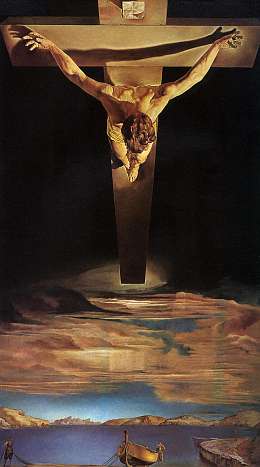
All across the world and through the ages, people have encountered God alive and moving, speaking into their lives in supernatural ways. 'The Christ of St. John of the Cross' by Salvador DaliPeople like Saul on the road to Damascus. Guys like St. Patrick, whose ministry to hundreds of thousands of people sprang from a dream he received as he slept. Or Dwight Moody, one of America’s great evangelists, who encountered God in a mystical, overwhelming way as he walked the streets of New York City, and his ministry immediately transformed in that meeting from good to great.



So this mysticism thing is awesome, right?

Well, maybe.

Christian mysticism perpetually runs the risk of deviating from the intended target. Aiming for God and hitting something (or someone) entirely different is possible. The wise way to open oneself to God requires a series of personal firewalls intended to keep out anything not of God.

To that end, some have asked me for a list of great Christian writers since 100 AD who’ve written flawless works that can be trusted 100 percent of the time. I’ve included that list below:
Nil, zero, zip, nada

Kind of empty isn’t it? That’s for a reason. God never intended for us to swallow everything we hear out of the mouth of someone who self-labels as a Christian. I don’t care if we line our bookshelves with the most orthodox writings known to Man, those books will contain errors. I hope I’m not bursting anyone’s bubble by saying this, but your favorite Christian author/teacher/pastor makes mistakes. True, some make more mistakes than others, but the point remains: we must ALWAYS be discerning in ALL encounters with ideas and practices, be they “Christian” or not.

One of the first posts I wrote for Cerulean Sanctum applies to this issue of Christian mysticism. “Charismatic Churches and the Cult of the New” outlines several flags we must always apply when dealing with anything we encounter presented in the name of the Lord. The following cautions should be considered whenever we approach “new moves of God” within the Church. I originally intended these flags to pertain to charismatic practices, but I believe these also apply to any practice or concept that relates to mysticism:

Flag #1 Cannot be squared with Scripture or is based on a single verse of Scripture (usually taken out of context.) If we’re doing something that violates Scripture, we need to stop. End of story. If we don’tknow what Scripture says about some mystic practice we wish to employ, better to actually KNOW the Scriptures first before we get all mystical.

Flag #2Is pronounced by direct revelation through a single individual or a small group of people. The Church today doesn’t lack for individuals and small groups speaking some strange things. I don’t believe that the Lord speaks “unusual” truth through one person or a small group alone. He may speak to you for your needs, but the whole “mystic secrets of divine union for select disciples who pay $200” thing isn’t going to wash with the Lord.

Flag #3Is considered relevant for today, yet has no historic precedent in the Church. Nothing new under the sun, folks. If the Church through the ages didn’t practice or teach it, it probably ain’t kosher.

Flag #4Attempts to make a New Testament practice/theology of an Old Testament practice/theology rendered moot by the finished work of Christ. While this plagues certain aspect of the charismatic movement more so than the mystic community, it’s still something to watch for.

Flag # 5Involves “Restoring or the “Restoration of a practice or theology. Some things died out for a reason. Yes, a few good practices have been neglected by us hypermoderns, but we must be careful.

Flag #6Is a “redeemed version of a secular/occult concept or practice (usually which has been abandoned or discredited by secular/occult practitioners.) A huge flag when dealing with anything deemed mystical. (I’ll unpack this more below when I talk about syncretism.)

Flag #7May produce immediate results, but does not move the Church or individual into a deeper, biblically-based relationship with Christ in the long run. Practicing mysticism for mysticism’s sake will get us nowhere. All too often, a fascination with mysticism reflects failing to pursue God in approved, traditional ways. Those must always be addressed first. All the mysticism in the world’s not going to make an infant in Christ into an adult. Got to make it to the teen years of the Faith before reaching adulthood.

Critics of contemporary mysticism in the Church have good reason to point out troubles. Any two of the flags above in combination should entail a gut check about the practice or idea we’re attempting to incorporate into our spiritual lives.

With Christianity in the West so heavily compromised by syncretism, if we wish to be a holy Bride, then we can’t keep whoring around. Too many Christians who are looking into mysticism don’t have the spiritual maturity or common discernment sense to know what’s genuinely of God and what’s not. Since the critics of Christian mysticism love to blanket condemn, clashes will be constant. For the chucklehead who wonders how well astral projection and Christianity work together, good for the critics for calling him on his folly. We’ve got so many Christians lacking in even basic discernment skills that perhaps a place may exist for the blanket condemnation. A sad state of affairs, but given the tendency to let all the garbage in 24/7/365, possibly warranted. We have only ourselves to blame for the critics’ hypersensitivity.

The thing about the old Christian mystics? They’d already gone through all the steps of growth and maturity. And that’s the key point here. The Cloud of Unknowing may very well grow us deeper in God. But if we’re not reading and meditating on the Scriptures, cultivating a consistent prayer life, making disciples, or laying down our lives for others, we’ve got no right to pick up that book and start yammering about how deep it is and how it’s going to take us to “the next level.” You don’t give an infant a powerful weapon like an AK-47 to play with, because if you do, someone’s going to get killed. And for the purposes of this illustration, it’s usually the infant.

The riches of the Lord are His and His alone. Looking into Buddhist (or any other non-Christian) mysticism to apply what one my find to Christianity is like panning for gold in a field of manure. God’s already got a river flowing with gold, no need to wade through the crap. Yet all too often we try to find truth in places it doesn’t exist. If we truly believe that Jesus is the Way, the Truth, and the Life, searching for Him by syncretizing rituals gleaned from the places He’s not couldn’t be a bigger waste of time. All too often, those dabbling in Christian mysticism do just that.

Get the basics of the Faith down first. Stay away from syncretistic practices that attempt to join Christ and Belial. Test every spirit to see if it’s of God (the flags above are a good start). Be as wise as snakes and as innocent as doves—not the other way around.

Yes, sometimes the critics are off-base. But then again, once in a while they’re not. It pays to listen to them and weigh what they have to say against the Scriptures and the Spirit.

I’ll conclude this mini-series in my next post.

Mysticism, Part 1

Standard

I know a man in Christ who fourteen years ago was caught up to the third heaven—whether in the body or out of the body I do not know, God knows. And I know that this man was caught up into paradise—whether in the body or out of the body I do not know, God knows— and he heard things that cannot be told, which man may not utter. On behalf of this man I will boast, but on my own behalf I will not boast, except of my weaknesses.
—2 Corinthians 12:2-5

Why is it that so many in the Christian Church, especially in the West, live to throw the baby out with the bathwater?

I see this tendency especially from those petrified that God will come along and shake up His Church by doing something they would classify as “weird.” Detail from 'The Resurrection' by Matthias GrünewaldI think that if you took those folks and put them into every biblical scene featuring the miraculous, they’d be quaking with fear with their hands over their eyes. They’d be the ones frozen stiff before the parted Red Sea screaming, “No! You can’t make me go through there!”

So these poor saints live to attack anything that threatens to undo their dusty religiosity. Unfortunately, in too many cases, that “anything” just happens to be God.

Now I perfectly understand the need to filter out heretical and false manifestations, but that’s why the Lord gave us discernment. Blanket condemnation of all such experiences, instinctive in these fearful saints, fails the discernment test. Nowhere in the Scriptures will you find “One bad apple ruins the whole bunch.” (If that were true, I suspect all our churches would be ruined!)

Instead, the Holy Spirit empowers our discernment. The Bible provides some basis for making distinctions between wrong and right, while the Spirit fills in the particulars. This is life in the Spirit, and it requires us to know His voice when He speaks to us in our day to day existence.

This brings us to today’s tossed baby, Christian mysticism.

I don’t know about the baby-tossers, but I can’t read the Bible and not see the mystical. As noted in the passage that starts this post, the Apostle Paul himself thought nothing of mystical experiences, such as being caught up in a heavenly realm where inexpressible realities can be glimpsed. Paul goes so far as to boast about the man who experienced this (likely Paul, as most commentators note).

The prophet Isaiah had a vision of God, the Holy One’s train filling the temple. He saw angels and they symbolically purged his sin with a touch of coal to the lips. Ezekiel glimpsed his famous wheel within a wheel. John fell prostrate before an angelic messenger who delivered a vision of the end of all things. Jacob’s ladder. Abraham entertaining three visitors. The inner sanctum of disciples witnessing Jesus’s transfiguration.

The Bible overflows with the mystical. So how is mysticism bad?

Some would claim that all these things vanished with the death of the Apostle John. That mystical experiences do not happen today.

Tell that to the Irish, though.

Last weekend, we celebrated St. Patrick’s Day. One could argue that no evangelist exceeded Patrick, for 120,000 conversions are directly tied to his ministry in the Emerald Isle. But to what did Patrick attribute his burning desire to evangelize the Irish?

From a classically mystical source: a dream.

Patrick, ensconced in England, had a dream one night of Irish druids begging him to come preach the Gospel to them. He wasn’t reading the Scriptures for this revelation. He wasn’t down on his knees praying. He dreamed it.

The Bible says this:

But Peter, standing with the eleven, lifted up his voice and addressed them: “Men of Judea and all who dwell in Jerusalem, let this be known to you, and give ear to my words. For these people are not drunk, as you suppose, since it is only the third hour of the day. But this is what was uttered through the prophet Joel: “‘And in the last days it shall be, God declares, that I will pour out my Spirit on all flesh, and your sons and your daughters shall prophesy, and your young men shall see visions, and your old men shall dream dreams; even on my male servants and female servants in those days I will pour out my Spirit, and they shall prophesy.
—Acts 2:14-18

Now as far as I can tell, we’re still in the last days. I think most of us would agree on this. So how is it NOT still true that God will speak to us through dreams and visions? I find it impossible for anyone to argue against the validity of dreams and visions for revelation. Consider what the 120,000 saved through Patrick’s ministry think about mystical revelation through dreams.

A.W. Tozer, one of Evangelicalism’s greatest prophets, had no qualms with the mystical. Even the most casual readings of his many books and sermons reveals Tozer’s heart that we Christians should pursue a mystical intimacy with God that defies earthly definitions. Tozer was known for his keen understanding of the writings of noted medieval mystics such as Julian of Norwich (who many of Tozer’s good friends referred to jokingly as his “girlfriend”), Teresa of Àvila, Meister Eckhart, and others. Tozer recommend that we Evangelicals read mystic literature such as The Cloud of Unknowing and The Dark Night of the Soul. Why? To cultivate a depth of intimacy with God that transcended the casual dabbling in Him afflicting so many of us time-burdened Evangelicals, to scry the secrets of the saints who have gone before us.

Because I hold Tozer in high regard, I’ve read many of those mystics and their writings. I’ve found them fascinating. But more than this, I found they relayed understandings of God I did not possess. Those mystics have been to the mountain of God, so they offer a valuable map, a treasured insight. Their talk of rapturous union with God should inspire us, not drive us to doubt the reality that we human beings can approach the Divine and know Him intimately! Sometimes I wonder if some of us merely wish to keep others from that deep intimacy for no other reason than we have not experienced it ourselves; our jealousy drives us to deny others the joy those few have found.

Many Protestants revere the Reformation, but they balk at anything that came before that. What a loss! As we stroll back in time to the Medieval era and Dark Ages, when some of the noted mystics lived, the less confident many of the mystic-bashers become, as if no big “c” Church existed at all during those times. That’s foolishness, though, and for some to act as if nothing can be learned from the Christians of those days, many of whom would be branded mystics by today’s Evangelicals, is nothing more than jealous pride.

Mysticism’s core ideal that knowledge of God and His ways can’t be explained in perfectly rational terms didn’t bother those Christians of that era. But it bothers those who live on the other side of the Renaissance and the Enlightenment.

If anything, the modern antagonism toward Christian mysticism has little of its basis in Scripture’s and the Holy Spirit’s illumination, and far more in the rationalism and anti-supernaturalism wrought by modernism (as ushered in by the Renaissance and the Enlightenment). Oddly enough, the real damage to Christianity came not from mysticism as practiced pre-Reformation, but from this post-Reformation upheaval in philosophy. Odder still, the stepchildren of the god-denying Enlightenment are those very Christians who oppose supernaturalism (especially as it pertains to the charismata), who endorse a sort of sanctified scientific rationalism that turns the tables and declares Christians being caught up into the third heaven not only not possible, but part of a damnable plot to subvert Christianity!

Who is the real wolf in sheep’s clothing? The mystics or the scientific rationalists? I would contend the latter far better fit the bill.

And so we’ve paid dearly within Christianity because of anti-mystic crusading. The rationalists have shoved the awesome God into a small box convenient enough to be understood. Miracles? Nah. Dreams and visions as guidance? No way. Only superstitious fools would embrace such nonsense.

Worse, any revival in mysticism within the Church is disingenuously labeled Gnosticism by the critics. But those who toss around the Gnosticism label do so haphazardly and with little regard for the truth.

Gnosticism is anti-matter, which Christian mysticism is not. As a result, Gnosticism denies the incarnation of Christ, which Christian mysticism certainly does not. Gnosticism holds to a dualistic worldview, which Christian mysticism does not . Gnosticism believes that secret knowledge necessary to salvation is held by a select few, and only a select few who seek that knowledge get it. Christian mysticism holds that deeper knowledge of God is the desire of all those filled by the Holy Spirit, but this knowledge is open to all and can be grasped by any who come to the Lord.

To stress that latter point, would anyone reading this doubt for one second that a great Christian who has sought the Lord through years of prayer would know more about God and His ways than the new convert? Does that righteous old saint (who may at some point in life have been swept up into the ecstasy of the third heaven by the Spirit) possess a deeper knowledge? Would anyone seriously label him a Gnostic? Or the third-heaven-visiting Paul for that matter?

No, in most cases the Gnosticism label is a fraudulent scare tactic.

This is not to say that all mysticism tagged “Christian” is. In the second part of this examination of mysticism, we’ll examine the criticism leveled against modern practices of mysticism and see in what cases the accusations against it should be heeded.