
The Half-Born

Standard

Been thinking. Thinking long and hard about life. Some accuse me of thinking too much and they’re probably right.

Been struggling. Struggling long and hard within life. Like most people, I don’t like struggling. I don’t like asking hard questions of myself. Don’t like staring into the sky and wondering why.

Why.

At some point in your life, you’ll sit down, look around, and ask, “Is this it?” Most of us will ask that question from the comfort of a nice home surrounding by nice things, the kind of things that the majority of the world could never afford.

At some point in your life, you’ll sit in church, look around and ask, “Is this it? Does this sum up the abundant life?” You’ll talk to a few folks on the way out of your nice church, load your nice kids into your nice car, and drive home with your nice spouse to your nice house. And it will all be so very nice. The kind of nice you’ve heard from your earliest days. A “gold watch and a handshake” kind of nice when you retire from the company. A nice retirement, a nice set of grandkids, and finally, a nice corpse.

The words of a song came back to me:

Sprawling on the fringes of the city
In geometric order
An insulated border
In between the bright lights
And the far unlit unknown

Growing up it all seems so one-sided
Opinions all provided
The future pre-decided
Detached and subdivided
In the mass production zone

Nowhere is the dreamer
Or the misfit so alone

Subdivisions —
In the high school halls
In the shopping malls
Conform or be cast out
Subdivisions —
In the basement bars
In the backs of cars
Be cool or be cast out
Any escape might help to smooth
The unattractive truth
But the suburbs have no charms to soothe
The restless dreams of youth

Drawn like moths we drift into the city
The timeless old attraction
Cruising for the action
Lit up like a firefly
Just to feel the living night

Some will sell their dreams for small desires
Or lose the race to rats
Get caught in ticking traps
And start to dream of somewhere
To relax their restless flight

Somewhere out of a memory
Of lighted streets on quiet nights… † 

The Bible put it this way:

As they were going along the road, someone said to him, “I will follow you wherever you go.” And Jesus said to him, “Foxes have holes, and birds of the air have nests, but the Son of Man has nowhere to lay his head.” To another he said, “Follow me.” But he said, “Lord, let me first go and bury my father.” And Jesus said to him, “Leave the dead to bury their own dead. But as for you, go and proclaim the kingdom of God.” Yet another said, “I will follow you, Lord, but let me first say farewell to those at my home.” Jesus said to him, “No one who puts his hand to the plow and looks back is fit for the kingdom of God.”
—Luke 9:57-62

You get handed a dream on a silver platter: this is what life is. It looks a lot like the American Dream. At first, you accept it, but then Christ comes along and something happens to you. Suddenly, the cover over the universe rips away and you can see endless possibilities. The opinions you trusted now pale. Perhaps the future isn’t pre-decided.

So you throw yourself into a different work—for a while.

But you want love, and with love comes responsibility. You get married. For a while, the new dream lingers. Miami, ©Alex MacLeanYet time brings changes, a nest, children. You sign for the mortgage, then the nice house, followed by the nice furniture. You buy the life insurance policies—just in case. You buy the health insurance. You work, and work, and work to keep it all from turning to dust.

Then, just as suddenly, the veil falls over the universe and what once burned brightly flames out.

And you don’t know how it happened.

Other seeds fell among thorns, and the thorns grew up and choked them.
—Matthew 13:7

A field of thorns desires nothing more than conformity to thorniness. All it understands is thorns. Anything not thorns must be consumed by them. The imperative is thorns.

So you wake up one day and realize your entire life looks like thorns. Your neighbor’s life does, too. So do the lives of most people in your church. It’s all thorns for as far as the eye can see. Nothing but weeds that will someday be thrown into the fire and burned.

It is said that some serious-minded people approached Charles Finney with a concern. Not enough of his converts went to the mission field, and the serious-minded people wanted to know why. Finney explained that many of these converts went back to their towns to be godly parents, godly mayors, godly bricklayers, and all manner of godly people living out a godly life in some now-godly town in America.

I suspect that this answer mollifies even Finney’s sharpest critics today. Most of those critics may despise Finney otherwise, but from what I see around me, they sure seem to aspire to be godly, serious-minded people in whatever town they went back to, be it big or small.

Finney’s answer seems good to most of us. Isn’t that the exact American Dream life we’ve carved out for ourselves? Opinions all provided. The future pre-decided. We’ll just be Christians wherever we are, and if that means being a suburban Christian in a nice quarter million dollar home we’ll be paying for the rest of our lives, who’s to say that’s wrong?

I never heard anyone say it was wrong. I never heard anyone questioning it at all. And that’s the problem.

I never wanted to put my hand to the plow and look back. But I did. I suspect most of us did.

What role models did we have? Sure, we knew young singles and marrieds who counted the cost. We may have even been those people at some point. But somewhere along the path we made a choice. And that choice was to go the way everyone else does. The wide way.

Who can blame us though? Where were our examples of going the narrow way? Doesn’t everyone conform? And so what if some people sit gauzily musing on their front porches about what might have been?

Do any of us escape this? Or is this the lot of every last one of us?

We wonder why the Church in this country is so ineffective in the face of the world’s onslaught, but which of us has actually counted the cost? In some ways, we’re like half-born people. We started out on the journey, but on seeing what it was going to cost us found ourselves hung up between worlds, neither here nor there.

So we live with the agony of being stuck half-born.

I sit here typing on my computer with more stuff than my ancestors two hundred years ago could possibly imagine, but I wonder if I sold my soul to get here. It bothers me, too, that I knew better, yet I could not escape the black hole’s gravitational pull. Worse, most people around me, especially the Christians, live as if no black hole exists. I don’t know which state is worse, knowing or not.

I don’t want to be half-born, but honestly, I have no way of knowing how to finish the process. Neither do most others.

I look for guides, but so few exist. In too many cases, even those leaders succumb. I find many of them to be young, doing the kinds of things I did when I was that radical young prophet/servant. And like me, they’ll probably fall into the same trap when the kids show up. That may sound jaded, but I can’t escape the inevitability of it; I’ve seen it happen more times than I wish to count.

So what does it mean to live a life in America 2007 that never looks back once the hands fall upon the plow? What does a life free of thorns look like? What does it mean to be fully born?

I thought I knew, but then again, so does everyone else.

†  Subdivisions” by Rush. Lyrics by Neil Peart.

{Image: “Miami” – © Alex MacLean }

Of Godblogs & Gobbledygook

Standard

As of this last month, I’m convinced that information overload is hurting our souls.

A common factoid spread around the blogosphere tells us that a single edition of the New York Times contains more information on its pages than the average person in the 17th century accumulated in a lifetime. Whether true or not, it doesn’t take a sociology degree to know that we’re bombarded with increasing amounts of data we must process daily. I think about the sheer amount of medical knowledge today and wonder how any doctor can possibly do his job without becoming irrelevant in only a couple years. Or consider how high-tech spawns and kills off new technology almost every day.

We don’t have to be doctors or IT specialists to know that the average person today must not only process local events, but happenings on the other side of the world. It’s not enough that a local teacher was killed in a car accident over the weekend, but a bus full of nuns holding babies in their arms went off a cliff in Outer Pradesh. It’s difficult enough to know the pain of our neighbors, but now the whole world is our neighborhood, and the newspaper screams the entire planet’s misery. Add in the Web, e-mail, TV, radio, and some new media yet to be produced, and you’ve created a litany of laments few rational adults can process.

Estimates vary widely, but some claim that publishers put out as many as 300,000 book titles last year alone, up from the year before, which was an increase over the year previous—and so it goes. Each book comes packed with information we must process, facts we must consider and digest. Data, data, data.

Many of those titles come from Christian publishing houses. Into that mix we add Christian magazines, music, curricula, television and even Bibles. And now we have the new phenomenon of the blogosphere, complete with its own Christianized blogs.

I used to skim through about 100 Christian blogs via Bloglines. I dropped that to about fifty. Now I’m down to about the same dozen. And I might need to trim even those.

I can’t speak for you, but I look at my own soul and see confusion. I can no longer process all the information hitting me daily. I cut my blog diet down simply because I’d come away from reading with an itchy scalp that required constant scratching. Too many opinions. Too many contrary facts. Too many discussions of esoteric theological minutia. Too many book reviews of too many “must-read” books guaranteed to make me a better servant of Christ.

But what I’m discovering, contrary to the pervasive wisdom of educating oneself, makes me wonder if this information deluge might be hindering the discipleship process God created rather than boosting it. One book tells me how to pray, but another claims that other book has it wrong. This blog here discusses the finer points of infralapsiarianism, with several blog participants yelling at each other. After a while, everyone is simultaneously right and wrong. I can’t possibly give any of it much deep thought. What I tend to do instead is build a wall around myself to keep the facts from demanding too much of me.

The restlessness many people feel in their souls may be due to an inability to handle this data deluge. I consider myself a fairly competent processor of info, but I can’t do it all anymore. When Paul tells Timothy to study in order to show himself to be an approved workman, I highly doubt he wrote of what you or I contend with daily. As the foremost book says:

Of making many books there is no end, and much study is a weariness of the flesh.
—Ecclesiastes 12:12b

Consider how many books the average person in Solomon’s day might encounter. There’s not a person reading this now who doesn’t own more books than a hundred households even a hundred years ago. Did Paul advise Timothy to sit down with a stack of systematic theologies? Was he advocating collecting the complete works of this rabbi or that and poring over them until their wisdom filled every nook and cranny of Tim’s noggin?

We know about Pavlov’s dog, but do we know about Seligman’s? That dog, placed in a wire pen, received an electric shock whenever a tone sounded. After a while, the dog sat helplessly whimpering in the corner of its cage on hearing the tone, even without the shock.

I believe that one reason the Christian Church in America continues to struggle with meeting the demands of the Kingdom comes from an overload of data, a sort of constant mental electroshock. Every time someone dumps another factoid on us, we run cowering to the corner, afraid of whatever inevitable damage must afflict us for the knowing. We live in a perpetual state of cognitive dissonance that sends us begging for it all to stop.

People beg for it to stop in different ways. Some throw themselves into one source that they hope might stem the noise from other sources. Information overloadOthers go searching for even more info, without knowing they’re using more to keep from dealing with the consequences of truths they already grasp. Others simply go into a self-imposed shell. Some avoid anything that smacks of more information, but they don’t know how to ultimately turn off the noise, growing frustrated.
And it has become noise, hasn’t it? Even the genuine signal gets lost when it’s pumped up to ear-splitting volumes. In a world hellbent on getting this message or that through the noise, life’s volume knob comes preset at eleven.

Who can blame people for failing to respond? With all that shouting, even from Christian sources, who can tell what’s right? Better to not risk doing the wrong thing based on conflicting info than to look stupid. And who knows what’s right and what’s wrong with everyone shouting?

It seems unbelievable to think that buying one more Christian book to read might be the wrong thing to do, or that perusing a respected Godblog might be a hindrance to growth. Or consider that Sunday’s sermon might be yet one more set of commands we can’t possibly live up to simply because it must contend with all the other data we don’t have time for. Lately, when I look at all the input, I don’t have any other way to think of it.

Listening to too many voices, even when those voices are good, is still the sign of a schizophrenic life.

I don’t know that that means for Cerulean Sanctum. I don’t want to add to the turmoil. I don’t want this blog to join others in numbing people to the Gospel. Whenever life gets reduced to a anesthetized blur, all meaning is lost. God never intended for us to dwell in a perpetual state of information overload.

I’m thinking. What are you thinking?

Wonderland

Standard

I maxed out last week. Every day filled with activity and left me scurrying from place to place like a squirrel on amphetamines. I swore at one point I heard a hummingbird yell, “Dude, slow down! You’re like wearin’ me out.”

Around dusk last night and late this afternoon, I took a break in my favorite place, the outdoors. My halcyon time of the year is that holy month of days between mid-May and mid-June. The late spring grows pregnant with possibility for the upcoming summer. Hallowed days swell with life. The sky pulses cerulean. The trees fluoresce with green.

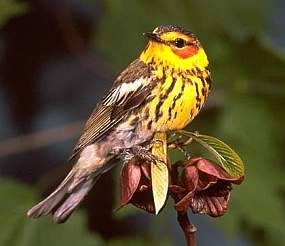
I picked up my binoculars, hoping to catch some stragglers on the spring warbler migration. The gorgeous Cape May WarblerWhile showing my son a Red-winged Blackbird atop one of our sycamores, I happened to spot a Cape May Warbler. On my own property! My neighbor across the street, an Audubon Society local president, blew my mind when he said he saw one of these uncommon birds in his stand of pines last year. Not having a Cape May on my life list, I thought I’d lost my opportunity forever. But it showed up when I least expected it.

Saw a Wild Turkey, too. It’s nice to know America’s bird is coming back. I’ve seen more in the last three years than in the previous twenty-five.

A Rose-breasted Grosbeak surprised me, since I hadn’t seen any on our property before. You tend to see more of them in winter in Ohio, but this one happily flitted through the canopy blissfully unaware of his being out-of-place in May.

An Eastern Wood Pewee hunkered on a spare limb by our pond…patience, patience. Then, zip! Snared a moth mid-flight. Back to the branch. Waiting….

Two Flickers tended their nest in a hole in an ash tree. Yellow Warblers, a Myrtle Warbler, a Yellow-breasted Chat, then pow—the eye-socking sight of the setting sun catching a Baltimore Oriole’s tangerine feathers. Two happy Chipping Sparrows watched me as they hopped around our gravel driveway, scouting for food, chipping as they searched.

Later, I left our forest, walked back to our porch, and pulled up a chair to watch the half acre of trees nearest our house, looking for tiny flashes of movement in the increasingly dense canopy. Here, the locust trees come late to the spring show, fighting with the walnuts to be the last to leaf. I hear the “drink your tea” of a Towhee, spot a Red-bellied Woodpecker as it digs for bugs wedged in tree bark, and hear a tiny Chickadee—its weight not more than a nickel, dime, and quarter together—scolding all 215 lbs. of me. And I’d probably lose that fight, too.

I saw a Cerulean Warbler a couple weeks ago, and I guess the reference to that color should bring me out of my reverie and back to the blog. People don’t want to read about a bunch of birds, do they? No time. People come here to skim some hard-hitting commentary on the latest ecclesiastical buzz, right?

A wise man once wrote,

Four things on earth are small, but they are exceedingly wise: the ants are a people not strong, yet they provide their food in the summer; the rock badgers are a people not mighty, yet they make their homes in the cliffs; the locusts have no king, yet all of them march in rank; the lizard you can take in your hands, yet it is in kings’ palaces.
—Proverbs 30:24-28

I don’t know what happened to wonder. It seems to be in short supply today. In a disposable world where people toss cigarettes and half-eaten bags of fast food out their car windows while on their way to their next appointment, I suppose there’s not much place for wonder.

Wonder goes missing in busyness. Spring warbler migration? What? When? Oh, I’ll pencil that in my calendar for next year, I promise.

Entertainment tramples wonder, since wonder may not be as flashy, not as trendy, not as immediate. Wonder takes a little work. Just a little.

We might not see wonder, but we do see truckloads of pragmatism in our churches. We can teach and preach and prophesy on how to have a great marriage, but most people will leave without any sense of wonder at the person sitting next to them on the drive home. We can spend an hour in worship, yet the second the last note dies out in the sanctuary rafters, we’re scanning our bulletins to see what’s next, hoping that the sermon won’t be too dry or lengthy.

Because we don’t wonder, we don’t pray. We already know what God’s like. Jesus won once and He’ll win again. Yadda, yadda, yadda. Hope He comes back soon—but not too soon. Amen.

When wonder goes missing in our churches, answers replace it. Not questions, just answers. Questions accompany the first signs of wonder, especially when the answers for those questions don’t come easily. And where wonder reigns, sometimes neither answers nor questions matter, only the wonder.

I wish I saw more wonder in American Christians. I suspect that many of us are too caught up in living our best life now to wonder at the way the Wood Pewee pirouettes in space to outmaneuver a zigzagging moth. Or how the craters on the moon form patterns. Or how the brook teems with tadpoles, mayflies, and tiny fish. What are the names of those fish? Does it matter?

I think it matters. I think we’ve lost something in the last hundred years in this country. Our wonder’s fled. I think it’s one reason why so many people take psychoactive drugs. Strip away the wonder and the world turns frightening, cold, and distant. It becomes the enemy. Life takes on a winner-take-all mentality where some win and others lose, and God help us if we’re not one of the winners. Now pass the damned Zoloft, thank you very much.

I think a loss of wonder means it’s far easier to take a gun and shoot at cars passing by. I believe a loss of wonder makes it that much easier for an angry husband to take a fist to his wife’s face. I know that a loss of wonder makes us shallower people.

Loss of wonder is a sin.

We won’t hear that sermon on Sunday, though. Because if we did, it would mean we’d have to start dealing with our culture, a culture that successfully murdered wonder and got away with it. Nothing pains me more than to hear some five-year-old say, “Ah, it’s just a stupid old bird.” Because I know that any child who says that will one day grow up to say, “God? What do I need God for?”

Something to wonder about.