
The State of the Miraculous in a World of Unbelief

Standard

One of the hallmarks of the final days, as noted by Scripture, is a horrifying level of unbelief.

Jesus said it Himself:

“Nevertheless, when the Son of Man comes, will he find faith on earth?”
—Luke 18:8b ESV

The end of all things depicted in the Book of Revelation shows that even when all of the earth is afflicted by the outcomes of supernatural wrath, mankind refuses to believe:

The rest of mankind, who were not killed by these plagues, did not repent of the works of their hands nor give up worshiping demons and idols of gold and silver and bronze and stone and wood, which cannot see or hear or walk, nor did they repent of their murders or their sorceries or their sexual immorality or their thefts.
—Revelation 9:20-21 ESV

There are some today who want to cast aspersions on the Kingdom of God and its many miraculous components, and they want to question how the Holy Spirit works in believers. Oddly, many doing so call themselves Christians. Though they claim to abide by the authority of Scripture and not by personal experience, they regularly challenge the miraculous in the Bible’s pages by asking where all the miracles are today. And they ask why those Christians who still believe in the miracles that are the hallmark of the Kingdom can’t always manufacture those miracles when such is demanded.

These naysayers like to point fingers at the ones who still have faith that supernatural works can occur through the ministrations of simple believers filled with God’s Holy Spirit. When a miracle does not happen, the naysayers often mock those who still believe in the miraculous.

But what the naysayers never take into account is the power of unbelief within a community. They do not ask how it is possible for the Revelation passage above to be true, that despite all the unrepentant have seen and experienced, the recipients of unprecedented levels of supernatural wrath remain in the grips of the powerful delusion that is unbelief.

We turn to the authority of Scripture to explain what happens when an entire community is gripped by unbelief:

[Jesus] went away from there and came to his hometown, and his disciples followed him. And on the Sabbath he began to teach in the synagogue, and many who heard him were astonished, saying, “Where did this man get these things? What is the wisdom given to him? How are such mighty works done by his hands? Is not this the carpenter, the son of Mary and brother of James and Joses and Judas and Simon? And are not his sisters here with us?” And they took offense at him. And Jesus said to them, “A prophet is not without honor, except in his hometown and among his relatives and in his own household.” And he could do no mighty work there, except that he laid his hands on a few sick people and healed them. —Mark 6:1-5 ESV

Jesus, the Son of Man, who was filled in all His being by the Holy Spirit, who was the sinless Messiah and Alpha and Omega, could do no mighty work in a community filled with unbelief.

When we consider the times we live in and the supposed paucity of miracles we see, do we ever ask if the reason for the lack of the miraculous is because the community around us is mired in unbelief?

Do we ask ourselves what a community of genuine belief can do when all unbelief has been thrown off?Christ and the Community
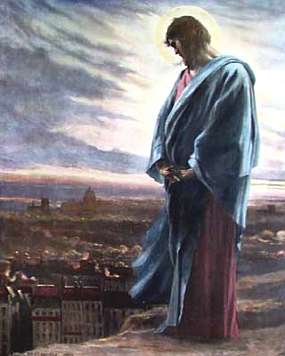
Do we ever think that the miracle denied the faithful person is because everyone around that faithful person does not believe?

Or do we blame the faithful person?

Or worse, do we blame God?

The question of the miraculous today never takes into account the crippling power of unbelief, especially when multiplied throughout a community. And those who would question the miraculous never ask if their unbelief and the unbelief of those they gather around them is what stands in the way of miracles.

Talking Various Church Oddities on a Sleepy Fall Morning

Standard

Sometimes, there’s just not enough in an idea for a full post. Sometimes, there’s almost too much, and the only recourse is a brief overview lest the topic overwhelm my ability to write. On such days, the best option is a series of post vignettes offered up for reader input. Feel free to fire away at any of these musings.

***

Is it me, or has much of contemporary worship music become more tribal and chant-like? I find a lot of this stuff tuneless and unsingable. First there was the charge that the lyrics were shallow. Now the melody is. When the Vineyard Churches energized modern worship music back in the late ’80s and early ’90s, the songs had lovely melodies. I dare you to find the melody line in more recent songs.

***

Sermon topics I have not heard preached in years:

The Fatherhood of God

The Humanity and Divinity of Jesus Christ

Repentance

Holiness: Why God Demands It, and What It Looks Like in Modern Living

Hmm. Weren’t those once considered foundational?

***

Conservative Christians are always accusing liberal Christians of a self-help, Oprah-esque form of the Faith that owes more to Jung than Jesus. But conservative Christians fall into their own ditch: sanctifying business solutions and calling them “spiritual wisdom.” Frankly, both are in error.

***

Kevin DeYoung has a new book, Crazy Busy: A (Mercifully) Short Book about a (Really) Big Problem, that seeks to address the frantic nature of contemporary life. I have not read the book, but from what I have read about it, DeYoung seems to throw the solution back onto the individual. I keep wondering when Christians are going to wake up and start challenging the entire system of how we live rather than trying to get individuals to modify their behavior to better work within that system. There’s only so much behavior modification one person can do. But then, show me Christians with a national platform who are willing to speak against the entire system of how we live, work, and play in America, and I’ll show you the one hand I can count them on.

Prepackaged, prefilled, communion cups & wafers***

These prepackaged, prefilled communion cup + wafer thingamabobs are just…well, words fail me. Nothing says prepackaged, prefilled, consumerized American spirituality more than those things. I dare anyone to partake of such a consumer good and soberly recall Jesus’ words that this is His body and His blood. Can you say that this is true of such a “communion meal”? Does this resemble the communion meal in the Scriptures in any way? In the end, what does it say about the Lord?

***

Jake Meador wrote “Why We Need Small Towns” for Christianity Today. I live in a small, rural town of about 3,100 people, and I have for the last dozen years. Heck, my son was off from school all last week because so many kids are involved in the county fair, there’s no point in having school. I can say without hesitation that Meador has over-romanticized the benefits of small town life. In truth, most small towns are no better than the suburbs, and in some ways, they have all the same problems but with fewer solutions. Most churches in a small town regret being churches in a small town, with their eyes forever on that suburban megachurch as their pined-for model. Really, I have no clue what Meador is talking about.

***

Tim Challies tried his best to bring some sense to John MacArthur’s Strange Fire Conference. He is braver than I am. As a charismatic, what bothers me most about this conference is the number of ways MacArthur and his select speakers could address the “charismania” issue, yet it seems they are going the most inflammatory route, one certain to cheese off charismatics everywhere, no matter how orthodox those charismatics might be. If the conference truly was about restoring sanity to the ranks of charismaniacs, then where are the solid charismatic speakers MacArthur has partnered with in this effort? You say there are none in the speaker list? Hmm…

***

Over at Patheos, Peter Enns wonders if there is wisdom in using the writings of contemporary “spiritual” authors (the kind Oprah—there she is again—would endorse) to jumpstart  conversations with lost people about Jesus. Looking over the Bible, I guess I’m at a loss as to where the Apostle Paul recommends that Christians read the liturgy of Molech with lost people before talking with them about Jesus.

***

I used to be able to talk to fellow Christians about any topic. We could even skewer each other’s sacred cows and both laugh and think more deeply about the possible flaws in our own thinking. Today, everyone walks on eggshells, every discussion of personal belief follies descends into battles and hurt feelings, and nothing seems to get better. We are all so caught up in our own stuff that we are all heading toward prideful unteachability—if we are not already there.

***

Every last one of us needs an infusion of genuine, Christ-like humility.

Reading Between the Lines of Paul’s Letters

Standard

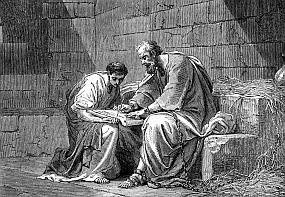
'Paul, The Apostle' by Gustave DoréMy son and I have been reading out loud through the New Testament this summer. We’ve tried to read as much as we can of one book in one sitting so that the harmony of the books is maintained. I’m convinced that we too often approach the Bible with a piecemeal mentality that ends up losing the bigger picture. This is especially true of the epistles, which should never be read any way other than in one piece. Reading them this way spotlights the confusion that our over-reliance on chapter and verse markings has created.

While I’ve read through the Bible many times in my life, I’ve never tried to read it both out loud and in the biggest chunks I can manage. That another person is listening as I read makes an additional subtle difference that forces me to be clear in how I pause and phrase the written word. Truly, it makes a difference. Try it.

This time through the New Testament, I’ve focused on most everything BUT the theology. Too often when we read the epistles, we tend to gloss over the credential establishments, the callouts to this person and that, and the real humanity depicted by the writers as they communicate to their readers.

For this post, I want to share a few thoughts from reading through Paul as if I were a long-ago church leader reading to an assembly of new believers who were going against the flow of the age.

A baker’s dozen thoughts on the Pauline epistles:

  1. We tend to see Paul as a dry, driven, exacting, Type A personality, but his emotional life is more rich on these pages than we give him credit for. This shows us that Christians need to be in touch with their emotional lives and bring emotion to our assemblies. Ours is not an arid, intellectual faith, though a quick perusal of Christian blogs and websites often communicates it as such. There is much to grieve—and also much to be joyful over. You can sense Paul’s melancholy and father-heart when he talks about his love for these young churches. His imprisonment weighs on him, and you can feel the sadness in the distance it creates. His writings show how important a solid network of Christian confidants and supporters is to our emotional well-being.
  2. Paul faced enormous opposition, often from people who seemed to be genuine Christians but were slightly off. (Sounds like today, right?) That so much of Paul’s writings consists of establishing his credentials is both illuminating and sad. This Christian life is more fragile than we imagine, and it is easy to go off the rails from simple carelessness regarding truth.
  3. To a modern age we think of as truly connected, Paul’s writings hammer the importance of Christian community, the need for loving, caring community that functions with peace, order, and utter dependence on God for direction. (Are our churches living that way?)
  4. Church hopping isn’t a 21st century phenomenon. Witness the number of companions to Paul who fade in and out of his life, many starting off well but finishing badly.
  5. As much as we look at Paul’s letters as theological treatises, the majority of their text, both opening and closing, is dedicated to connecting with specific people and establishing what Paul is all about.
  6. Personal holiness, perseverance, and a sober understanding of the age are themes in nearly every one of Paul’s books. So is the reality that Christianity is not another religion. The Christian faith cannot be equated with other streams of religious thought because it is not a dry—and ultimately empty—system like those others. Instead, Christianity is a dynamic relationship with Jesus Christ, based in complete reconciliation, and awash in grace for living each day.
  7. The Christian is to be the most average of people but one who lives an extraordinary, eternal life. Humility, gratefulness, and discipline are hallmarks of that life.
  8. Sins of a sexual nature and those that afflict male-female relationships are extraordinarily prevalent and a major stumbling block for many, but Christ can forgive, redeem, and restore.
  9. Paul’s letters repeatedly note that many people will wash out of the faith, and while we can have confidence in God’s preservation, the number of people who get sidetracked and seduced by the world’s offerings is larger and more common than we understand.
  10. The Christian life is NOT a set of rules and can never be. People who teach a set of rules are false teachers.
  11. Grace in our present age is largely misunderstand and rarely dispensed to the extent that Paul writes that it should be.
  12. Most of what Paul writes about isn’t rarefied, theological ponderings but practical Christian living. He points out how faith translates into real life and how practical our beliefs must be.
  13. A believer not living by the Holy Spirit is not living. The Christian life is less scripted than the religious life of the day, which is what makes it so exciting.

Those are a few thoughts on the writings of Paul from an overarching perspective. I hope they resonated with you. Have a blessed day and week.