The Problem with Christian Criticism

Standard

Recently, I wrote “Humility, Unity, and the Overly Opinionated Christian.” In it, I noted that too often we lack the facts to comment and should probably, in humility, refrain from adding our two cents.

Seems some may consider me part of the problem. 😉

At Christianity Today, Rachel Marie Stone, in her “Why Criticism Belongs in the Christian Blogosphere,” argues the merits of Christian opinion. She equates it to iron sharpening iron, and she wonder how it is that Christians are refraining from offering much-needed criticism.

I would like to offer my answer.

1. Many people are tired of angry discourse on the Internet. It doesn’t seem as if anyone has enough couth to criticize without resorting to sinful expressions of anger and resentment. Stone notes her own criticism of others has often resulted in ad hominem counterattacks. Well, yeah. That’s where we Americans are in 2013. Still, some thoughtful people—thankfully—are tiring of this.

2. Our critical vision as Christians is too small. Nearly all criticism by Christians on the Web is directed at individuals rather than at systems. Problem is, it’s mostly the systems mucking up everything. While it is much easier to criticize individuals, doing so rarely changes anything on a larger scale, because the power of that larger scale is not in individuals but in systems.

3. Systems are ridiculously hard to address. Criticizing the guy next door for letting his dog poop on your grass may accomplish getting him to keep his mutt out of your yard. But if your state determines your house is ground zero for a new shopping mall for “the public good,” good luck with your criticism of the state. And many systems are more complex than even a state government. Try criticizing the result of the Industrial Revolution and changing it through criticism. That system is far harder to assault because it is enormous and nebulous at the same time.

4. Criticism of individuals does not lead to change on a larger scale, while criticism of a system often gets absorbed by the immensity of that system. That tendency toward “lose-lose” explains the result Stone laments in her article.

For too long, some Christians have focused too much anger in their criticism, reserving much of it for individuals. So and so is a heretic! You don’t know your Bible! And on and on. This does not get us far. More people now recognize this. They also note that much of that criticism was not wrapped in love but in self-righteousness and pride.

Where Christians should be focusing our criticism is on systems, yet almost no one does. No one talks about workplace justice. No considers whether our lifestyles are based on fallacies locked in place by deviant cultural assumptions. No one asks whether the Reformation and democracy have led Americans to no longer fear of God. For the most part, Christians are not offering criticism of these larger thoughts, ideas, and systems because we’re too intellectually lazy and too satisfied with the status quo. Why rock the boat and bring down the system on our little heads?

I stopped reading most Christian blogs because they went after the minuscule. They strained for gnats. And then when they did, they were too often mean-spirited about it.

I think many people are tiring of the mean spirit. Meanwhile, few are willing to wade into larger battles. Stone talks about how hard it was to receive criticism for her criticism of another writer’s book.  If that’s the size of our vision, then all is lost already. Taking on systems, which is what we Christians SHOULD be addressing, is costly, complex, and tedious. Our criticism needs to be laser-like, educated, and relentless if we are to fix entire systems in the name of Christ.

Christians of long ago were up for that task. I’m not so sure we are today.

Oh, look…

“Hey, you! Get your dog off my lawn!”
When the Church Gets All OT on You

Standard

Can’t stop thinking about this…

Whenever Church leaders talk about how great it is to be a follower of Jesus, does it ever bother you that they always go back to the Old Testament for props for their teachings and sermons?

In the Old Testament, the reward in this life for faithfulness included the following:

Health

Material prosperity

Freedom from want

Large families

Respect from the community

Long life

But then in the New Testament, something else enters that idyllic picture and seems to replace it. The reward in this life for faithfulness in the New Testament:

Persecution

Separation from family

More persecution

Martyrdom

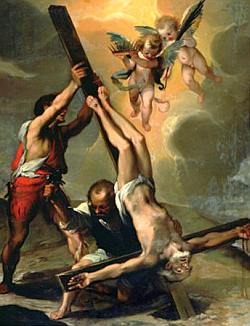
"The Crucifixion of St. Peter" by Ventura SalimbeniAmid all those sermons on all the great stuff you’ll now get from claiming OT promises, no one seems to talk about the hallmarks of NT faithfulness and what its rewards now look like.

My son and I are reading through the entire NT together, and that thread of persecution for following Jesus is simply unmistakable. Not only this, but Jesus Himself states that much of what was thought to be the hallmark of Old Testament faithfulness and reward would look different in the Kingdom of God that Jesus was instituing and that expectations should change. Something larger was now here, and it eclipsed what was thought to be the be all and end all of faithfulness and reward.

We don’t talk about that though.

What if instead of thinking about the OT reward of long life and material prosperity we instead thought of the blessing of having our head lopped off at age 30 by people who hated us and our Christ?

What does that do to “counting the cost”? Can any of us who have bought into the OT reward mentality truly accept the NT reward reality? Or do we keep retreating to a place that lessens the likelihood that we should ever receive a genuine NT reward—the only kind that truly matters.

Because, hey, someone once called me a bad name on my Christian blog, and I felt all persecuted.  🙁

God of the Group

Standard

UnityA reader wrote recently to say that my previous post (No ‘I’ in ‘CHURCH’–How American Evangelicalism Gets Its Pronouns Wrong) mirrored the collectivist thinking found in error-ridden cults and the teachings of New Age gurus. While I would argue that the actual teachings of such people are, in fact, largely about self-actualization rather than group actualization, if there is any guilt here, it is by association alone (ha, ha).

Here is truth: The entire narrative of Scripture is geared to a group. The story of God working is a story of Him working among a people. If anything, the words of Scripture should disabuse us of any notion that at the heart of it is the individual. What God is doing in the world has always been a “group project,” and if anything, the individual finds his or her truest expression of fullness only within a group.

Rather than give a million verses to back up this reality of the group, I will sketch out the ideas. Anyone who wants to fill in the blanks is setting himself or herself up for a tremendous journey into the mind and heart of God, and I would fully encourage anyone reading this to use it as a basis of further study.

The greatest lie afflicting the Church today is that you or I can do life alone. As we will see, in the eyes of God alone is never a good state of being.

The positive illustrations (the group):

God is a trinity. The Trinity exists in perfect commune within itself, Father, Son, and Holy Spirit.

God has made Man in that same image.

God creates the male and says of him, “It is not good that man should be alone.” God creates a female partner for the male. God’s first charge to them is to be fruitful, multiply, and fill the earth.

When mankind sinned, God saved from destruction an extended family. Prior to that destruction, He told that family to gather together groups of fertile creatures capable of recreating their own animal families that would continue the original fruitfulness command of God in the Garden.

When God chose to express His purpose for mankind, He chose a group model. He chose Abraham, to whom His promise would be that Abraham’s descendants would be like the stars in heaven. God’s promise is that Abraham will not be just Abraham but a great nation. Abraham finds comfort in knowing that he will not be alone.

God is referred to as “God of Abraham, Isaac, and Jacob.”

The exodus from Egypt left no Hebrew behind but removed an entire nation from the land.

The nation of Israel is established as a collective whole among which God dwells.

The joy of  the barren Hannah is that God granted her a son, completing her family, and Samuel became a great leader of the nation.

Blessed is the man who has a “quiver full” of children.

Elijah’s mistaken belief that he is the last prophet of God left, but God said He has preserved a remnant.

Imagery of streams that bring life to an entire region, of the fruitfulness of the land that is overflowing, of the the abundance of God’s provision.

The threefold cord is not quickly broken.

Iron sharpens iron.

The Christ is revealed to a group that consists of the lowliest and the highest within society, abolishing class distinctions. Christ says He comes to establish a Kingdom and says that all are equal within the Kingdom of God.

Christ taking on a group of disciples.

Christ noting anyone who does His will is His brother, sister, or mother. His noting that there will be no hierarchies among those who believe in Him.

Followers of Christ depicted as a flock. The Good Shepherd understanding that the flock is not complete if even one sheep is missing from it.

“Where two or three are gathered, there am I in the midst of them.”

The promise that even eunuchs will be made fruitful. The holy as the wheat.

Christ speaks of the vine with many branches.

Christ establishes the Church. The Church is grafted into the vine.

The first act of the Spirit-filled Church was to gather and make sure that no disparity of needs in the group existed, but that all had needs met. The early Church met together daily. “God added to their number daily”

The Body of Christ is composed of many parts, but the Body cannot function unless the parts are in sync, and no part is worthless.

The Holy Spirit gives gifts intended for the edification of the collective Body. Some gifts do not function correctly unless others contribute to them.

The New Testament Scriptures are addressed to the collective you. “Brothers.”

The Church, collective, is a royal priesthood and the Bride. The Church is made of living stones, built together into a collective edifice in which God dwells, the New Jerusalem.

The uncountable entirety of believers.

The marriage supper of the Lamb.

The negative illustrations (the individual, alone and disconnected):

Satan coming to tempt Eve, the lone individual, apart from her plurality with Adam and God.

“Adam, where are you?”

The barren woman. The desolate land. The alien. The eunuch. The wanderer. The leper. The blind man. The cripple.

“Everyone did what he thought was right in his own eyes.”

The splitting of Israel and Judah.

The prodigal son. The lost sheep. The fig tree devoid of figs.

The agony of Christ in His taking on the collected sins of the world alone, and His “Why have you forsaken me? ” cry of disconnection from the Trinity.

Being left out of the Book of Life.

Hell as separation from God.

***

If we do not understand that Christianity is the individual finding fulfillment in the collected Body of Christ and being made part of that vine, then we do not understand the Faith.

We must not care what the world or New Age gurus say. God establishes a group and He dwells in that group. There is no other reality. Everything in Scripture points to this.