
The Least-Believed Verse in the Bible

Standard

In the past few days it appears the Spirit has wanted me to blog about the supernatural. I wrote about demons on Saturday, Pentecost and the Holy Spirit on Sunday, and on Monday the tendency of some Christians to believe that God no longer speaks to individuals.
Bible imageMonday’s post felt incomplete, so I feel compelled to expand it to discuss the fascination some Christians have with deflating everything supernatural, be it inside the Church or outside. And even though there are some naysayers who want to cast doubt on the very miracles that Jesus performed, I would offer that even for Christians who believe in the innerrancy of Scripture, especially those in the rarified air of nationally-known preachers and teachers, this is the least-believed verse in the Bible:

Truly, I say to you, whoever says to this mountain, ‘Be taken up and thrown into the sea,’ and does not doubt in his heart, but believes that what he says will come to pass, it will be done for him.
—Mark 11:23 ESV

From the lips of Jesus Himself and yet so many of us rush right over that verse and automatically filter it through our newfangled Western Scientific Rationalism Sunglasses, so we see it, but we don’t believe it. “Mountains cast into the sea just by believing? I know that’s what it says, but—”

Talk about big “buts!” I think for most of us who have been around for a while, Mark 11:23 merits a logical explanation that goes something like this: “You know, the Bible does contain hyperboles. Jesus was just being hyperbolic. He’s such a card! You ever see a flying mountain? C’mon!”

Now I’ll be accused of faulty exegesis by most of the people who read this blog, but I’m going for it anyway because I don’t believe the following verse has merely the traditional exegesis so often given it. I think Paul is saying something even more startling:

But understand this, that in the last days there will come times of difficulty. For people will be…lovers of pleasure rather than lovers of God, having the appearance of godliness, but denying its power. Avoid such people.
—2 Timothy 3:1-2a,5 ESV

Traditionally, the meaning of “denying its power” has solely been attributed to justification and sanctification, God’s powerful transformation of children of damnation into Children of God. I will not even begin to question that interpretation. However, I also believe that this passage is a cautionary bit of advice to Timothy by Paul concerning those people who would handcuff God’s supernatural power operating in the lives of believers. And those supernatural powers extend to raising the dead, speaking in tongues, healing, and all those other numinous manifestations of God’s power working through the lives of believers, and which operate within God’s justification and sanctification of those same believers.

I find it odd that many who would lessen God’s ability to do such things today love to equate preaching the Word with prophesying. And while I am perfectly comfortable with them believing that, I am mystified as to when preaching passed away when those other gifts supposedly ceased. Preaching/prophesying is listed as one of those supernatural gifts of the Spirit we find in 1 Corinthians 12, though I didn’t know that it or its well-loved compadre faith bit the dust with John’s last breath, yet some would have me believe that.

Although I suspect those same folks would argue they fully believe the least-believed verse in the Bible, they have a funny way of showing it by their tendency to use tangled arugments to mock anyone who might still believe that the Lord can raise the dead today just as He raised Lazarus. And while many are willing to suspend disbelief when it comes to the Earth being created in only six days, somehow a modern day Lazarus-like resurrection just ain’t possible.

I’m really getting fed up with anti-supernaturalists who want to have compartmentalized “miracles” on their own terms and not God’s. If God wants to blow through Bob Jones University and blast everyone there with the gift of tongues, well, stranger things have happened—and God was in control of those stranger things, too.

J.B. Phillips wrote a book with one of the greatest titles ever: Your God Is Too Small. I can’t help but believe that a deity who no longer speaks to people in his own voice, who can do no more miracles, who was once mighty but is now routinely outdone by Satan’s counterfeit parlor tricks is just that small. And perhaps our problem is that we so easily put qualifiers on a verse like Mark 11:23 that we’ve created for ourselves a convenient god that is pleasurable in his smallness, convenient enough so that he does not ruffle our little kingdoms more than he ought, and while a tad bit idolatrous, looks enough like the big “G” God of the Bible that few people will notice his impotence.

That is not the God of Abraham, Isaac, and Jacob. If we really wanted to know why the Church has become a joke to most people I think its largely because too many self-professed Christians believe in a handcuffed God who closely resembles the god of Deism, a god who stepped back and never again brought his superatural touch to mere mortals. This is a god easily encapsulated and who bears a too comfortable resemblance to you and to me. Who wants a god that pathetic?

I don’t know about you, but I want a big “G” in my God.

Overflowing

Standard

Today is Pentecost, the birth of the Church and the fruition of the Old Testament prophecy of Joel declaring that the Spirit of God would personally indwell men and women.

El Greco's PentecostHow sad then that the Holy Spirit is barely a presence at all in our meetings or in American believers in general.
Yesterday, I wrote to a faithful reader of this blog about my experiences in camping ministry. Ruminating further on what I wrote her, I want to literally and figuratively talk about two camps. I'll let you decide which one was more Spirit-filled and had a more effective ministry.

The camp in Southern Wisconsin had everything that an Evangelical camp could want—multi-million dollar budget, national recognition, much-copied programming, an enormous staff filled with well-known names in camping, and superior food and accommodations. They had all the right doctrinal stances and perfect theology. The director of the camp was also the sitting director of Christian Camping International.

The camping program in Southern Ohio had a minute fraction of that money and was part of a Mainline denomination that had been losing members to churches like the one that supervised the Evangelical camp. They didn't own their own campgrounds and the camping program was largely funded by one church. There was no national recognition and the leaders, while respected, weren't being asked to speak at Christian Camping International conventions.

The Wisconsin camp was a stickler for rules, even those that made it hard for summer staff members to attend church on Sundays. The camp didn't provide for the spiritual needs of the staff, going so far as to oppose a volunteer, staff-run, mid-week church meeting (organized by yours truly.) Year-round staff made it clear to summer staff that they were just there for a few weeks and the camp really didn't belong to them in the same way that it did for the resident year-rounders. Resident staff almost never let summer staff into their homes.

The Ohio camp made every allowance for the spiritual lives of staff. When leadership saw that the staff was getting tired, they poured their lives back into the staff and made certain that each staff person was getting fed by the Lord. Although many of the summer staff were not local, almost everyone on staff decided to attend the sponsoring church and time was made for staff to attend church and even enjoy fellowshipping afterwards. People from the church housed the staff in their own homes when camp was not actually in session. Relationships were forged for a lifetime.

The Wisconsin camp believed that God came first, campers came second, and staff came third. The Ohio camp believed that God came first, staff came second, and campers came third.

The Wisconsin camp poured out their staff until they were bone-dry and used-up. The Ohio camp got their staffers into the waterfall of the Holy Spirit and let them minister out of the overflow.

By summer's end, the Wisconsin camp staff had nothing more to give, while the Ohio camp staff was still ready to serve. The staff of the Wisconsin camp limped out of camp with long faces and few tears. The Ohio camp staff walked away empowered for service, and there were long farewells and many tears. Many of the people from the Ohio camp are still friends almost twenty years later.

I tell the tale of those two camps because today's Church in America falls into the same two camps. Our ministry is either a pouring out of people until there is nothing left to give or it happens out of the overflow of the hearts of people filled with the Holy Spirit.

Unfortunately, I believe that too much of our ministry today is taking what little of the Spirit of God is in those ministering and pouring Him out until people are dessicated.

A simple look around the United States will reveal the following:

1. We have more seminarians than ever and yet people are starving for good preaching.
2. More people have taken evangelism courses than ever and yet there is no revival in this country.
3. We have more books on Christian topics than ever, yet the ignorance of the Word of God is growing.
4. We have more Christian conferences and seminars than ever, and yet the world around us thinks Christians have nothing to offer.
5. We have snazzier, more consumer-oriented programming in our mega-mall-churches than ever before and yet every poll shows more and more people staying away from our churches.

Folks, we cannot do this by our own strength and yet that is all we seem to offer people. Is it any surprise that people stuck in this kind of dry, manmade Christianity are bored and restless? And for those who labor within those congregations, should we scratch our heads when they burn out and go elsewhere?

There is no substitute for the Spirit of God! We cannot build Christ's Church by any other means than by His Spirit! Our programming won't do it, our happy faces won't do it, our seminaries won't do it, our bookstores won't do it. Nothing builds the Church but the Spirit. We're wasting our efforts and wasting God's time if we think otherwise.

I've said here before that you never have to advertise a fire. If each believer in Jesus was filled to the brim until they overflowed with the Spirit we'd have people begging us to know what our secret is! We'd sit down on a plane and the people in the seats next to us would be clamoring to know how it was possible that they could actually sense our contentment and inner joy. Anyone who is empty would want a piece of Who we have!

I wish that everyone who reads this blog will take time today to read the entire Book of Acts in one sitting. Read it all the way through—your translation doesn't matter. Just read it. Now ask yourself if what you read there bears any resemblance to your own experience. If not, then why not?

The simple answer is that we are not serious about ministering out of the power of the Holy Spirit. But can I tell you something? You will burn yourself to a cinder of you minister to others in the way that most of you have been taught. But if you minister out of the overflow of the Holy Spirit, ministry becomes so effortless that you'll wonder why you wasted so much of your sweat trying to do it by your own strength!

My favorite passage in the Bible is Acts 4:23-31:

When [Peter and John] were released [from prison], they went to their friends and reported what the chief priests and the elders had said to them. (24) And when they heard it, they lifted their voices together to God and said, "Sovereign Lord, who made the heaven and the earth and the sea and everything in them, (25) who through the mouth of our father David, your servant, said by the Holy Spirit, "'Why did the Gentiles rage, and the peoples plot in vain? (26) The kings of the earth set themselves, and the rulers were gathered together, against the Lord and against his Anointed'— (27) for truly in this city there were gathered together against your holy servant Jesus, whom you anointed, both Herod and Pontius Pilate, along with the Gentiles and the peoples of Israel, (28) to do whatever your hand and your plan had predestined to take place. (29) And now, Lord, look upon their threats and grant to your servants to continue to speak your word with all boldness, (30) while you stretch out your hand to heal, and signs and wonders are performed through the name of your holy servant Jesus." (31) And when they had prayed, the place in which they were gathered together was shaken, and they were all filled with the Holy Spirit and continued to speak the word of God with boldness.

Did you catch that last verse? The place they were in was shaken! When was the last time that the Holy Spirit showed up so powerfully on Sunday morning or Wednesday night that your gathering place was shaken? Or how about you? When was the last time the Spirit go so ahold of you so fully that you were shaken? Those folks in that place already had the Holy Spirit in them since it was a gathering of believers, but look how God filled them to overflowing. And notice what follows from that massive empowering of the Spirit: the people went out filled with the Spirit, ministering the word of God boldly out of that overflow of their hearts! Do you think that they could NOT talk about the Lord after being filled like that? They didn't go out timidly, nor by whipping themselves into an emotional frenzy, nor by whatever they'd learned in a two day Evangelism Explosion session, but they went out in the utter confidence of the Holy Spirit! How could they NOT impact their environs if God Himself was dwelling in them so richly?

You can't buy the Holy Spirit; people have tried unsuccessfully (Acts 8:18-24.) The only way we can experience that filling is to humbly repent of our sins, travail before the Lord in prayer (and I don't mean for five minutes, either), praise His Holy Name by the Spirit already living in us, and wholly offer up our lives as a living sacrifice to Christ—our spiritual worship. We also need to surround ourselves with others who have the same single-minded devotion to Christ. And lastly, we need to be around mature Christians who have tasted the Lord in His fullness. They know what is possible and they believe, even when others don't.

The Lord never intended us to live any other way than overflowing with His Spirit. His promise in Joel was not half-hearted; He promised radical lives, radically changed, and radically equipped by Him to radically speak to shattered people in a shattered world. He alone makes this happen. And no matter how hard we try to manufacture results, without Him we can do nothing. N-O-T-H-I-N-G.

Now do we believe that?

{Image: "Pentecost" by El Greco, 1600. One of my favorite artists.}

Let’s Play “Spot the Heretic!”

Standard

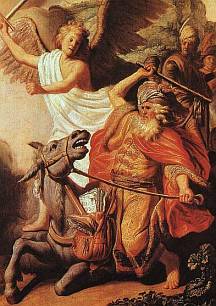
Balaam's Ass by RembrandtThis is the post wherein I make my secret confession before you all.

I've been a Christian for nearly thirty years. I've read a lot of books by a whole host of authors. And despite the fact that I'm fairly intelligent, graduated with high honors from probably the toughest Christian college in the country, and can use seven-syllable words with abandon, I don't read today's Christian writers much anymore.

Now I'm not speaking of Christian novels about young, chaste teachers coming of age on the Kansas prairie of 1880—aren't all Christian novels about that?—I'm talking about the non-fiction works of everyone from N.T. Wright to Brian McLaren.

If I were a proud man, I would attribute this to the lofty theological edifice I have constructed from bare rubble through my hard-won Christian discipleship. But I'm not a proud man; I'm simply a person like you who finds himself progressively confused by what passes for Biblical scholarship and discipleship lately.

Now with the Christian blogosphere filled from one end to the other with wild-eyed apologists, "remnant watchers," bell-ringers, deconstructionists, and self-christened "apostles for a time such as this," I've come to the conclusion that I simply can't parse it all. Yeah, this guy may be right and then he might not. She's got a good point, but arrived at it through a highly tortuous route that deviated through "Suspect City" to get there. And that guy in the corner always cries "Heretic!" over any idea that isn't his.

Sadly, there just isn't enough time in the day, so my only recourse is to ignore the vast majority of it. If it comes down to a case of discernment, perhaps the best discernment that a Christian in the 21st century can achieve is to always assume something's wrong unless it's been tested by time.

So that's my stance.

I used to help manage a Christian bookstore. I was the Bible and book buyer. Once you're in a position like that, you quickly attune your sense of smell to the stench of one lousy book after another grappling for bestseller status. I got adept at finding the stinkers before they found us. I attribute this to the Holy Spirit and to the spirit of our age.

The "spirit of our age" as I use it here is the quality of a book or set of thoughts that smacks of everything that is trending one way or another at this moment in time. Doesn't matter if it's right or wrong; in the end it simply won't last. Twenty years from now, no one will be referencing it for anything. It was dead on arrival, but the readers simply couldn't tell because the hype machine and word of mouth drowned out the naysayers.

Honestly, I think the Lord understands the dilemma of most earnest Christians today as they attempt to trudge through the mountains of half-baked theology and pseudo-spiritual tripe that get served to us on a sizzling hot platter—every single day. I believe that He knows it is far worse than in His own day when He battled the superstitions and mindless obeisance to the prevailing ethic of the land that relentlessly fought for the minds of His own disciples.

What is my out? Well, I'm hopelessly behind the times. I've said here before that most of the authors I read are dead. And that's my out. They're dead, no one is making big bucks off 'em, and yet their words last from one generation to the next. One set of Christians a hundred years ago read this stuff and found it spoke to the soul. And now another set today is reading it still because someone continues to be blessed. It won't crack the top ten on the bestseller list, or even the top ten thousand, but the words on those pages live. They give life and will do so until the day the Lord comes back—if, on that glorious and awful Day, He still manages to find enough people who take those old words to heart.

So I don't keep up with "New Think" for the most part. If I do mention a new book from time to time here, or mention a new blog that seems to have "it," then it's only because every reference in it goes back to someone from fifty years ago who could be trusted. I can tell you right now that Tozer, Ravenhill, Schaeffer, and a few like them can be trusted. Time's imprimatur has shown they can stand up and still speak the truth to a day and age where truth is so easily warped to be untruth that even the best of us can't always spot the mistakes.

I just can't filter it all; too much comes in. And while ninety-nine and forty-four one hundredths pure is good enough for soap, it's not good enough for the Gospel. As for me, I'm simply not smart enough or spiritually adept enough to mercilessly spot the 0.56% impurity that exists in today's writings.

Are you?

{Image: Detail of Rembrandt van Rijn's "Balaam's Ass" (1626)}