
And Now a Word from Our Sponsor…

Standard

I read another blogger’s comment that she received some words prayed over her this last weekend. Now comes the mulling of whether or not those words constitute a clear leading of God.

I can sympathize with that conundrum. I use the word conundrum because we receive a lot of “words” in today’s Church, but all too few of them turn into anything at all, making receiving such a word a dicey proposition.

It shouldn’t be that way.

Though I count myself a charismatic and thus have been exposed to hundreds of words prayed over me in my lifetime, I can count on two hands the number that truly reflected the intervention of God. That’s a darned poor track record for “words.”

Scarier still: all the ones I can verify as legit came from the same two men, one an oldster in the Faith and the other a young man old in soul.

Two men in thirty years of my Christian life. Two.

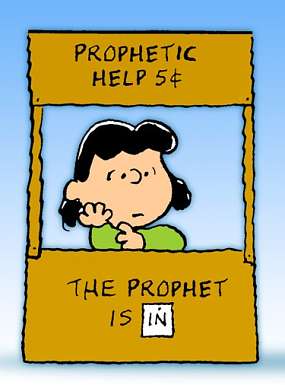
You’ve got to wonder at the damage all those phony messages from God cause. The prophet is in!If I hear another person mention they’re going to a prophecy conference I’m going to lose it. Those folks follow these so-called prophets around like groupies and it’s sad. Considering the accuracy of today’s modern prophets, you’ve got to wonder how many of those conference attendees have had hundreds of words prayed over them, none of them amounting to more than so much air. Yet the addiction’s there, so they go, always seeking, but never finding.
Don’t get me wrong here. I believe in modern day prophecy and gifts of wisdom and knowledge. I’ve given out a few of those in my life, emphasis on few. I’m hearkening back through time and I can count perhaps three—at the most. Why so few? I don’t speak unless I’m absolutely sure of my source.

It bugs me that for all these prophetic words, almost none of them resemble Jesus’ warning to the man at the pool of Bethesda: stop what you’re doing or something bad is going to happen to you. Usually the word consists of some vague reference to how God loves the person receiving the word so much and has grandiose plans for him or her. Every once in a while, you do get someone calling out a “Jezebel spirit” just to keep from seeming too positive. (All I can say is that this Jezebel spirit’s getting a workout in some charismatic circles. Must be exhausted by now.)

It’s all too easy to make up some high-falutin’ spiritual language talking about great nations, lampstands, and watchmen. Curiously enough, none of those handful of accurate words prayed over me ever contained such language. Most were just plain talk. But at least they were right.

On the bogus side, I once received a word from someone telling me I would be a great nation. I’m not truly sure what that’s supposed to mean, although I’m convinced my wife wouldn’t go along with it. Our pastor came from a household with fourteen kids and I can tell you that the Mrs. shudders at the thought. Another time, two very earnest women insisted I’d be getting back into camping ministry “in the next few months,” but my phone’s not rung for that idled career in fifteen years. That’s a whole lot of months.

Pity the poor person who has those mistaken words turned against them, too. When some minor prophet makes a pronouncement and it doesn’t come to pass, it’s never the prophet who’s wrong. It’s the poor unfortunate who received the bad word who gets his or her mustard seed of faith questioned. I don’t know about the prophet, but when I read the Scriptures it says that God’s words don’t return void.

I wish I didn’t have to write this post. Yet with all these “words from the Lord” being bandied about, someone needs to speak up.

About ten years ago, I remember a church meeting where a man stood up and relayed a highly specific word. (Note: the details have been changed for privacy concerns.) This man had a word of knowledge about a woman whose teenage daughter Josie had run away from home, traveled south, and was now deeply immersed in the drug culture of Miami. She’d been gone for three years now, effectively missing, though the mother had heard from her once in that time. The man went on to say that the mother needed to contact her daughter at that last known phone number, even though the daughter had not been at that number for more than a year. The man then said the daughter was afraid to call her mother, but if the mother called her first, God would do a great healing in both their lives and they would be restored to each other. But the mother needed to make that call to the only phone number she had.

My wife turned to me and noted that we didn’t know anyone in the church who fit those details and she suspected the word was wrong. Our small church met in a rented facility, and what no one knew was that a woman had come in to prepare the building for another activity later that day. She was in a back room and heard that word over the building’s sound system. Amazed, she wandered up front to the man who gave the word and told how astonished she was that anyone knew her situation. She prayed with some folks, then went home and called her daughter at that phone number. And yes, everything the man said came to be.

Now THAT’S a word folks. It’s specific. It contains information that can only be spiritually discerned. It intersects with known realities. It meets a need. It makes something happen because of the faith of the hearer who trusts it. And, most of all, it comes to pass.

I guess I’m tired of the burden of proof falling on the one receiving these supposed words from God from someone else. I don’t want to seem glib, put I think “put up or shut up”—a most earthy sort of spiritual testing— applies. If all these folks delivering words have a track record that resembles a 500:1 shot bound for the glue factory, then they need to sit down and stop hurting others with their “gift.”

And yeah, I get a little steamed thinking about it. I wish more of us did.
Becoming Spiritually Literate

Standard

For this is the covenant that I will make with the house of Israel after those days, declares the Lord: I will put my laws into their minds, and write them on their hearts, and I will be their God, and they shall be my people. And they shall not teach, each one his neighbor and each one his brother, saying, ‘Know the Lord,’ for they shall all know me, from the least of them to the greatest. For I will be merciful toward their iniquities, and I will remember their sins no more.” In speaking of a new covenant, he makes the first one obsolete. And what is becoming obsolete and growing old is ready to vanish away.
—Hebrews 8:10-13

I don’t normally jump all over someone else’s posts. Nor do I encourage rancor in the Godblogosphere since it (100 percent of the time) accomplishes nothing good for the Kingdom. But I saw something this weekend that just made my jaw drop.

Over at the Council of Reforming Churches, Tony Carter wrote an innocuous-looking post entitled “Reasons for Reading.” As an avid reader, I fully support reading. If I can look back on one good thing I did for my son, it’s that I got him reading at a young age—and enjoying it immensely. He goes over to another kid’s house and scopes out the books before the toys. If nothing else I do for him educationally, at least I know he’ll have a love for books.

No, what troubled me more than anything was Carter’s reasoning for why all Christians should be avid readers:

[Reading] is the primary means through which God has chosen to communicate to his people.

In short, no. Not even close.

Now before I get a hundred Scripture verses tossed my way, let me make a very simple (and historically) accurate statement: The reason that reading CANNOT be the primary means through which God has chosen to communicate to His people is that for most of human history, very few people could read. Illiteracy is the primary state of most humans throughout civilization, and only the cultural and governmental elite possessed a literacy rate worth mentioning.

I shouldn’t have to draw out this conclusion, but if most people in human history are/were illiterate, than that goes for most of the people labeled “Christian.”

This poses a horrid problem then, for if what Carter says is true in his statement, then most Christians were fundamentally cut off from communicating with God.

Let’s go even further and understand that even for those Christians who could read, very few of them had a Bible. Even during the days of the early Church, only a few households had any written Scriptures at all to select from. The situation gets worse when we consider the plight of the Gentiles, who had little access to what were then considered Jewish writings.

Further historical analysis shows that Christianity swept through the Roman Empire largely through the poor, who rarely had the kind of education that would allow them to read or write. The common people who embraced Christ so readily had almost no reading material of any kind, much less anything considered Biblical.

More to the point, it would be a millennia and half before the printing press even made owning a copy of the Bible possible, and still possessing copies of the Scriptures lay beyond the reach of the large majority of Christians.

So simply from a historical and sociological standpoint, it’s impossible to claim that reading is the primary means by which God communicates with His people.

But if not reading, what?

Well, for one, we know that oral communication made up much of what the people heard of God. Those few who could read may have been able to use that skill as a stepping stone to teaching others the Gospel. Again, history shows that the leaders of the Church possessed some level of literacy, or at least the ability to pass on what they heard orally. This explains the need for solid preaching—many people had no access to the Scriptures except from the preaching they heard.

But even this poses problems, for the second you remove the leaders from the life of the Christian, the common people end up deaf to God.

No, what is needed is the ability to always come before God, to hear Him, and to communicate with Him in such a way that even the most powerless, poverty-stricken disciple can talk with Him. That ability must not discriminate. It can’t be reserved for one special group or another. It must be available to all.

So what is God’s primary means of communicating with His people?

The Holy Spirit.

Not a believer exists who exists without the Spirit. Access to Scriptures may come and go. One may be able to read the KJV with total comprehension or one may be unable to even read or write one’s name. But no matter what, God gave us a means of communicating with Him and with each other through the Holy Spirit.

Need more proof?

When did the Church come into existence? At Pentecost. And what was the sign of Pentecost? Tongues of fireThe Holy Spirit coming to indwell Man. And what was the sign of proof for that indwelling? A communication gift—tongues.

Even better, what distinguished the Church from the old Temple-based system in Israel comes down to access. The Temple system demanded literacy and was restricted to a priestly class of elites. The glory of Christ’s sacrifice to gather to Himself a a Bride is the rending of the Temple veil and a Holy God making his home in even the lowliest person. By the Holy Spirit alone are we made equals. Literacy or illiteracy, the Holy Spirit is the equalizer, transcending man-made barriers.

The Bible itself states that there are limitations to the written word:

Now there are also many other things that Jesus did. Were every one of them to be written, I suppose that the world itself could not contain the books that would be written.
—John 21:25

Truthfully, those books have not been written in pen and ink. If we consider carefully, those “books” are you and me, in that what Christ has done in us by His Spirit fills those unwritten books. Not by any means that can be read in print, but in transformed lives that “speak” and attest to the power of God by the very fact that you and I testify to Christ.

But it all comes by the Holy Spirit.

Because the depths of the wondrous workings of Jesus in our lives hasn’t been codified in its entirety (as is evidenced by the concluding statement of the Gospel of John above) , no limit exists to what we can know of the Godhead or His wonders. And who reveals the depths of the Lord to us?

But we impart a secret and hidden wisdom of God, which God decreed before the ages for our glory. None of the rulers of this age understood this, for if they had, they would not have crucified the Lord of glory. But, as it is written, “What no eye has seen, nor ear heard, nor the heart of man imagined, what God has prepared for those who love him”– these things God has revealed to us through the Spirit. For the Spirit searches everything, even the depths of God. For who knows a person’s thoughts except the spirit of that person, which is in him? So also no one comprehends the thoughts of God except the Spirit of God. Now we have received not the spirit of the world, but the Spirit who is from God, that we might understand the things freely given us by God. And we impart this in words not taught by human wisdom but taught by the Spirit, interpreting spiritual truths to those who are spiritual. The natural person does not accept the things of the Spirit of God, for they are folly to him, and he is not able to understand them because they are spiritually discerned. The spiritual person judges all things, but is himself to be judged by no one. “For who has understood the mind of the Lord so as to instruct him?” But we have the mind of Christ.
—1 Corinthians 2:7-16

I wrote a few weeks ago that we in the American Church continue to give short shrift to the Holy Spirit. Instead, let’s cherish the Holy Spirit and give Him the rightful place as the primary means by which God communicates with His people.

The Two Christianities

Standard

Sometime around 12:30 a.m. on Saturday morning, as I shut down the lights in our downstairs in anticipation of going to bed, it hit me. I finally understood something about the Church that I’d never realized before. Some may not see what follows as any great revelation, but it jumped out at me so strongly that I nearly couldn’t go to sleep for thinking about the ramifications.

I haven’t processed it all, but I’d like to share what I discovered. Like I said, it may be a big ho-hum to you, Two roads diverged...but I now see why the Church in this country fails to grow and meet the basic objectives of discipleship.

Consider two different Christianities at work, the Externally Motivated and the Internally Motivated…

Externally Motivated (EM) Christianity sees the Kingdom of God existing in systems and institutions “erected by God” or by Christians faithful to God. The essence of what it means to be a Christian dwells in hallowed monolithic icons, largely existing outside the believer. We see the expression of EM Christianity whenever we encounter Christian groups and individuals seeking to preserve or defend some aspect of the truth they see encapsulated in a system, institution, or organization.

By nature, EM Christianity is conservative in that it works to retain and preserve those creations because it equates an assault on them with an assault on the Kingdom of God. EM Christianity bases much of its credo on the Old Testament and Old Covenant because Israel invested its faith in God through the accoutrements of God in the Temple, in the Ark, in the Law, and in the evidences of God it erected in the faithful community.

But negatives within EM Christianity abound. By equating systems and institutions with the Kingdom, EM Christianity becomes a fear-based expression of the Faith. Not a day goes by without some perceived threat erupting that may be “the final blow” to the hallowed structures maintained by “good Christians.” Therefore, EM Christianity assumes a defensive position at the least provocation because EM Christians live their lives from the outside in.

Furthermore, EM Christianity’s defensive stance exists to defend the community within EM Christianity, rather than looking beyond the group. In other words, it loves its own and that’s as far as it goes. Blindness to causes that ask for a Christian response, but don’t enhance EM Christian strongholds, runs rampant. In the end, EM Christianity creates an insular community that resists the call of the Lord to go into the highways and byways to find those not initially invited to the party.

We see a practical expression of these negatives in the culture wars waged by American Evangelicalism. Leaders that follow the EM practice of the Faith resort to fear to marshal their followers against perceived threats against the systems and institutions that, in their eyes, represent the Kingdom. You can hear their mantra in the following battlecry:

The {opposition group} is going to destroy {pillar of External Christianity} by {sinful tactic}, which will lead to {fearful outcome}, and the end of {secondary pillar of External Christianity} as we know it!

Creating fear-based “Mad Libs” by filling in those brackets becomes an exercise in identifying EM Christianity:

The homosexual lobby is going to destroy our children by infiltrating our schools with pro-homosexual children’s books, which will lead to sexual identity confusion in our children, and the end of the family as we know it!

OR

The Democrats are going to destroy our legal system by failing to approve conservative judges, which will lead to godless special interest groups running the country, and the end of the United States of America as we know it!

You can go on an on with this formula.

What’s sobering for Christianity is the resemblance of that thinking to the following:

So the chief priests and the Pharisees gathered the Council and said, “What are we to do? For this man performs many signs. If we let him go on like this, everyone will believe in him, and the Romans will come and take away both our place and our nation.”

—John 11:47-48

And we know exactly how that ended. The chief priests’ and the Pharisees’ cry sounds very much like the fearful lament of EM Christianity, based as it is in spending all its time and effort in propping up systems and institutions that are secondary (or possibly in opposition) to the expansion of the Kingdom.

Another troublesome issue within EM Christianity concerns its reliance on charismatic leaders to push its agenda forward. When such a leader stumbles, the flock who followed him scatter and the movement loses momentum or falls into public disgrace. We see this all the time and it hurts the cause of Christ in this country immeasurably.

Lastly, those who follow an EM Christianity find themselves subject to the whims of forces having nothing to do with the expansion of the Kingdom of God. Their emotional state shifts with whatever perceived “win” or “loss” follows their cause. Because their faith is so rooted in externalities that can suffer at the hands of the godless, they set themselves up as martyrs even though they may very well lack the proper grounding to be true martyrs for the Faith. Theirs becomes an angry expression of Christianity because of this dilemma.

Yet despite these lacks, EM Christianity is still Christianity. It’s the response of people who have had their eyes opened to the pernicious realities of sin, but have not yet developed an understanding of the Faith that goes beyond labeling others as sinners or saints. EM Christianity is not a seasoned expression of our faith in Christ, but a waypoint on the path to true maturity.

Internally Motivated Christianity, in sharp contrast, invests little time and energy in externalities. Its hope is not in systems and institutions because it understands that those succumb to entropic forces. To the IM Christian, the Kingdom of God cannot rest on externalities prone to decay:

And when [Jesus] was demanded of the Pharisees, when the kingdom of God should come, he answered them and said, The kingdom of God cometh not with observation: Neither shall they say, Lo here! or, lo there! for, behold, the kingdom of God is within you.

—Luke 17:20-21

The distinguishing mark of IM Christianity is the Holy Spirit, who dwells inside each believer. The Kingdom exists because the Spirit comes to live in each believer, that indwelling marking the end of the Old Covenant and the beginning of the New. The externalities, the mere representations of the Kingdom of God, surrender at Pentecost. Therefore, the Kingdom of God cannot be destroyed from without because the Kingdom of God is within us. When attacked, IM Christianity responds with grace and love. It continues to offer Christ to all, even to those who oppose it.

For this reason, IM Christianity signals the mature Faith because nothing can diminish it. Its liberality comes from its freedom to give without fear of loss. IM Christians have considered ALL things lost, receiving in return what cannot be taken away. Though all the systems and institutions collapse and the heathens run amok, IM Christianity remains at peace because its adherents carry within them the fruit of the Kingdom. The Enemy cannot prevail against IM Christianity and cannot sway its adherents because they realize the Kingdom of God lives inside them. The power of God doesn’t come to them from the systems they create, but through the Holy Spirit working miracles in the absence of those systems. They live their faith from the inside out.

IM Christians…

…have humbly died to the externalities.

…don’t concentrate on defending external systems and institutions prone to decay.

…concentrate on the real mission of evangelism and disciple-making.

… comprehend that they are expendable for the Lord because their lives are hidden in Christ.

…work best under persecution.

…have nothing to fear because what they have cannot be taken away from them.

…are truly free.

When we examine the state of the Church in 2007, we find that EM Christianity predominates in the American Church, while IM Christianity marks most regions of the world undergoing revival. IM Christianity thrives in places like China, India, and South America. Those lands have no institutions or systems that support Christianity, anathema to an EM Christian. In fact, institutions and systems in those countries oppose Christianity. This forces the Church there to internalize the Faith. And so it flourishes.

If a warning exists for IM Christianity, it comes in the form of the giant step backward. As noted earlier, EM Christianity exists as a waypoint on the journey to mature faith. However, IM Christianity’s misguided tendency is to retreat by creating systems and institutions that must be defended at all cost. Persecution helps keep this in check, and may explain why the Chinese Church actively prays that the American Church will suffer like it does. When all the systems and institutions fall away, IM Christianity will be forced to take root or people will fall away.

Two Christianities: Externally Motivated and Internally Motivated.

Lord Jesus, make us Internally Motivated Christians.