
And [Jesus] came to Nazareth, where he had been brought up. And as was his custom, he went to the synagogue on the Sabbath day, and he stood up to read. And the scroll of the prophet Isaiah was given to him. He unrolled the scroll and found the place where it was written, “The Spirit of the Lord is upon me, because he has anointed me to proclaim good news to the poor. He has sent me to proclaim liberty to the captives and recovering of sight to the blind, to set at liberty those who are oppressed, to proclaim the year of the Lord’s favor.” And he rolled up the scroll and gave it back to the attendant and sat down. And the eyes of all in the synagogue were fixed on him. And he began to say to them, “Today this Scripture has been fulfilled in your hearing.”
—Luke 4:16-21 ESV
Michael, a reader, commenting on my post “Lonely Christian Men,” wrote:
“I come to church broken from the week, and who wants to talk with that ‘hot mess’? Who wants to be dragged down by reality, what with the up-tempo music, extra-foamed latté, and positive message? Sunday seems to have become the day to ignore the struggler, unless you want to invite them on the next men’s retreat.”
Sadly, whatever it is that struggler is dealing with, even if he should accept the invitation, his struggle won’t likely be addressed on the men’s retreat.
Here’s how the online Urban Dictionary defines hot mess:
A person who is a handful; he/she is a piece of work, and/or a colorful character.
Every church has a few folks best described as such. Truthfully, not a one of us escapes that label, for each of us is probably a hot mess at some point or other in life.
I’m sure many of us have had that same experience as Michael, where we feel as if we’re messing up church by our very presence. Our being there on Sunday is a downer for everyone else because we’re the ones chained to a 10-ton weight we can’t escape. And no one else wants to deal with our load. This makes for the worst alienation imaginable. Because if the Church doesn’t care, who will?
 I think we live in an age where people are burned out of dealing with others who face difficult situations. I also think we’re seeing a multiplication of problems. It’s not enough that someone is facing cancer, but the cost of the treatments is also creating a possible home foreclosure AND the patient is caring for decrepit, elderly parents who live with her. Life, once simpler, now resembles the Gordian Knot. And everyone has his or her own Gordian Knot, small or massive, to untie.
Still, the question remains: If the Church doesn’t care, who will?
In the opening Scripture above, Jesus spoke of why He came. That purpose never left Him. Nor has He abandoned it now that He has ascended to glory. The problems He addressed remain, but it is the Church that must now take on Jesus’ task. We proclaim. We heal. We liberate. We are there when no one else is.
I know everyone is busy. Perhaps busyness is the root problem. Nonetheless, we can’t leave the hot mess to stew. If we aren’t doing those liberating works in the lives of broken, hurting people that Jesus addressed in His reading from Isaiah, then we’ve forgotten what it means to be the Church.
We need each other, folks. Now more than ever. None of us escapes being a hot mess at some point in life. None of us wants to be the downer at the party. But this side of heaven, the Church isn’t tasked with being a 24/7/365 party. It’s meant to be a respite, a source of healing, and a place and people that help others encounter God and help get their needs met.
Have we forgotten what we’re about?
 I hear a lot of laments online about why America is in trouble as a nation. There’s a reason for that trouble, a remarkably simple one. It’s found in this verse of the Bible:
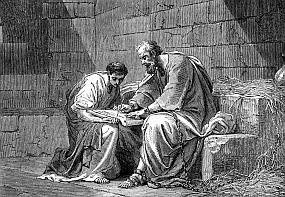 My son and I have been reading out loud through the New Testament this summer. We’ve tried to read as much as we can of one book in one sitting so that the harmony of the books is maintained. I’m convinced that we too often approach the Bible with a piecemeal mentality that ends up losing the bigger picture. This is especially true of the epistles, which should never be read any way other than in one piece. Reading them this way spotlights the confusion that our over-reliance on chapter and verse markings has created.