
Still Looking for a Gospel That Speaks to Failure

Standard

Another friend lost his job last week. He spent the last nine years in the housing biz, and we all know where that has gone. These are tough times, aren’t they?

When I think of the difficult lessons I have learned in life, whether through my own experiences or those of people I know, many of them revolve around our work lives:

The business world never forgives mistakes—ever.

It’s always about the bottom line, and almost never about the employees. (The sign of a soulless company? Its leaders refer to employees as “human capital.”)

If a man makes a bad career decision at age 18, it will more than likely haunt him for the rest of his life.

In the same way, if a man feels a call to ministry in his young adulthood, he will be hard pressed later in life if he fails in that ministry and must find his way in the regular work world.

If a man is trying to transition out of one field into another, more than ever he will find it impossible because employers can’t seem to break out of the niche mindset. In other words, once a bricklayer, always a bricklayer, and never a computer technician.

Men who lose their jobs at the most vulnerable point in their peak earning years are more likely than ever before to find themselves unable to return to the same level of pay.

Reaching for the brass ring may instead find one falling off the carousel.

This is not to say that God can’t do miracles. But the simple fact is that you don’t go to bed a video store clerk and wake up the next day as the lead on the Large Hadron Collider. And the even simpler fact is sometimes all the hard work in the world will not get you there, either.

And that’s why, especially at this time, we need a Gospel that speaks to failure.

A couple years ago at this time, I wrote a post called “We Need a Gospel That Speaks to Failure.” Take a couple minutes to read it, if you can.

You would think that we would have such a Gospel, but somehow we’ve missed it. To me, one of the oddest thing about living in a world that has seen its Savior come is that the one thing the Savior came to deliver is in such radically short supply: grace.

Recently, I said that I thought the largest unreached people group in the United States right now are those who have lost their homes to foreclosure. Here in America, what greater failure can exist than to kiss the American Dream home goodbye? Yet where is the Church on this?

Worse, where are the former homeowners? Are they in our pews or not? My guess is on the “not” side. The new breed of failure?I’m thinking that nothing hurts worse than to go down in flames in your church while everyone around looks the other way or quotes you Romans 8:28 off the motivational plaque they bought from the local Christian bookstore. Why stick around listening to sermons on Christian leadership when you were desperate for a servant in your time of need and one never showed up.

It really galled me that one of the largest sources of the pile-on afflicting those first homeowners who lost their homes at the beginning of all this was Christians. In our self-righteous ire, we blamed people for being stupid. And perhaps they were. But when is grace only for the smart people of the world?

One of the things about this financial implosion are the bystanders. Now, even people who did everything right are being wiped out. That may even be some of us. Does that make us stupid? Is the same measure of gracelessness that we doled out coming back to haunt us?

God, we need a Gospel that speaks to failure preached in our churches more than ever. Please, someone, anyone, preach it!
A Nation of Fig Trees

Standard

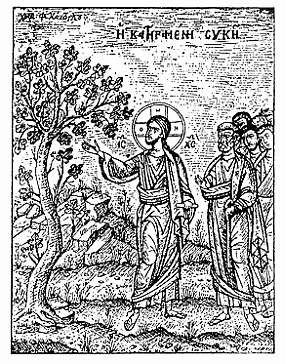
And seeing a fig tree by the wayside, he went to it and found nothing on it but only leaves. And he said to it, “May no fruit ever come from you again!” And the fig tree withered at once.
—Matthew 21:19

A conversation with my sister-in-law troubled me. It had to do with the old aphorism “Bloom where you’re planted.”

A couple weeks ago, I posted the following:

Overheard countless times in the last two months: “I am concerned about the poor performance of my investments and savings.

Not heard even one time in the last two decades:  “I am concerned about my poor performance in laying up treasure in heaven.

It all ties together, trust me.

I recently turned 46. To me, that’s an “other side of the mountain” age. I look at people just 10 years older and they’ve gone gray and have that “retired” look. Entropy overshoots no one.

When I take stock of my life, I’m deeply troubled. I’m simply not laying up treasure in heaven. Period. End of story.

I wish I could say that the problem is found only inside me. But it’s not. In many ways, I know that I surpass a lot of other Christians in treasure-laying-up. At least here in the States.

So my sister-in-law and I were talking about this issue and she unleashed the “Bloom where you’re planted” line. She said that God can’t fault us if we’re good employees providing for our families, Jesus cursing the fig treeraising up our kids in the knowledge of the Lord, and just being a good Christian when a good Christian is called for. Given the pressures most people face in life today, just doing those things has to count for something.

But does it?

The way I look at it, if you pull the average family man off the street and analyze his life, he’s probably doing most of those things. He may even be packing his family off to church once a week.

But I can’t see how any of that fulfills the upward call of Christ. For all I know, that man doesn’t know Jesus at all. What then distinguishes the average American Christian from his non-Christian neighbor? If “bloom where you’re planted” is the be all and end all of modern living, then isn’t Joe Pagan blooming, too?

A quick read of the ending of Matthew gives us a clue into Jesus’ standard of living:

And Jesus came and said to them, “All authority in heaven and on earth has been given to me. Go therefore and make disciples of all nations, baptizing them in the name of the Father and of the Son and of the Holy Spirit, teaching them to observe all that I have commanded you. And behold, I am with you always, to the end of the age.”
—Matthew 28:18-20

How does that jive with the list of prerequisite works found within the “bloom where you’re planted” ideal?

It doesn’t.

In the last 10 years, I’ve had one person try to witness to me. Her witness consisted of handing me and the rest of my group a tract. She did this for about 20 people, ran out of tracts, and then skedaddled, not saying a word.

I fear that encounter pretty much encapsulates what passes for making disciples today: quick, harmless, and no cost to the “discipler.”

But then again, how can we expect anything else? Everyone is too busy blooming where they are planted to give a hoot about evangelism or spending time making disciples.

The sad part, to me at least, is that I’m no better than anyone else. I’m too busy attempting to feed my family to have even two seconds for ministry.

Back when I had a little bit more time, I encouraged my church to consider a mentoring program for kids in the church who lacked dads. Today, they put out the sign-up sheet. I stood there with a tear in my eye, unable to sign my name on the sheet endorsing the very idea I suggested.

Something has got to give.

How can any of us expect to hear “Well done good and faithful servant” if the only people we serve are our families? Don’t the godless do the very same thing?

Jesus said, “Truly, I say to you, there is no one who has left house or brothers or sisters or mother or father or children or lands, for my sake and for the gospel, who will not receive a hundredfold now in this time, houses and brothers and sisters and mothers and children and lands, with persecutions, and in the age to come eternal life. But many who are first will be last, and the last first.”
—Mark 10:29-31

The way we Christians in America live, I expect to see the vast majority of us standing at the end of the celestial line, our heavenly garb tinged with a hint of soot and sulfur after the test of fire incinerated everything we worked for in our earthly lives. Maybe a minuscule fleck of gold remained. Maybe. Emphasis on minuscule.

And what is that speck? Our treasure in heaven.

To bloom where we are planted requires we actually bloom. But not simply for ourselves. The fig tree that Jesus cursed probably did bloom. It just didn’t produce any fruit. Yet what point is a fruit tree with no fruit?

What point is a Christian who has no time for obeying the command of Christ to go make disciples no matter the cost to us? What good is a Christian whose life revolves around the same daily routine as the non-Christian, save for squeezing in church on Sunday and some prayers and Bible reading during the week? Isn’t the barrenness just as obvious between the avowed follower and the lost?

Many of us believe the end is close at hand. If so, what explains the lack of work for the Kingdom? We’re all so worried the economy will take our jobs away, but what if being forced to watch all our earthly treasure signed over to some bank is the best thing for each of us? Maybe actually losing everything would reinforce the words we speak glibly about forsaking all for Jesus.

It’s a hard word, isn’t it?

The Coming Religion

Standard

Genuine vs. CounterfeitAs I noted a few posts ago, my church is going through The Truth Project, a series from Focus on the Family that outlines a Christian worldview. I have enjoyed the series so far, and I think it is excellent. But I have a problem with the third lesson, which asks the question, “What is Man?”

The lesson contains an excellent outline of the case of biblical anthropology against an anthropological theory that many would immediately recognize as that of atheism or secularism. You know, the favorite bogeyman of those enmeshed in the culture wars.

My thoughts? I absolutely agree that the secularized worldview portrayed in the lesson (as epitomized by Maslow’s hierarchy of needs, with its pinnacle of self-actualization) is definitely a problem. What troubles me is that I don’t feel that a secular worldview is the threat against genuine Christianity that the lesson makes of it. Atheism? Secularism? That’s so…well, 1990.

Fact is, if you look around the world, people are not rushing to atheism and secularism. Sure, in some places they’re buying the books, but not in the majority of the world. With the exception of small pockets of atheism and secularism in Western nations, the actual trend is toward a more progressive spirituality, a spirituality that may not—at least from undiscerning human eyes—appear to enthrone self, as does secularism. In fact, some people might even call it a new fundamentalism, a return to what are ultimately superstitious or flawed religious beliefs. Ask an African what is sweeping Africa, and he’ll not reply atheism, but Islam.

Though atheists and dim-bulb “brights” claim antisupernaturalism is on the rise, that is anything but the case. Witness the mass euphoria over the so-called Lakeland revival. The supposed supernatural displays on center stage had people transfixed. Rational people who never would have entertained supernaturalism otherwise flocked to Florida, hoping for a miracle. Many spent thousands of dollars to fly in from around the globe to bask in the overhyped glow of the Bentley miracle show. People who believe in nothing outside the material world don’t do that.

Remember this:

For then there will be great tribulation, such as has not been from the beginning of the world until now, no, and never will be. And if those days had not been cut short, no human being would be saved. But for the sake of the elect those days will be cut short. Then if anyone says to you, ‘Look, here is the Christ!’ or ‘There he is!’ do not believe it. For false christs and false prophets will arise and perform great signs and wonders, so as to lead astray, if possible, even the elect. See, I have told you beforehand. So, if they say to you, ‘Look, he is in the wilderness,’ do not go out. If they say, ‘Look, he is in the inner rooms,’ do not believe it.
—Matthew 24:21-26

Does Jesus Himself predict that secularism will reign at the end? Hardly. If anything, it will be a time of people desperately seeking spiritual nourishment, seekers who latch onto one magician after another.

Jesus’ warning should shake us all because the genuine lie isn’t going to be as obvious as secularism or atheism. That’s bush-league deception. That will only fool the completely gullible.

What should sober us is that the coming lie will look so much like truth that even the elect will be perplexed by it. Brother doesn’t hand over brother because of secularism, but because of fundamentalistic religious beliefs that sound exhilirating yet are at odds with genuine Christianity. It’s the form of godliness we shoud be alarmed by, not the form of godlessness.

Lee Grady, the editor of Charisma magazine, claims a pastor he knows insists that many charismatics will follow the antichrist because of their devotion to supernatural signs. I think that pastor nails it. The deception that is coming is less obvious. It’s subtle. It’s sorta-Christianity, with a veneer of powerful wonders. It will have many of the trappings of what Western Christians have come to accept as Christianity but will actually be a complete lie. In some ways, we Western Christians have been test subjects. We’re just too drowsy to see it.

To the man buried in an avalanche, the entire world is snow. But the man standing at the top of the mountain knows better. With the world moving in a more religious direction, not a lesser one, the ultimate snowjob may be just around the corner.