Then were there brought unto him little children, that he should put his hands on them, and pray: and the disciples rebuked them. But Jesus said, "Suffer little children, and forbid them not, to come unto me: for of such is the kingdom of heaven."
—Matthew 19:13-14 KJV
Earlier this week I posted a More Cowbell Award , handing out "The Award No One Wants to Win" to children's Christian education programs (including Sunday School, Vacation Bible School, and Christian summer camps). That 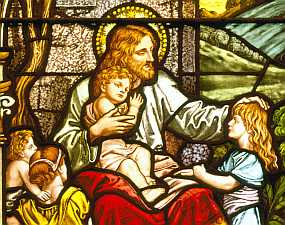 particular post generated more comments than any other More Cowbell Award I've given out. When it comes to educating the next generation of Christians, plenty of opinions exist.
I suspect even more opinions exist about the nature of children and salvation.
My son is nearing six years old. He's quite intelligent, loves God, enjoys church, spontaneously prays for others and for his own needs, and has a decent knowledge of the general truths of the Bible for his age. He continually surprises me with his questions about God, and surprises me even more with some of his answers. He'll always answer positively when asked if he believes in Jesus.
But is he saved?
For most of my adult life, I've leaned toward credobaptism. I was baptized as an infant in the Lutheran Church, but grew convinced of the need as an adult to show my own faithfulness toward God by being baptized as a confessing adult. (I kept this secret for many years from my parents. My brother felt the same as I did, got baptized, and told my folks, bringing lots of grief down on him and them.)
Later on, I worked in ministry to children and grew increasingly distressed about the issue of whether or not a child under ten understood the Gospel well enough to be justified. Probing kids for any information that might shed light on their eternal status yielded few results. Kids are such natural mimics that it's hard to discern whether they truly believe or are just mimicking what they know adults like to hear.
Kids don't make it any easier when it comes to the fruit of genuine Christian belief. Kids whose parents adamantly claim are rock-solid, baptized kiddie believers can be as rotten as those kids whose parents make no such claims. If a kid shares his milk and cookies with his friends and can rattle off a few memorized Bible verses are those actions proof of a genuine conversion?
For adults, the issue isn't always clear, but it's still far easier to discern. The dope fiend in gothic drag who comes to Christ and then goes on the mission field—that's an easy one. But truthfully, as long as I've worked with kids under ten, I'm not sure what an honest-to-goodness conversion looks like in a young child. And I don't think I'm the only one.
This whole sticky wicket poses enormous theological problems. A quick scan of the great Christians poised in every possible corner on this issue makes a less diligent believer like me feel extraordinarily uneasy.
Our inability to come to any unified answer on the topic of the justification of children clearly shows in our split on credobaptism (baptizing confessing believers) and paedobaptism (baptizing children, though without a profession of their own personal faith in Christ.) While I don't believe in regenerative baptism—and most Protestant's don't if they truly hold to the truth that justification is by faith alone in Christ—it's still clear that Jesus put an extremely high mandate on baptism:
Jesus answered, "Truly, truly, I say to you, unless one is born of water and the Spirit, he cannot enter the kingdom of God."
—John 3:5 ESV
Obviously, one can go too far with this, though. I once had a friend whose boyfriend got mixed up in the Boston Church of Christ movement. That group believed in regenerative baptism. After he'd made a profession of faith, there was a delay in getting him baptized, and he basically locked himself up in his room until that day, afraid he'd be killed accidentally before he got baptized.
We read that and shake our heads, but if we extend the baptism beliefs of many Christians out to their logical ends, some relatively normal denominations pretty much believe the same thing—or else have to do a lot of intellectual shimmying to make their beliefs fit. I wrote a piece last year that talked about this issue after Steve Camp wrote a blistering predestination piece that pretty much came right out and said that the infant who dies in childbirth is predestined to hell. I don't know about you, but as a parent it's pretty hard to take to think that any child of mine that might have died in childbirth went straight to hell because God predestined him/her to die in childbirth. That seems a rather strict limit on God's mercy and any covenants He makes with believing parents.
Whether you're a credobaptist or paedobaptist, the questions remain:
- What constitutes a genuine conversion in a child? And isn't it only by being converted that we are saved?
- How do we know a child truly believes and isn't just repeating what he or she heard in Sunday School (or is mouthing what receives the most attention and adoration from Mommy and Daddy)?
- Is there a covenantal aspect in the faith of believing Christian parents that ensures God's mercy and grace upon their children, whether baptized or not, believing or not?
- For paedobaptists: If we're truly saved by faith alone, what good is baptizing an unbelieving child? And doesn't your baptizing of that child before a profession of faith only later lead to a false confidence in that child for his/her salvation? And what about the murky area of being "rebaptized" after a full confession of faith?
- For credobaptists: How confident are you in credobaptism that you would risk letting your children die unbaptized?
It doesn't give me much comfort that so many good Christian sources are split on this. I noted earlier this week that Monergism.com highlighted the split, with solid theologians occupying both sides of the baptism argument. Ironically, most Arminians are credobaptists, so you would think the Calvinist monergists would be 100% in opposition, falling completely into the paedobaptist position. But even Jonathan Edwards was conflicted on this issue, baptizing infants but giving that baptism no efficacy for salvation. (What's the point then, Jonathan?)
Apart from the issue of baptism, Jonathan Edwards presents another unusual case that takes us back to our original question of the salvation of children: he states he was converted at four (or was it his wife—I can never remember). I talked to a member of my wife's family who told me last week that his kids were converted at that age. Honestly, I don't know how anyone can tell that for certain in a child that young, and if one can't (and happens to be a credobaptist), I'm not sure that baptizing them is a wise move.
In the end, this issue troubles me greatly. I'm sure I'm not the only one who's bothered by it, though.
You can't go to the great Christians on this issue because so many diverge on their opinions on baptism. Others fail to give any standards for judging if a child is saved or not. And like I said in my post from two days ago, what do we do when the pantheon of Christian greats can't answer the question? I certainly don't want to trust the opinion of a man on this one, either, if salvation is truly on the line.
If we go to the Bible, we can find plenty of verses that go either way on baptism, so I dunno. And as to telling when a child is saved or not, well, the age of accountability doesn't exist in the pages of the Word, nor is there a truly solid "age-related" guide for discerning whether a child is genuinely espousing the faith or just trying to win "mommy points."
Other ideas have problems, too. If we are to receive the Kingdom as a child does, is this implying that children are already in and they can only fall out? So much for original sin. And if Jesus readily healed children in the course of His ministry, why would He do so if those kids would only grow up to either forget Him or reject Him? What's the point of healing people who are only destined for hell? And what of the perseverance of the saints if a child comes to Christ innocently in their young childhood, then completely rejects Him in adulthood? How many people can each of us name who did exactly that?
I get (wrongly) accused of being a blogging Christian know-it-all, but I'll be honest: this issue has me stumped. If there was ever a topic that I wish the Bible was more explicit on, it's this one.

 I mostly read dead authors, at least when I’m considering Christian theology. Call me crazy, but I find more truth in those writers than what I read in modern ones. My personal library reads like a big list of dead guys: Lloyd-Jones, Schaeffer, Tozer, Lewis, Bounds, Ravenhill, Edwards, Nee, Murray, Torrey, and Bonhoeffer.