To the Christian, All of Life Is Holy

Standard

Heard  a good message recently that was marred by someone adding her thoughts to it. The ruinous addition was that we need always to be careful about those things in life that distract us from God or bring us down to a more worldly level.

When I was younger, I would have heartily endorsed that addendum. Now, I see it as a dilution of the Gospel.

One of Paul’s consistent understatements in his books is that the sacred/secular divide is something of a hoax. Yes, the OT is filled with illustrations about what is holy and what is not, but doesn’t Christ’s death redeem ALL of life?

What verse in the Bible is more astute than this one?

To the pure, all things are pure, but to the defiled and unbelieving, nothing is pure….
—Titus 1:15a ESV

Nothing destroys the joy of Christ more than dogmatic, persistent sin management. We encounter these semi-tortured folks who burn worry lines into their faces from all the concern over potential sinning. It’s like grace doesn’t even exist. To those people, I recommend reading about Martin Luther’s rediscovery of grace and his own fight against perpetual sin.

Can I have a glass of wine, play a game of Ca$h ‘n’ Gun$ with friends, and read a novel that makes no pretenses at being Christian? Why would anyone have to even ask that question? Yet there are M-A-N-Y Christians out there who struggle with all that. (Why? Because well-meaning Christians in authority positions keep knocking certain actions as sinful when those actions are anything but.)

One of  the reasons people don’t want to be Christians is that they don’t want to constantly monitor themselves for “sinful” behavior. You know what? I don’t blame them. Call me lazy, but I don’t want to either. That’s not what being a Christian is about.

Crazier still, the sins that most bother some Christians are the ones the Lord Jesus spent the least amount of time denouncing. He wasn’t so worried about how people dress, what they eat and drink, their leisure activities, and so on. Instead, He was angered by pride, injustice, lack of concern for other people, factionalism, materialism, and the like. Last time I checked, those latter sins were the ones least addressed and most stumbled over by the greater crowd of Christians in North America.

Even if we are guilty of any and all of those sins, let’s deal with them and move on. Let’s not keep wallowing in our own filth and lamenting it. Instead, be glad for grace and live fully.

To the Christian, all of life is holy. And there is joy in that!

When the Bridge Is Out–How to Deal with Lost People God’s Way

Standard

They called him Farmer John, and that was OK by him. He had a farm. His name was John. He was a practical man, and the appellation made sense to him.

Farmer John was the sort that didn’t say much, but when he did, people listened. He’d been around long enough so that his voice in town meetings carried some weight. Some folks would toss around the word wise when talking about John, but he preferred practical. Folks can say lots of things, but no one ever considered practical a bad thing, so in John’s eyes, practical won out.

Practical was not what that semi driver had been when he decided to take a wrong turn off the highway and down that old gravel road a month back. The supposedly abandoned road ran past Farmer John’s house and crossed a gorge via a bridge John believed must’ve been built when Chester A. Arthur was president.Bridge out Along with Arthur, most folks had let the bridge slip into the Sea of Forget. Seems the bridge suffered a bout of amnesia, too, because the sudden application of a semi filled with ball bearings across its surface made the bridge forget its own sole purpose for being, and the whole thing collapsed into the gorge.
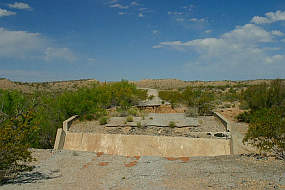
A knock on Farmer John’s door that morning revealed a rather sheepish truck driver who somehow escaped a 200-foot freefall into the gorge, though the man’s conveyance had not fared as well. The county took one look at the wreckage, chalked it all up to rare misfortune, and left the whole mess sitting at the bottom of the gorge to rust.

When John happened to mention the empty space where a bridge had once been, the county engineers looked at him and said, “No one comes by here anyway.” They didn’t even bother to put up a “Bridge Out” sign, which John thought was rather an impractical way of dealing with a missing roadway over a 200-foot-deep gorge. “Budget cuts,” one of the engineers said with a laugh.

John stared at the place where the bridge had been. He then trudged the half mile down the road to his barn and found the biggest sheet of plywood he had. He painted “Danger—Bridge Out” on it, lugged it back to the gorge, and propped it up on the gravel road with a couple small boulders. It wasn’t art, but then he was a farmer and not Picasso. Still, it served its purpose, and if he himself should be careless some day and in the grip of a “senior moment” forget the missing bridge, the sign might just help him too.

One day, Farmer John heard wheels spinning on gravel.

Outside his window, John saw the unmistakable plume. He walked down to his drive to where a red Camaro hunkered. In his youth, Farmer John had once owned a Camaro, but it proved less practical than a tractor for farming purposes, so he sold it. Still, he knew a Camaro when he saw it, even if it was “one of them new ones.”

A young man with tossled hair popped his head out the driver’s window and said, “I think I’m lost.”

John replied, “If you’re here, I’m certain of it.”

“But my GPS said to turn here if I wanted to get to Frederickstown,” the man said.

“Wrong is wrong,” said John as he walked up to the driver’s window, “even if a computer says otherwise.” He looked at the man and added a couple beats later, “And perhaps especially if a computer says.”

The man pulled the GPS from its suction-cupped holder, popped open the glove compartment indignantly, and tossed the device inside. He turned back to John. “So where does the road go?”

“Nowhere you want to be,” John said, “unless you don’t like yourself or your car too much. Bridge out.”

The man laughed. “Look, I’m lost. I know it. How do I get to Frederickstown?”

“Go back out to the highway.” John motioned with his good hand, drawing in the warm, summer air. “Take a left. Drive until you see the Exit 77 sign. Take that exit, then hang another left. Twenty minutes and you’re there.”

But the man kept looking down the gravel road.

“Son, I’ve lived here more decades than you’ve been breathin’,” John said, the serious creeping into the many lines on his face. “You go down that road there, and it will not end well for you. I know the way you need to go. If’n you need, I can ride with you down to that exit and you can let me off there. I’ve got no problem walkin’ back.”

The man’s countenance seemed to soften, and his head swiveled back to the highway. “That’s a kind offer, but I think I’ve got it. Thanks.”

The old farmer extended a hand. “John.”

The young man gripped it. “Steve. Thanks, John.”

“God bless you, Steve.”

The young man nodded and shifted the car into reverse, the throaty growl of the engine a familiar sound to the old farmer. John waved, stood in place, and watched his visitor shift again, make a left, and enter the highway.

A pheasant called in the distance, and by the time John’s eyes returned from where it might be hiding to the place the Camaro had been a heartbeat before, both the car and its driver were out of sight.

***

Most people are headed toward the gorge, and the bridge is out. Christians know this. How we respond to lost people makes all the difference in whether they listen to our warnings or not. Frankly, we’re not sharing what we know as well as Farmer John did.

Rescue those who are being taken away to death; hold back those who are stumbling to the slaughter. If you say, “Behold, we did not know this,” does not he who weighs the heart perceive it? Does not he who keeps watch over your soul know it, and will he not repay man according to his work?
—Proverbs 24:11-12 ESV

John was wise enough to know others would come down that road. He knew how it would end, even if others pretended not to. He didn’t want to see anyone end up dead at the bottom of the gorge. People mattered to him.

Why do you see the speck that is in your brother’s eye, but do not notice the log that is in your own eye? Or how can you say to your brother, ‘Let me take the speck out of your eye,’ when there is the log in your own eye? You hypocrite, first take the log out of your own eye, and then you will see clearly to take the speck out of your brother’s eye.
—Matthew 7:3-5 ESV

John was wise enough to know that in a weak, forgetful moment, he too might drive into the gorge unless he set up a warning. He dealt with his own failings first. This granted him the right to speak to other people’s weaknesses.

In addition, John didn’t question the preceding part of the man’s trip or how he had come to end up in his driveway. All he knew was that the man was going the wrong way, and that steering him the right way was the best approach. Then John offered that better way.

…but in your hearts honor Christ the Lord as holy, always being prepared to make a defense to anyone who asks you for a reason for the hope that is in you; yet do it with gentleness and respect…
—1 Peter 3:15 ESV

John kept to the main and the plain. He didn’t rail against the man’s head turning back to the gravel road. He was gentle, respectful, and genuinely concerned. No, he didn’t back down, but he didn’t yell,  cause a scene, or draw too much attention to himself. He shared what he knew and did it simply.

Do nothing from selfish ambition or conceit, but in humility count others more significant than yourselves. Let each of you look not only to his own interests, but also to the interests of others.
—Philippians 2:3-4 ESV

John not only gave directions, he offered to ride with the stranger down to the proper exit to ensure he was going the right way. Even though the walk back might be considered an inconvenience to some, to John it was part of caring for this man God put in front of him.

If we Christians keep these four verses in mind whenever we deal with lost people, our interactions with them will be as God wills them to be.

This isn’t hard. Farmer John didn’t do anything impractical or wild. When dealing with lost people, we don’t need to either. John kept it simple. So should we.


R-E-S-P-E-C-T, and Why No One Can Get (or Give) Any

Standard

I’ve got about six months until I hit 50. That milestone isn’t sitting well with me, though.

Part of my unrest is that the major tropes of my youth with regard to the accumulation of years have failed. Or perhaps I should say that I failed to fulfill them.

By the time you are 50, you are supposed to be in the prime of your career. You are a leader in your community. Your savings account is overflowing. You have power. Your words matter to people and they listen to you because you are a success.

At least that is what I grew up believing because that’s what we were all taught to believe.

Problem is, I haven’t achieved any of those. My careers (yes, multiple) have all been derailed at one point or another by uncontrollable economic factors, so this elusive “prime” I keep hearing about seems to be some mysterious other’s to enjoy. I’m not rich, so I have no power, since the money = power equation only grows stronger the larger the number of years on the calendar. Politics seems to be the only avenue to leadership anymore, and no party will have me. And since achievements in those preceding traits are the sole signal for success in our society today (with the possible exception of scandal, so there’s at least that still open), I’ll never be a worldly success.

They say that youth is wasted on the young, and I understand this more and more. Supposedly, the counterbalance is wisdom, but no one cares about wisdom. In an age of knowledge, where Google can give you answers to nearly any question you have, and it’s all within reach of a ubiquitous cell phone, what is wisdom? The Internet is filled with dime store philosophers, and most days anymore, I feel like just another of their horde. Name a topic and there’s a pundit for it.

So if none of this works, what is left for the guy who has managed to get to 50 years without making a total wreck of life?

I was taught to always refer to adults with “Mr.,”Mrs.,” or “Miss” preceding their surname. Even when I was in my 20s and 30s, my parents’ peers were still “Mr. Kreider” or “Mrs. Frey,” not “Joe” or “Phyllis.”

This gave those neighborhood stalwarts some ethereal cachet that made them different from me. Better. Smarter. More worthy of respect.

Just the other day, I was out with my son, and we ran into the daughter of a friend. She’s 19-21, if my faulty memory serves, and she called out to me by saying, “Hello, Mr. Edelen.”

I found it almost startling to hear “Mr. Edelen.” Perhaps I am now an adult, part of that elusive set of peerage that reserved such titular prefixes for the friends of my deceased parents.

If anything, that callout got me thinking more deeply about respect.

If none of the other standards for adulthood drilled into me in my youth can be assumed, surely respect can. Yet despite being called Mr. Edelen by one well-raised young lady, I think that more of us can identify with Rodney Dangerfield.Rodney Dangerfield - No respect

Getting to 50 without screwing up one’s life no longer merits the special favor of respect. Perhaps it never should have in the first place. We keep hearing that respect must be earned, and if anything, that’s still the prevailing thought.

Yet if our societal beliefs on respect are to be grasped, no one is earning respect.

The presidency used to be a position of respect. I don’t know if that was forever shot down by the presence of presidential protein on an intern’s dress, but since that event, neither of our last two presidents have garnered any respect. Even from Christians, respect may be talked about with regard to the POTUS, and we can blabber with the best of ’em about Founding Fathers and the greatness of America, but the words we say about our president don’t encompass respect.

In fact, even in the Church today, I can’t think of anyone who gets any respect. The world at large has a built-in reflex for questioning authority, and that seems to have slid down the gutter into the American Church.

Don’t believe me? Consider the following.

An elder from your church pulls you aside some Sunday and says, “I notice your giving has been down this year. What can we do about that?”

For many of us, the first thought is, Take a long walk off a short pier, buddy.

Even if we substitute pastor for elder in that scene, nothing improves. Doesn’t matter who the person is, we don’t want anyone telling us we’re doing it wrong.

But, Dan, the giving thing is a naturally divisive issue, you may say. And I know you don’t ascribe to a New Testament tithe, anyway. OK, then have the elder or pastor suggest that you’re not spending enough of your time in service to either the church or the community. Or that a church leader noticed a sin in your life you may need to address. Or that you might think you’re a gifted teacher, but that class you really want to teach is not what the church needs from you now. Or that you’re not as gifted in teaching as you think you are, and that perhaps your gift is driving the church bus.

How quickly the thought becomes, So which other churches can I visit next Sunday?

We can talk all we want about respect, but no one seems to get any anymore. We are so selfish and believe ourselves so wise, that no one can speak into our lives with any authority and have us instantly consider his or her words worthwhile simply because who he or she is demands respect.

We don’t honor offices or the people who inhabit them. Titles now mean nothing. We have become like cliffs of granite, immovable, unswayable, and suitable only for jumping off for those who would suggest we move or sway.

Sure, plenty of Christian leaders have abused their authority. Sure, some people may not be worthy of respect.

But is anyone?

I maybe a poor example of human being and perhaps an even lousier Christian. Maybe respect should not be afforded me simply because I’ve hung around nearly 50 years.

Yet what else is there? If we can’t respect those people who are still standing after 50 years or more, especially within the Church, what hope do we have to ever move anything—including the Church—forward? Instead, we may be dooming ourselves to a downward spiral of selfishness that keeps crying out for others to respect us, even as we fail to respect anyone else.