The Spirit-Led Church Is the Only Real Church

Standard

In his book Reimagining Church, Frank Viola poses a few questions that should unnerve us. I’ve asked similar questions here, but I think revisiting at least one is worthwhile:

If the Holy Spirit were to depart, what aspects of our Sunday church meeting would be changed by His absence?

Unfortunately, I suspect the answer for most churches would be Not a darned thing. Our worship, prayers, liturgies, sermons, and even our greetings could go on and on without anyone noticing the Holy Spirit had left the building.

Why? Because almost nothing of the way we practice the faith in our meetings relies on the presence of the Holy Spirit.

We can sing songs without the Holy Spirit.

We can recite lines of liturgy without the Holy Spirit.

We can talk with others about life without the Holy Spirit.

We can prepare sermons without the Holy Spirit.

We can listen to those Spirit-less sermons without the Holy Spirit.

We can offer prayers without the Holy Spirit.

We can partake of a thimble of grape juice and a tiny cracker without the Holy Spirit.

We can run through our optimized order of service without the Holy Spirit.

We can perform dozens of church-related rituals without the Holy Spirit. Truth is, every Sunday in America, thousands of churches go through these motions and could keep going through them without noticing any difference if the Holy Spirit departed.

We are on auto-pilot in our churches. We have them programmed and timed down to the smallest letter and to the last minute. We don’t need the Holy Spirit at all.

Problem is, that’s not the Church of the Bible.

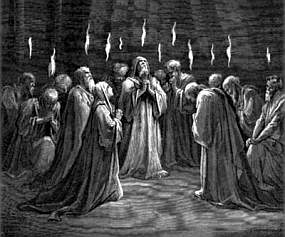
The church assembly of the Bible was led by the Spirit from beginning to end. It depended in the Spirit for everything. Without the Holy Spirit, the charismatic gifts would cease to function. Pentecost - DoréThere would be no prophetic words possible. No words of knowledge or wisdom. No healing. None of the functions of a normal assembly of Christian people filled by the Spirit coming together to share their individual giftings in a public setting.
The order of the church would vanish without the Holy Spirit. What would those assembled do next? No one would have a psalm or spiritual song to bring because the Holy Spirit would not be there to inspire its singing or bringing. What inspired-in-the-moment message would be possible? Who would lead?

The people in the church assembly, those equipped by the Spirit to use their gifts, would have nothing to do, their reliance on the Spirit shattered by His absence. They would sit passively, lost.

A real church without the presence of the Holy Spirit to guide, equip, use, and mobilize would cease completely to be what it is supposed to be as depicted in the Bible.

From all this, the only conclusion that we can make is that most churches in America, because they would not cease to function  the moment the Spirit departed, are simply not real churches. They have become a sort of theatrical performance with a bit of group participation thrown in—and a tiny fraction of participation at that.

This should alarm us, shouldn’t it?

I have written previously that the one key aspect of the Christian Church that separates it from all other religious bodies is the Holy Spirit indwelling believers in the assembly, the infinite God of the Universe making Himself at home within the faithful follower. Other religions have sacred books, theologies, and practices, some of which mirror those of Christianity, but none can be said to include the Holy Spirit of God indwelling. That indwelling makes the Christian unique and gives the Church its raison d’être. No wonder that most pseudo-Christian cults mangle or do away with a theology of the Holy Spirit.

If your church could continue to do what it does each Sunday morning should the Spirit depart, then it is not a genuine church.

Something to consider the next time you sit in the pew on Sunday and wonder what is missing.

The Church’s Lost Tribe

Standard

Had a conversation with a friend from church yesterday regarding a lost tribe. No, not one in the Amazon basin of South America, but in our own church. Truthfully, many churches suffer for the loss of this people group. Maybe yours does too.

The lost tribe? Adults 18-28.

Sure, some of these youth group graduates go on to college or leave the area to pursue jobs elsewhere. But, in general, churches don’t seem to retain this group.Young adults These young adults aren’t sticking around.

My experience has been that young people from churches with denominational or theological ties to the Azusa Street revival fare the worst. Pentecostal and Assemblies of God churches seem hardest hit.

My friend suggested that perhaps those young people never really grasped the reality of Christ. If true, what does that say about our youth groups and all these conversions and “changed lives” we keep hearing about?

It’s especially troubling when the youth group grads DON’T go away to college or move out of the area. What are we to think of their sudden disappearing act once they get their high school diploma?

True, some young adults do drift back once they marry or have children, but as many do not. What about them?

What thoughts do you have as to why this group goes missing so easily? What do you think might be the solution?

Misfits of the Church

Standard

This post has long been in the queue. Though it has been ruminating in my heart, I haven’t wanted to hurt anyone or to run the risk of being too personal or too specific, which might have repercussions and would make life harder for me and the people I love.

But I have to write this anyway. It’s just taken a few months, and I can’t vouch for the results. YMMV in whether this is a worthwhile post or not.

________________

The people in my church whose homes I have visited have been leaving. While the church itself appears to be growing, familiar faces, the ones I most look for, are gone. The tables in the church café once occupied by those who were ready to talk deep things now sit empty. I look for those people whose thoughts I most appreciated, but they aren’t there.

Empty pewI note the fact that I have visited these people’s homes because it says something about who they are. Sure, I’ve visited the homes of a few others who are still around, but the disproportionate number of leavers still says something about who those people were to me: my best church friends.

Gone. And they’ve taken something vital with them.

People leave churches for different reasons. Church shoppers will go on about one or two things they didn’t like that became dealbreakers, but when longtimers leave by choice and their reasons for doing so vary widely, one wonders if a more systemic problem exists.

When I reflect on the people I have known in my Christian life who have left churches, they all seem to have something in common: they are square pegs in round holes.

This is not to say that no square hole exists for them anywhere, only that they will always stick out from the crowd. Not only do they tend to be the 20 percent who do 80 percent of the work, but they tend to be the least acknowledged for it.

And this is because the Church in America has no idea what to do with them.

Something is broken in our churches when it comes to some kinds of people. I’ve encountered too many ultragifted people who ended up as so much church-created roadkill because church leaders either had no idea how to utilize that gifting or they resented or despised that person’s gifting.

Some would argue that this is all sour grapes, but the list of names keeps growing of good people I’ve known who were either used up by a church and discarded or ignored altogether.

The one who creates beautiful art but who is told she can’t display it in the church building.

The one who hears from God but who is told such words are not appreciated.

The one who can see the roadblocks preventing growth and ways around them but who is despised because he is not ordained.

The one from the “rough background” who is forever limited by those who cannot put aside what he once was and did.

The one who failed once and will never be given a second chance.

The one who doesn’t agree with every denominational position and so will never be considered for leadership.

The one who warns people, who prefer the status quo, of the dangers ahead.

The one with great vision who is surrounded by those with little or none.

The one with many flaws but who loves people abundantly and unconditionally, just like Jesus did.

The one who is always serving, though not with the imprimatur of those in charge, and who makes them look bad for doing so.

Those are ten such “misfits” of the church. Many more exist. You may be one of them.

I keep encountering more longtime Christians who are giving up. They’re not abandoning Jesus; they simply don’t know how to fit within the typical church. And it’s not for trying. I know these people have tried. But they’re weary of always receiving the left hand of fellowship, and they despair of ever contributing their God-given gifts because The Church™ does not want those gifts or it places ridiculous qualifications on their use that have no basis in Scripture and every basis in human selfishness and pride.

We talk, talk, talk, and talk about community in the Church, but what kind of community do we really have when someone is told to stop being the person God Himself is making him?

The Kingdom of God is filled with misfits, so how come our churches aren’t?