
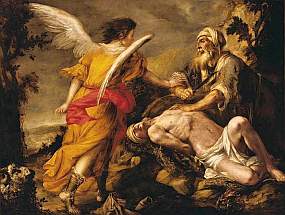
Juan de Valdés Leal - 'The Sacrifice of Isaac'
Evangelicals love the Reformation. While most Evangelicals are not Lutherans, you’ll get a lot of head nods if the importance of Martin Luther’s actions comes up in casual conversation. And it’s next to impossible to talk about Luther without talking sola fide.
But as much as Evangelicals want to talk about faith, I’ve found that the more educated an Evangelical is and the higher up on the socio-economic ladder, the more the issue of faith becomes one of talk and conjecture rather than actual practice.
In fact, when some hoped-for and prayed-over outcome fails to come to pass, anymore it seems that the most intelligent and wealthier Evangelicals are most likely to come up with a tortuous explanation for the failure based on issues of God’s sovereignty or His will. What they don’t ever want to say to one who failed to receive is “The failure was due to your lack of faith.”
In Evangelical circles, at least in the educated and wealthier ones, claiming that one failed to have enough faith is tantamount to shouting a racial slur or vulgarity in someone’s face. We just don’t do that. We’re too afraid of hurting someone’s feelings.
Problem is, I’ve read the New Testament and the writers are constantly telling us that God honors faith and that doubters shouldn’t expect to receive anything from Him. In short, we didn’t get what we asked for because we lacked faith. It’s our fault, not God’s, no matter how hurt our feelings may be to hear that.
I looked up the phrase your faith in the ESV version of the Bible, and Jesus uses that term nine times in a positive sense, typically along the lines of “your faith has made you well.” Those faith possessors got what they wanted because they didn’t doubt but instead trusted Jesus wholeheartedly.
Lack of faith is almost never (and I’ll show you the one semi-exception that I know) rewarded. Instead we get passages like this:
[Jesus] went away from there and came to his hometown, and his disciples followed him. And on the Sabbath he began to teach in the synagogue, and many who heard him were astonished, saying, “Where did this man get these things? What is the wisdom given to him? How are such mighty works done by his hands? Is not this the carpenter, the son of Mary and brother of James and Joses and Judas and Simon? And are not his sisters here with us?” And they took offense at him. And Jesus said to them, “A prophet is not without honor, except in his hometown and among his relatives and in his own household.” And he could do no mighty work there, except that he laid his hands on a few sick people and healed them. And he marveled because of their unbelief.
—Mark 6:1-6a
Jesus could not do many miracles in His hometown because his old neighbors rationalized away whatever faith they may have had in Him. They came up with naturalistic, “educated” explanations of why they could expect so little from Jesus. And they received the results of their unbelief.
Then there is this:
If any of you lacks wisdom, let him ask God, who gives generously to all without reproach, and it will be given him. But let him ask in faith, with no doubting, for the one who doubts is like a wave of the sea that is driven and tossed by the wind. For that person must not suppose that he will receive anything from the Lord; he is a double-minded man, unstable in all his ways.
—James 1:5-8
How often do we ever apply that passage to our own lack of faith? Instead, we treat those words as if they apply to some nebulous, theoretical other.
In the truly “impossible” situations, Jesus deals with the unbelieving by choosing who stays and who goes. Witness His actions here:
While [Jesus] was still speaking, there came from the ruler’s house some who said, “Your daughter is dead. Why trouble the Teacher any further?” But overhearing what they said, Jesus said to the ruler of the synagogue, “Do not fear, only believe.” And he allowed no one to follow him except Peter and James and John the brother of James. They came to the house of the ruler of the synagogue, and Jesus saw a commotion, people weeping and wailing loudly. And when he had entered, he said to them, “Why are you making a commotion and weeping? The child is not dead but sleeping.” And they laughed at him. But he put them all outside and took the child’s father and mother and those who were with him and went in where the child was. Taking her by the hand he said to her, “Talitha cumi,” which means, “Little girl, I say to you, arise.” And immediately the girl got up and began walking (for she was twelve years of age), and they were immediately overcome with amazement. And he strictly charged them that no one should know this, and told them to give her something to eat.
—Mark 5:35-43
Jesus took only the three disciples most likely to trust Him, and He had all the scoffers removed from the house. Why? Because He has no room for those who lack faith.
On the positive side, there’s this:
As they passed by in the morning, they saw the fig tree withered away to its roots. And Peter remembered and said to him, “Rabbi, look! The fig tree that you cursed has withered.” And Jesus answered them, “Have faith in God. Truly, I say to you, whoever says to this mountain, ‘Be taken up and thrown into the sea,’ and does not doubt in his heart, but believes that what he says will come to pass, it will be done for him. Therefore I tell you, whatever you ask in prayer, believe that you have received it, and it will be yours.”
—Mark 11:20-24
I once wrote a post about that Mark passage, claiming it was the least-believed passage in the Bible. I stand by that statement. That so many of us Evangelicals will try to explain away the very upfront nature of Jesus’ statement here, making excuses for ourselves and for others, is a sign that maybe we’re just as lousy at the faith thing as Jesus’ doubting neighbors.
As for Jesus even remotely rewarding doubt, the only passage that comes to mind is this one, and I believe the Lord puts this in the Scriptures as a cautionary tale (and with a big qualifier):
And they brought the boy to [Jesus]. And when the spirit saw him, immediately it convulsed the boy, and he fell on the ground and rolled about, foaming at the mouth. And Jesus asked his father, “How long has this been happening to him?” And he said, “From childhood. And it has often cast him into fire and into water, to destroy him. But if you can do anything, have compassion on us and help us.” And Jesus said to him, “‘If you can’! All things are possible for one who believes.” Immediately the father of the child cried out and said, “I believe; help my unbelief!” And when Jesus saw that a crowd came running together, he rebuked the unclean spirit, saying to it, “You mute and deaf spirit, I command you, come out of him and never enter him again.” And after crying out and convulsing him terribly, it came out, and the boy was like a corpse, so that most of them said, “He is dead.” But Jesus took him by the hand and lifted him up, and he arose.
—Mark 9:20-27
Jesus here is somewhat shocked that the father of the boy questions His ability to work through faith. Despite this, He restores the boy to wholeness, though one could argue that He does so only after the father confesses the error of his unbelief.
Yet don’t we routinely add “if you can” to our prayers to the Lord? Aren’t we constantly hedging our bets when it comes to asking for big things in prayer?
And who are we that we should be let off lightly? Maybe someone needs to simply say to us, “You didn’t get what you wanted because you didn’t have enough faith.”
My mother died from brain cancer. She died just months after our first child was born, right when we needed her most to help us. That my father had died just months before her only compounded how much we needed her help, if for no other reason than the major relief of having an on-call babysitter now and then.
During my mother’s illness, I had to come to grips with the fact that I didn’t have much faith to believe that she would be healed. Her kind of cancer was almost always 100 percent fatal within a couple years of diagnosis.
Now my perspective on supernatural healing and the ability of the Lord to work miracles was no different then than it is now. But the fact remained that a part of me doubted that God would indeed raise up my mother to wholeness. I remember the months of her slow decline and my lying in bed at night realizing that I just didn’t have enough faith to believe she would be restored. And she died.
Now it may be a horrifying thing to some of you to hear me say this, but honestly, I need to own up to my lack of faith for her healing. Her death may in fact be partly due to the lack of faith in me and those around her. It may not, but I can’t excuse myself. The whole incident made me realize that I needed to grow up.
I think it’s time we stop being babies about faith. Maybe we need to man up and accept that perhaps the bad outcome was because we simply did not take God at His word and failed to have faith. That may be galling to people. It may be hurtful to those who have suffered loss. But I can’t find any excuses in the New Testament for doubt. They just aren’t there. If we say we believe the Bible is the inerrant word of God, then we have to come to grips with this reality right from the myriad examples in Scripture: People who have faith get what they ask for and people who don’t have faith don’t.
One last thing: Paul’s thorn.
So to keep me from becoming conceited because of the surpassing greatness of the revelations, a thorn was given me in the flesh, a messenger of Satan to harass me, to keep me from becoming conceited. Three times I pleaded with the Lord about this, that it should leave me. But he said to me, “My grace is sufficient for you, for my power is made perfect in weakness.” Therefore I will boast all the more gladly of my weaknesses, so that the power of Christ may rest upon me. For the sake of Christ, then, I am content with weaknesses, insults, hardships, persecutions, and calamities. For when I am weak, then I am strong.
—2 Corinthians 12:7-10
That passage is the one most people will cite when it comes to unanswered prayers said in faith. I will fully concede that God did not give Paul what he prayed for.
But I will add what few people ever do: God audibly spoke to Paul to specifically explain why the apostle would not receive what he prayed for in faith.
When God audibly speaks to you and me to give us a reason why we should stop praying for something in faith, then we’ve got a great reason to stop praying and start accepting the hard answer. Otherwise, this is how we are to pray—always:
And he told them a parable to the effect that they ought always to pray and not lose heart. He said, “In a certain city there was a judge who neither feared God nor respected man. And there was a widow in that city who kept coming to him and saying, ‘Give me justice against my adversary.’ For a while he refused, but afterward he said to himself, ‘Though I neither fear God nor respect man, yet because this widow keeps bothering me, I will give her justice, so that she will not beat me down by her continual coming.'” And the Lord said, “Hear what the unrighteous judge says. And will not God give justice to his elect, who cry to him day and night? Will he delay long over them? I tell you, he will give justice to them speedily. Nevertheless, when the Son of Man comes, will he find faith on earth?”
—Luke 18:1-8
That final question of Jesus should haunt us. That we try instead to make excuses for our own lack of faith should haunt us even more.